



Platform: McKinsey & Company
Duration: 10 weeks (self-paced)
Certification: Yes, it is free; available upon completion
I completed the McKinsey Forward Learning Program, which was offered by the international management consulting firm McKinsey & Company. I learned about this programme through online media, including YouTube and LinkedIn. My motivation behind applying to this programme was to learn new skills for self-improvement. The objective of this course is to enable people at various career stages—whether new to the workforce or seeking to advance their skills—to succeed in the modern work environment.
The Forward programme is a 10-week course, and on average, learners are required to dedicate 2 hours per week to meet the learning requirements. The programme emphasises improving practical skills through various highly interactive, self-paced digital modules, such as 1. Adaptability & Resilience, 2. Communicating for impact, 3. Problem-solving, 4. Relationship & Well-Being, 5. My Digital Toolkit, and 6. Lead Forward Webinar, which help enhance qualities that are increasingly important in the field of agricultural extension.
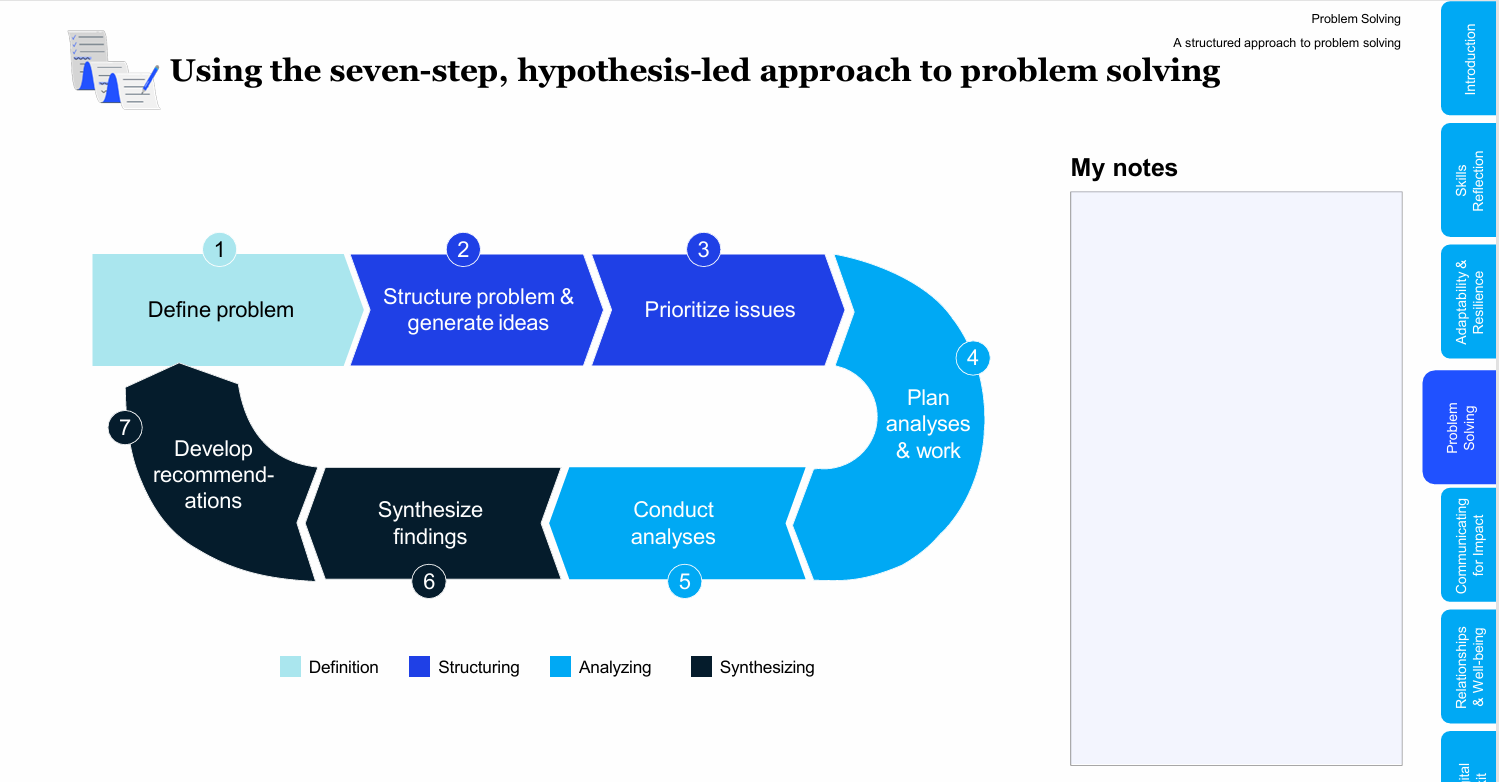
The objectives of the course are to improve learners’ critical thinking, strategic planning, and clear communication skills while also encouraging a leadership and lifelong learning perspective. These abilities are essential for agricultural extension professionals to engage farmers, create effective solutions, and overcome institutional roadblocks.
The learning method is asynchronous, which allows learners to engage with the content at their own pace. It is best suited for learners at the intermediate level, particularly those with some experience in fieldwork, teaching, or advisory services. This makes it a very accessible and flexible training for working professionals.
The course is divided into distinct sections and includes interactive professional skills modules, video lectures, situation-based exercises, and peer evaluation.
At the end of every level, the learner’s comprehension was analysed by a short quiz. Assignments were straightforward, reflection-based, and applied what one has learnt, with scenario/situation-based questions to enhance thought-provoking, encouraging practical application. There was no conventional grading; it was mainly based on the individual’s participation. Peer discussion forums and interactive tools make learning more engaging, even though it’s asynchronous.
The grading process is not exam-based but emphasises completing modules, participating in discussions, and submitting reflections. The learners need to complete all the modules to earn the certificate and a digital badge. The course can be completed with no accessibility limitations; all you need is a reliable internet connection and a basic understanding of digital technology.
The quality of the content was phenomenal. The learning videos were a mix of animated/pre-recorded ones for course content, along with live human-led webinars. Some of the course facilitators included Divya Katticaren, Antonio Martinez Beltran, and Ameena Adileh, among others. The videos were clear, concise, professionally produced, and engaging. Instead of focusing on academic theory, the course materials include real-world examples. Learners are encouraged to think critically about time management and decision-making through scenario-driven quizzes and projects. The teaching approach was easy-going, lively, and relatable. Better acceptance of concepts is encouraged using application-focused assignments.
In my own opinion, the course was positive and motivating, a soft-skill development program. It improved my ability to organise my thoughts and manage my time, two crucial skills for working with various farmer groups or overcoming institutional obstacles. In my capacity as an agricultural extension educator and as a lifelong student, the course inspired me to think more strategically and lead with assurance. To enhance my leadership, communication, and change management skills—all of which are crucial for field extension work and teaching—I enrolled in this course. Earlier, I focused mainly on delivering content by providing relevant examples. After completing this course, I guide students in a more structured, interactive way, encouraging independent thinking, clear communication, and practical problem-solving. I am now more comfortable in guiding students with stronger accuracy and efficiency.
For students and researchers who wish to enhance their professional toolset beyond technical proficiency, I strongly recommend this course. It is an exceptional chance to gain highly valuable professional skills at no cost and with substantial practical relevance.
 Akhila Papishetty holds a master’s degree in Agricultural Extension from the ICAR – National Dairy Research Institute, Karnal and is currently working as a teaching associate at MJPTBCWR Educational Institutions Society, Agricultural College, Wanaparthy, Telangana. She can be contacted at akhilapapishetty04@gmail.com.
Add Comment