


Platform: United Nations University-MERIT
Duration: 2 weeks
Certification: Yes, it is free
We consume more information today than ever before, yet much of it is quickly forgotten or remains underutilised. With ideas, notes, and resources scattered across platforms, many young professionals face a common struggle: turning information into something meaningful and usable. This is where personal knowledge management (PKM) emerges as a practical and necessary solution.
The Knowledge Management for Young Professionals course is a short, intensive online virtual exchange program designed to introduce early-career professionals to the principles and practical applications of personal knowledge management (PKM) using the Obsidian tool. The course focuses on how knowledge is created, structured, shared, and applied effectively at both individual and organisational levels. The program emphasises developing a structured approach to managing information in an increasingly complex, data-rich world.
The course follows a synchronous learning format, guided by an experienced tutor with scheduled live sessions. It is suitable for beginner to intermediate learners, especially those who have limited prior exposure to formal knowledge management systems. The course is organised into four well-structured live sessions. It introduces Obsidian as a tool for building a personal knowledge base, starting with the basics of knowledge and information. Gradually, it moves on to practical strategies and useful shortcuts for organising and managing knowledge effectively in Obsidian.
One of the most valuable parts of the course was learning how to use Obsidian as a practical tool for personal knowledge management, rather than just a simple note-taking app. What makes it different is its ability to connect ideas through links, turning scattered notes into an organised and evolving network of knowledge. Instead of storing information in isolated folders, Obsidian allows you to link related concepts, making it easier to revisit and build on what you have learned over time. The graph view feature is particularly helpful, as it visually shows how different ideas are connected, often revealing patterns that are not immediately obvious. Obsidian also includes Canvas, which serves as a mind-mapping space for organising ideas visually and supports plugins that extend its functionality based on user needs. Additionally, features such as tagging and flexible note structures enable users to organise information in a personalised, efficient way.
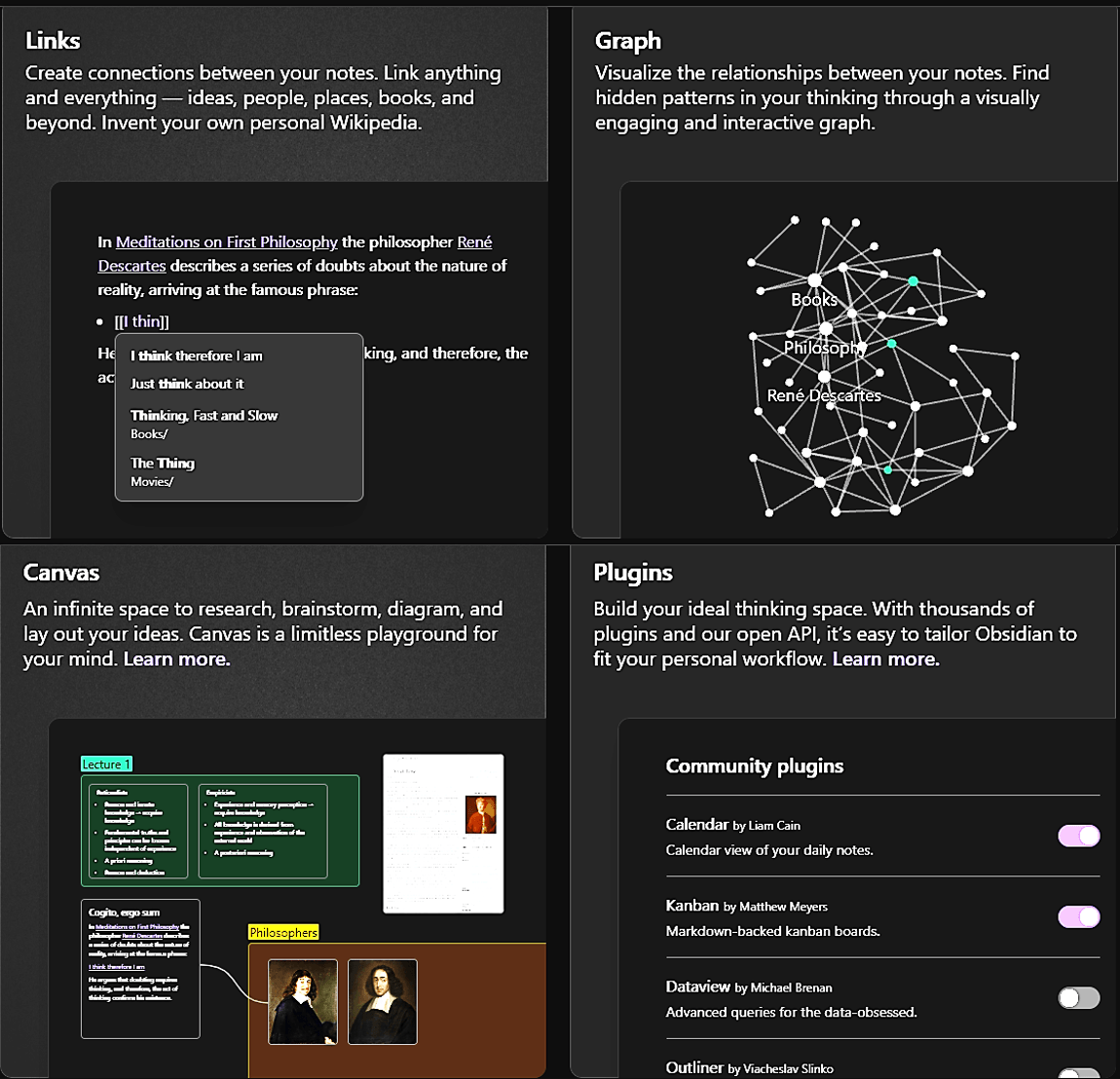 Some screenshots from the Obsidian tool
Over time, it supports the development of a “second brain”—a system that helps in continuous learning, better organisation, and more informed decision-making. For agricultural extension professionals, this can be especially useful for bringing together field observations, farmer feedback, research insights, and training materials in one place, making knowledge easier to access, connect with, and apply in practice.
Learners are guided through live online class demonstrations on how to create structured notes, link ideas, and visualise connections using graph-based systems. What I appreciated most is that the course does not remain theoretical. It encourages learners to build their own system as they learn actively.
For certification, participants must attend live sessions and successfully submit an assignment on a domain they choose. Class recordings are provided along with resource materials, including practice files, tutorial videos, PDFs, articles, etc., to support understanding.
The quality of content delivered throughout the course is excellent. The lectures are clear, concise, and well-structured, effectively balancing theoretical understanding with practical application. The instructor, Dr Lutz Krebs, adopts a practical and learner-centred teaching style. Concepts are explained straightforwardly, often supported by real-world examples and demonstrations. This approach helps learners connect abstract ideas with practical use cases.
From a personal perspective, I found the course both engaging and highly relevant to my academic and professional interests. My motivation for enrolling stemmed from a desire to improve how I organise and utilise knowledge, particularly in the context of agricultural extension and research. The concept of building a “second brain” was especially impactful because it provides a systematic method for capturing, connecting, and using information over time. It shifted my perspective from simply collecting information to actively structuring and connecting ideas in ways that support long-term learning and better decision-making. This approach has clear implications for extension work, where systematically capturing field insights, farmer feedback, and research findings can significantly enhance the effectiveness of advisory services.
Overall, this course offers a practical and impactful learning experience for extension professionals and students alike. Equipping learners with tools and strategies to manage knowledge more effectively contributes to improved communication, innovation, and evidence-based decision-making in agricultural systems. For extensionists seeking to strengthen their competencies in a rapidly evolving, information-rich environment, this course is a worthwhile investment of time. It not only builds technical skills but also encourages a more strategic approach to learning and knowledge use.
Note: This course is offered under the VIS project, an international exchange initiative supported by the Dutch Government. Since seats are limited, applicants must go through a selection process. I would strongly encourage interested extension professionals and students to keep an eye on the official course page for upcoming sessions and apply when applications open.
 Mehedi Hasan is a graduate researcher in Agricultural Extension and Rural Development at Gazipur Agricultural University, Bangladesh, focused on advancing sustainable and inclusive rural transformation as a National Science and Technology Fellow (2025–26), Bangladesh. His work centres on climate resilience, food security, and translating research into scalable field impact. He can be contacted at mail.hasan.mehedi@gmail.com.
Add Comment