
On the eve of World Television Day, 21 November, Sahithi Pasupuleti, Aiswarya S., and Vinayak Nikam highlight DD Kisan’s essential role in enhancing agricultural extension and advisory services for the benefit of the farming community.
CONTEXT
Imagine a farmer in a small village in Bihar. It’s early morning, and as he switches on the TV, he isn’t looking for entertainment or news, but searching for answers. Will it rain today? Are tomato prices rising? Is there any new pest alert? Which scheme can help him buy a small irrigation pump? For millions of farmers like him, information is not just knowledge, its survival, planning, and hope.
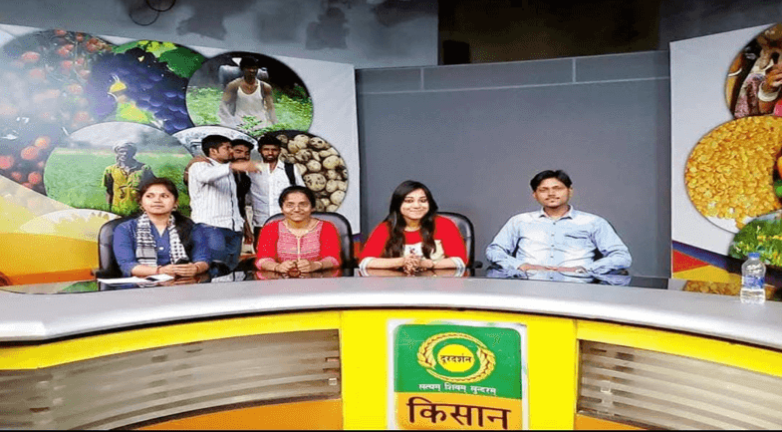
Now imagine a platform that speaks directly to him, in simple language, at the right time, and without any commercial agenda. A channel that doesn’t try to sell him anything, but tries to help him farm and live better. That is the promise with which DD Kisan was born: India’s only 24/7 farmer dedicated television channel, launched on 26th May 2015 by Prasar Bharati. In a world where smartphones, apps, and digital platforms increasingly shape how we communicate, DD Kisan remains one of the few media that can reach those who do not own a smartphone, live in remote villages, and need trustworthy, research-based, practical guidance presented visually.
DECODING DD KISAN: WHAT INDIA’S ONLY FARM TV CHANNEL REALLY DELIVERS?
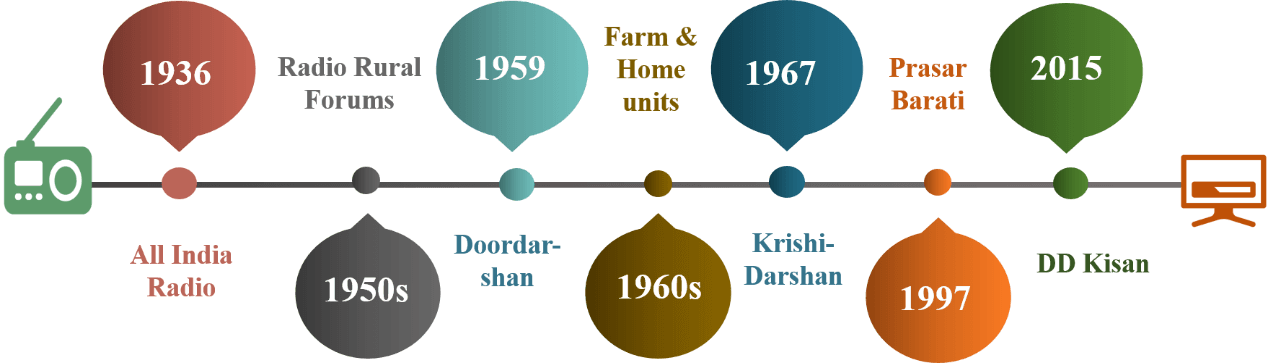
How did we get here? Historical evolution of DD KISAN (Author’s compilation)
When we look closely at what DD Kisan broadcasts every day, an interesting picture emerges. DD Kisan records an average monthly viewership of about 7.2 million on television.
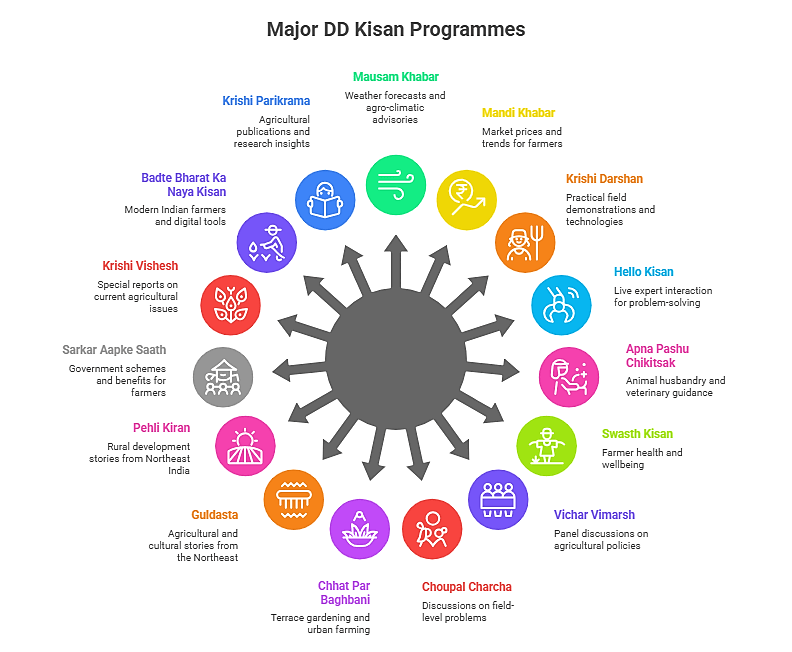 Major DD Kisan Programmes (Authors Compilation)
Its digital presence on platforms like YouTube, Facebook, and Instagram further expands its reach, with 70-80 lakh weekly views and nearly 10 lakh YouTube subscribers. The channel effectively covers mainstream farming topics through various programmes, as shown in the figure above.
KEY FEATURES OF DD KISAN
- An exclusive platform that imparts knowledge without making sales: DD Kisan is unique in a world where influencer marketing is commonplace. There are no unnoticed product pushes or promotions. All of the suggestions are neutral, instructive, and based on what is actually beneficial to the farmer.
- Information that is reliable and up to date: DD Kisan’s close partnerships with agricultural universities, KVKs, and ICAR institutes ensure that farmers access the most up-to-date and trustworthy information.
- Speaking a language that seems familiar to farmers: With their clear words, practical visuals, and demonstrations shot on actual farms, shows like Kisan Ki Baat speak to the rhythm of rural life. It sounds more like a neighbour sharing what worked in their own field than a lecture.
- Experts are on the line when farmers call: A farmer can call in with an issue and receive a prompt resolution on shows like Hello Kisan and Apna Pashu Chikitsak (Helpline numbers: 1800113060/1800113061).
- Take care of the hands that provide the country with its food: Swasth Kisan discusses issues that are frequently overlooked in the media, including family nutrition, zoonotic disease awareness, heat-stress management, and safe pesticide handling.
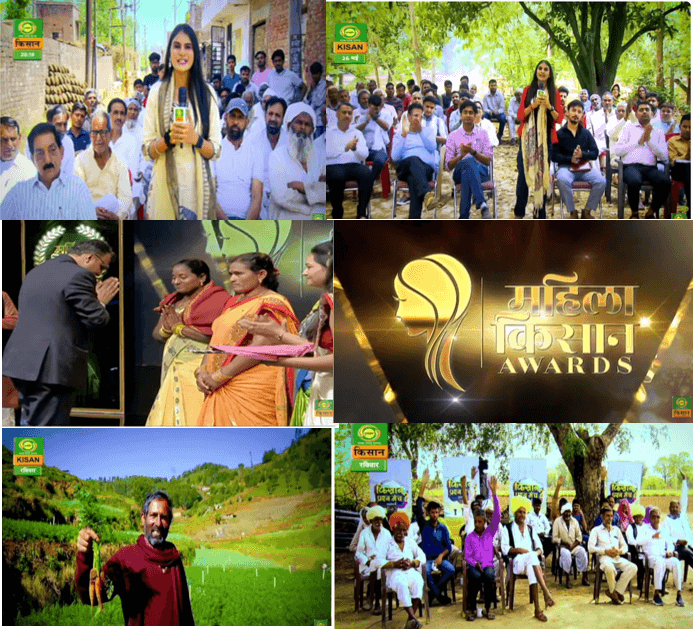
- Real people, real challenges, and genuine innovations: Khet Mitra’s segments share inspiring stories, like a young farmer who invented an affordable sprayer or a woman dairy entrepreneur who turned her shed into a thriving business. These tales show what is possible, not just advisable. The Mahila Kisan Awards, supported by ICAR, honour outstanding women farmers for their success, resilience, and leadership in the sector.
However, in a recent paper titled “Content analysis of DD Kisan Programs: Disseminating agricultural information to rural India,” the authors identified that the channels’ content is skewed towards a few agriculturally dominant states, such as Uttar Pradesh, Rajasthan, and Madhya Pradesh. In contrast, smaller states received only 1-2 per cent coverage. They also found that most programmes focus on cereal crops and millets, while pulses, cash crops and oilseeds receive comparatively less attention. Furthermore, most of the DD Kisan programs are aired in Hindi; farmers in southern and some northeastern states may not fully benefit.
Similarly, vital sectors such as fisheries, beekeeping, and sericulture, which support thousands of livelihoods, receive comparatively limited space. This presents a real opportunity for DD Kisan to broaden its lens and create space for every region, every sector, and every production system. Hence, farmers everywhere feel seen, heard, and supported.
HOW CAN DD KISAN ENHANCE ITS VIEWERSHIP AND RELEVANCE?
To enhance its viewership and relevance across the country, DD KISAN has to do the following:
- Broaden thematic coverage: Cover subsector themes such as fisheries, beekeeping, sericulture, agri-tourism, climate-smart agriculture, nutri-sensitive agriculture, post-harvest management, etc, which are proven ways to increase income and reduce risk, making farming more innovative and more rewarding.
- Multilingual and Contextual outreach: Lack of language experts restricted its reach to fewer regions. A closer look at DD Kisan’s popular programmes reveals a striking trend: viewership rises noticeably when an auto-dubbed English option is available. A clear example is the Mahila Kisan Diwas episode (16 October 2025), an English-dubbed version drew five times as many views as similar Hindi-only programmes. While Artificial Intelligence anchors like AI Krish and AI Bhoomi help bridge this gap and increase accessibility, they often lack the human touch. Collaborating with State Agricultural Universities, agri startups, KVKs and FPOs; engaging students as reporters or anchors; and co-producing with institutes for commodity-specific information can make the content more relatable and practical for farmers across regions.
- Go digital for a wider reach: These days, farmers are scrolling as much as watching TV. Quick tips, reels, success stories, and WhatsApp clips can make DD Kisan a daily companion. Being online isn’t optional anymore; it’s how you stay connected. But the question here is: are these social media platforms really complementing viewership, or are they slowly substituting for it by offering faster, more engaging content? The answer lies in the example of Shape Up, an agri-reality show from Kenya (Box 1).
| Box 1: Shamba Shape Up: A powerful blend of TV and digital media for farmers Shamba Shape Up from Kenya demonstrates how a farming TV program effectively harnesses the power of digital media. The show doesn’t end when the episode ends; it follows the farmer home through SMS leaflets, the iShamba expert helpline, the Budget Mkooni planning tool, and farmer-friendly podcasts that let farmers learn even while working or travelling.  This innovative integration enabled it to reach 12 million viewers, benefit 4.28 lakh households, and generate nearly USD 24 million in dairy profits. It works through 3 mantras: educating through on-farm demonstrations, entertaining with reality shows, and elevating farmers by connecting them to digital tools. This innovative integration enabled it to reach 12 million viewers, benefit 4.28 lakh households, and generate nearly USD 24 million in dairy profits. It works through 3 mantras: educating through on-farm demonstrations, entertaining with reality shows, and elevating farmers by connecting them to digital tools.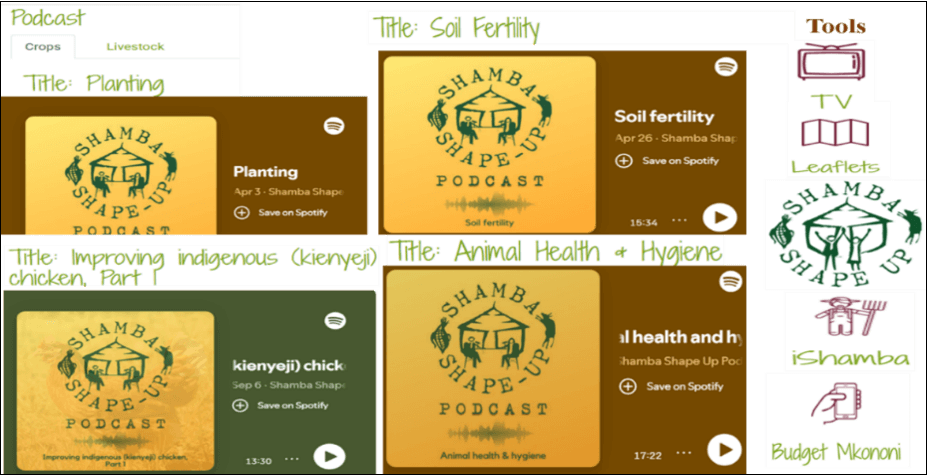
Overview of Content Highlights and its Tools |
- Develop Agro-climatic zone-based content: In a diverse country like India, an idea that succeeds in a coastal village may fail in a dryland area, and advice for hills won’t work in irrigated plains. A shift from generic to region-smart programming can make the channel a trusted companion for all kinds of farmers
- Enhance viewership: Making the channel more visible and engaging calls for innovative on-ground initiatives. Imagine wall paintings in villages or Panchayat endorsements catching a farmer’s eye as they go about their day. Seasonal campaigns timed with cropping cycles can spark timely interest. QR-enabled learning boards scattered across villages or dedicated DD Kisan corners at KVKs can make information more accessible. Even everyday spots like Panchayat offices, milk collection centres, and input shops can become mini hubs, bringing the channel closer to where farmers live and work. Some ideas for winning over the next generation of young farmers are presented in Box 2.
Box 2: Some Smart Ideas to Win the Next Generation of Farmers
|
IMPLICATIONS FOR EXTENSION RESEARCH
The channel requires research that goes beyond conventional audience surveys. Artificial intelligence, digital behaviour, and real-time feedback loops significantly influence today’s media landscapes.
- Machine Learning for Precision Content Planning
DD Kisan can analyse thousands of episodes, scripts, and viewer queries using machine learning techniques such as topic modelling, clustering, and predictive analytics, instead of relying on manual feedback. This turns content planning into a data- and science-based method rather than conjecture. - Social Learning and Behaviour Change Studies (Bandura’s Framework)
Apply the social learning theory to examine how farmers change their practices after viewing DD Kisan content. This enables DD Kisan to create content that not only raises awareness but also actually changes behaviour. - Web Scraping and Sentiment Analytics of Farmer Conversations
Millions of online farmer conversations can be analysed using web scraping and natural language processing to learn about their preferences, uncertainties, and perceived gaps. Sentiment analysis reveals trends in disinformation, emerging issues and regional needs, helping the channel quickly update content and provide knowledgeable answers to what farmers are actually discussing. - Comparative International Analysis of Agricultural Media Models
By studying best practices from Global agricultural communication systems, such as RFD Television in the United States, BBC Media Action programmes in the UK, and Shamba Shape Up in Kenya, DD Kisan can identify practical innovations and adapt them to India’s diverse agro-ecological conditions. - Behavioural and Technology Adoption Modelling Using Modern Communication Theories
The evaluation of clarity, usefulness, trust, and relevance by farmers can be studied through contemporary communication theories, such as nudge-based behavioural models and technology adoption frameworks like UTAUT, TAM, and related social influence models. It helps to explain why a farmer selects a programme, keeps watching it, or suggests it to others. Such modelling can guide DD Kisan in improving its digital extensions, polishing its presentation style, and creating content that is simple, culturally relevant, and actually beneficial for daily decision-making.
ENDNOTE
To improve DD Kisan’s effectiveness, more efforts are needed to raise farmers’ awareness of its programs. Addressing the workforce shortages and budget constraints faced by the programme requires additional funding or testing Public-Private models, with advertising revenue boosting sustainability. Translating content into regional languages and increasing social media presence will help reach more areas, especially in Southern and North-Eastern India. More studies on channel effectiveness, limitations, and constraints are needed to improve planning. Mainstreaming the channel into the extension system can reach more farmers and facilitate learning through interactions. As the only dedicated channel for farmers, all stakeholders must work to make it accessible and valuable to millions of farmers nationwide.
 Sahithi Pasupuleti is a PhD Research scholar (Agricultural Extension) at ICAR-Indian Agricultural Research Institute, New Delhi. Her research interests focus on the evaluation of Farmer-Producer Organisations, agri-value chains, and gender dynamics in agriculture. She can be contacted at pasupuletisahithi8@gmail.com
 Dr Aiswarya S. is a Scientist (Agricultural Extension) at ICAR-Central Institute for Research on Buffaloes, Hisar. Her work spans psychometrics and behavioural modelling for technology adoption. She can be reached at aishuambady@gmail.com
 Dr Vinayak Nikam is a Senior Scientist (Agricultural Extension) at ICAR-National Institute of Agricultural Economics and Policy Research (New Delhi). His research expertise includes performance and impact assessment of Farmer-Producer Organisations and evaluation of Extension and Advisory Services. He can be contacted at vinayakrnikam@gmail.com

Add Comment