




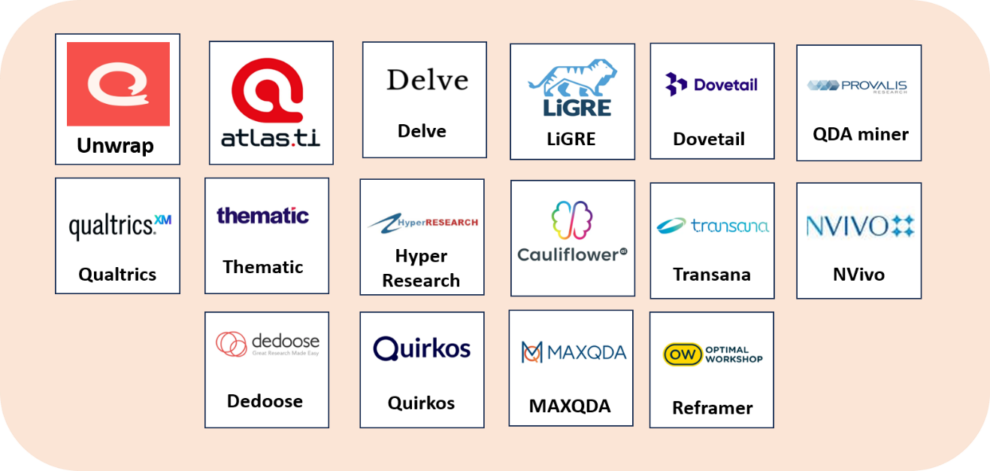
Pallavi, with Snehal and Kuldeep, dives into the evolving world of qualitative research, focusing on how CAQDAS (Computer-Assisted Qualitative Data Analysis Software) with AI-powered tools can enhance the transparency, efficiency, and methodological rigour of qualitative research in the social sciences.
CONTEXT
If you’ve ever found yourself knee-deep in transcripts, field notes or hours of recorded interviews, you should know that qualitative research is both an art and a demanding craft. While it gives depth to our understanding of human experiences, it also brings an overwhelming challenge: how do we systematically manage and interpret so much unstructured data? In practice, qualitative software helps organise and analyse rich textual, audio, and visual data to track decisions and advocate for the analytic journey with more transparent and rigorous methodology. This is not just a matter of convenience. In today’s research landscape, scientific records require greater transparency, reproducibility, and a rigorous methodological approach. Many qualitative research presentations still struggle with manual organisation, scattered notes and inconsistent coding schemes. These problems often make it challenging to trace decision paths or demonstrate how findings were derived, weakening the perceived reliability of qualitative insights. As more agricultural and social science researchers embrace qualitative approaches, one question keeps popping up: Which Software and Tools can actually make this process easier?
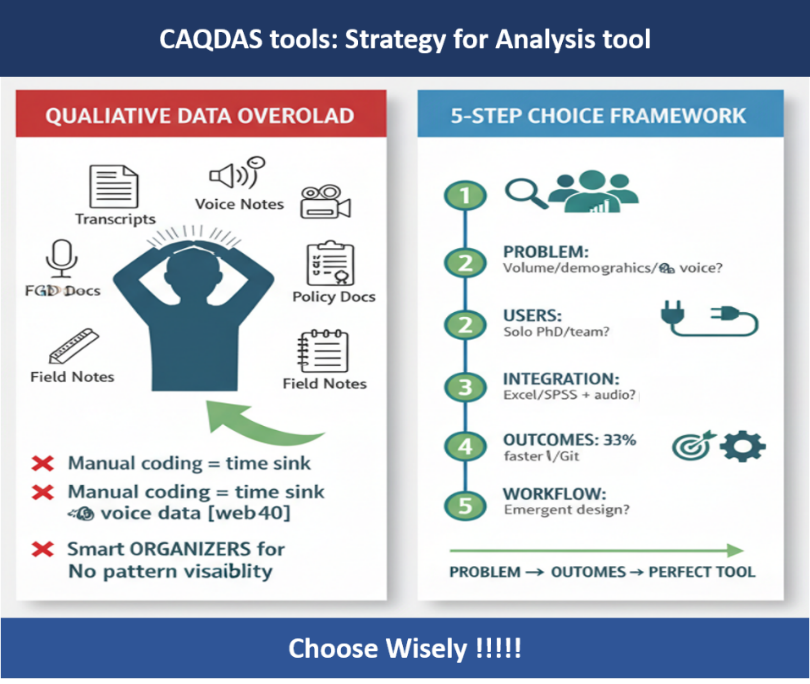
Qualitative research has conventionally relied on intensive human interpretation and manual coding, which are frequently constrained by limited scalability, interpretive subjectivity, and the growing volume of textual data. Qualitative data analysis software is also equipped with AI-powered features; recent advances in Large Language Models present a substantive methodological innovation by enabling the automation of core qualitative tasks, including open coding and thematic extraction, thereby improving analytical efficiency. By rapidly processing large-scale text corpora, these models would allow researchers to engage with broader empirical contexts and detect subtle patterns that may be obscured in purely manual analyses. Qualitative data analysis tools such as ATLAS. ti, NVivo, MaxQDA, or Quirkos are not there to replace us, but rather as smart digital helpers. They do not “analyse” the data on their own; instead, they help keep work organised, transparent, and easier to navigate.
Why Go Digital with Qualitative Data?
In qualitative research, especially with flexible or emergent designs, analysis is never linear. Codes evolve, categories merge, and insights deepen as you return repeatedly to earlier segments of your data. This back-and-forth can be messy, but digital tools bring method to that messiness.
- Keeping Track When Designs Evolve: Helps to store all documents, codes, memos and relationships in one project file, so you do not lose earlier decisions when you refine your framework later.
- Saving Time on Routine Work, Not Interpretation: A single click can regroup related codes under a new category instead of re-marking all documents. Arranging codes for decoding, arranging in categories, and managing their reflections can be easy tasks.
- Supporting Rigour, Reflexivity and Objectivity: A frequent criticism of qualitative research is that it is “subjective” or “less scientific”. These tools help code documents with timestamps and integrate rigorous triangulation with field notes, audio-visual material, all in side-by-side to dominate the storyline with facts and sources.
- Making Teamwork and Supervision Practical: Inter-coder functions allow two or more researchers to code the same material and check where they agree or differ, which opens discussion about concepts and definitions.
Digital assistance does not take away the heart of qualitative research. Still, it simply makes that heart stronger by letting you see, trace and reflect on your own analytical journey more clearly. Some of the primary Qualitative tools in the domain are listed below.
CAQDAS Tools Grouped For Social Science Researchers’ Usage
- Comprehensive All-Rounder Platforms (For Large Projects)
Can be utilised for multi-year theses, Policy papers and brief collaborations, Brainstorming sessions and heterogeneous data (transcripts + policy + media)
| ATLAS.ti | NVivo |
 Best for: Inductive Research, Grounded theory, complex relationships between concepts and Discourse Analysis Best for: Inductive Research, Grounded theory, complex relationships between concepts and Discourse Analysis
Key Features:
Pricing: Student license $99 for 2 years; academic annual ~$750 |
 Best for: Big mixed data (survey open-ends + interviews + literature reviews), sentiment analysis and Research Framework development Best for: Big mixed data (survey open-ends + interviews + literature reviews), sentiment analysis and Research Framework development
Key Features:
Pricing: Student/academic ~$118/year or $1,350 perpetual |
- Mixed-Methods Specialists
Used for Extension research demanding linking “why farmers resist tech” (qual codes) to “who resists” (farm size, gender, district stats). Both excel at qual-quant bridges for heterogeneous farmer groups.
| MaxQDA | Dedoose |
 Best for: Thematic + demographic classification + Complex relationship with quantitative data description Best for: Thematic + demographic classification + Complex relationship with quantitative data description
Key Features:
Pricing: Academic license~$253/year, and 15 15-day free trial version is available. Some features are freely available. |
 Best for: Big mixed data (survey open-ends + interviews + literature reviews) and GENNOVATE gender patterns Best for: Big mixed data (survey open-ends + interviews + literature reviews) and GENNOVATE gender patterns
Key Features:
Pricing: Student $10.95/month; small group $12.95/user/month |
- Visual & Beginner-Friendly (Workshops, Pilots, Students)
| Quirkos | Transana | Taguette |
 Best for: Visual thematic discovery, Respondent mental models, Development and pattern recognition Best for: Visual thematic discovery, Respondent mental models, Development and pattern recognition
Key Features:
Pricing: Offline lifetime $69 (1 computer) |
 Best for: Focus Group Discussion activities and brainstorming Best for: Focus Group Discussion activities and brainstorming
Key Features:
Pricing: ~$39 per license (perpetual), and some features are freely available |
 Best for: Beginner open-source, visual tagging and Participatory training Best for: Beginner open-source, visual tagging and Participatory training
Key Features:
Pricing: Free (open-source) |
- Policy Analysis
Used particularly for Systematic reviews, media analysis, policy documents and keyword dictionaries
| QDA Miner | WebQDA |
 Best for: Ethnography capturing tone/pauses/gestures beyond text Best for: Ethnography capturing tone/pauses/gestures beyond text
Key Features:
Pricing: Academic ~$595 perpetual |
 Best for: Role-based institutional collaboration Best for: Role-based institutional collaboration
Key Features:
Pricing: Some features are free usage, but some have custom pricing (subscription-based and academic discounts available) |
Embracing Tool synergy
All discussed Qualitative software excels in unique designs, where codes evolve with new respondents’ narratives or field insights. When tools such as ATLAS.ti and MAXQDA are synergised, they will help maintain audit trails and memos, enabling reflexivity vital for PhD defences, multi-site projects, and policy framework development. Synergically using these qualitative tools supports rigorous triangulation across transcripts, video, and policy documents, bridging individual interpretation with team validation. Match tools to scale its work, like Quirkos or Taguette, suit low-budget pilots, while NVivo handles large Government datasets with query systems for cross-farmer comparisons. In Agricultural extension research, MAXQDA’s matrices reveal theme variations by demographics and quantitative data reflections, aiding policy recommendations on adoption barriers. For researchers considering finances, several completely free tools are available, including Taguette (open-source), QualCoder (free, cross-platform with full features at qualcoder.wordpress.com), and QDA Miner Lite (free version with core functionality). At the same time, Cauliflower and HyperResearch offer limited free trials. Student and early career researcher licenses around $100 annually make ATLAS.ti accessible, with most CAQDAS offering special academic discounts: ATLAS.ti (2-year student ~$99), NVivo (student ~$118/year), MAXQDA (academic ~$253/year), and volume discounts for early career researchers through institutional partnerships.
Automating qualitative research with Large Language Models (LLM)
Powered by large parameter spaces, contemporary LLMs, such as GPT-based and LLM-based architectures, can conduct thematic analysis and generate structured codes within a fraction of the time required by human analysts. This capacity transforms qualitative inquiry from a static, linear procedure into a more interactive process in which researchers can iteratively interrogate their data, refine conceptual relationships, and explore emerging theoretical propositions. Such dialogic engagement supports the identification of latent meanings and complex linkages that are difficult to capture through conventional qualitative software or fixed coding schemes.
Beyond assisting with coding, LLMs increasingly function as analytical collaborators by proposing interpretive insights and alternative framings, thereby strengthening methodological rigour while retaining researcher oversight. Their integration supports a systematic yet flexible analytical framework that can be adapted to diverse qualitative traditions. LLMs can extend manual coding to large datasets through supervised text classification or reveal underlying thematic structures through unsupervised techniques, often in alignment with established approaches such as grounded theory. Owing to their ability to process large and heterogeneous textual datasets, LLMs substantially expand the scale and scope of qualitative research.
Key Privacy Concerns with LLMs:
- Data Retention Risks: ChatGPT/Gemini/Perplexity retains conversations for training by default (opt-out available but may delete chat history after usage), and also stores activity only up to 18 months.
- Academic Safeguards: Use institutional LLMs (e.g., ChatGPT/Claude), anonymise data before input and document opt-out procedures for audit trails.
A range of AI-enabled tools is now available for qualitative data analysis, spanning both traditional CAQDAS and AI-native platforms. Established software such as NVivo, ATLAS.ti, and MAXQDA integrate machine-learning features to support automated coding, pattern detection, and summarisation within conventional analytical workflows. In parallel, AI-first platforms such as Dovetail, Delve, and Aurelius leverage large language models to automate theme extraction and facilitate interactive data interrogation. Additionally, general-purpose LLMs can be incorporated into custom analytical pipelines to scale qualitative analysis while retaining researcher oversight.
WAYS FORWARD
There is a stigma surrounding qualitative research, which is inherently subjective and therefore less rigorous than quantitative inquiry. However, in practice, qualitative research follows systematic procedures for data collection, coding and validation. Yet the absence of numerical metrics has contributed to doubts regarding its objectivity. The way forward for qualitative research lies in the judicious integration of AI-enabled tools with established qualitative traditions rather than their uncritical substitution for human judgment. Misconception with reality of Quantification is Possible by quantitative-qualitative values (QQVs) via:
- Code frequency analysis,e. Count occurrences of themes across transcripts (e.g., “farmer Literacy” appears in 68% of interviews)
- Sentiment scoring: Convert qualitative responses to numeric scales (positive/negative/neutral)
- Inter-coder reliability metrics: Statistical agreement between researchers (e.g., Cohen’s Kappa = 0.82) available in MaxQDA and NVivo Software.
- Mixed-methods matrices: Cross-tabulate themes by demographics (farm size × adoption barriers)
However, the researcher remains the prime player, responsible for framing research questions, validating codes, interpreting meaning and ensuring theoretical coherence. When deployed as decision support systems rather than autonomous analysts, these tools strengthen the researcher’s capacity to engage reflexively with data while reducing subjective inconsistencies. From a policy perspective, the aforementioned tools offer a more objective and reproducible lens for synthesising diverse narratives, thereby improving the credibility and usability of qualitative evidence in decision-making. Ultimately, methodological rigour depends on maintaining human oversight, ethical accountability and contextual sensitivity alongside computational augmentation.
 Pallavi Shaktawat is a PhD scholar in Agricultural Extension at the College of Post-Graduate Studies in Agricultural Sciences (CAU), Meghalaya, specializing in digital marketing tech, qualitative research, AI/ML in education, entrepreneurship, food security, and gender budgeting in agriculture. Her expertise includes Data Visualisation, qualitative analysis, rural policy brainstorming, and interface design. (Email: Pallavi.agext21@gmail.com)
 Snehal Athawale is a Research Investigator at the Institute of Economic Growth, specialising in Agricultural Economics. Her work focuses on sustainable farming economics in India’s North-East Hill Region, along with production economics, food systems, value chains, and marketing. She aims to improve rural economic resilience. (Email: snehalathawale98@gmail.com)
 Kuldeep Singh is a doctoral researcher in agricultural economics, focusing on farm production, marketing, agro-residue management, and circular economy for sustainable development. His work involves policy analysis, data analysis, and environmental economics, emphasising waste-to-wealth and inclusive rural livelihoods (Kuldeepthakurkt7@gmail.com).



Thank you so much for sharing this Blog, Sir. Qualitative research and tools still continue to be an unexplored domain, though its importance cannot be overemphasized. There is a limited attempt to use qualitative methods even in the PG/PhD studies. Awareness of the tools and their versatile functionality would help the extension researchers in a great way. This blog is an eye opener in this regard.
Really good attempt to introduce tools that can digitally track the evolution of codes in a Qualitative excercise. However, it is important to remember that in Qualitative Research, the tool is the researcher themselves, and these software can only assist in keeping record of codes and some visualization. Using the embedded AI Coding algorithm is not a good practice to follow. There is a paper by Ashwin, Vijayendra Rao and others cautioning over the use of AI for coding (https://doi.org/10.1177/00491241251338246).