



Platform: SWAYAM
Duration: 8 weeks
Certification: Yes, you have to pay (₹1000 for the optional proctored certification exam)
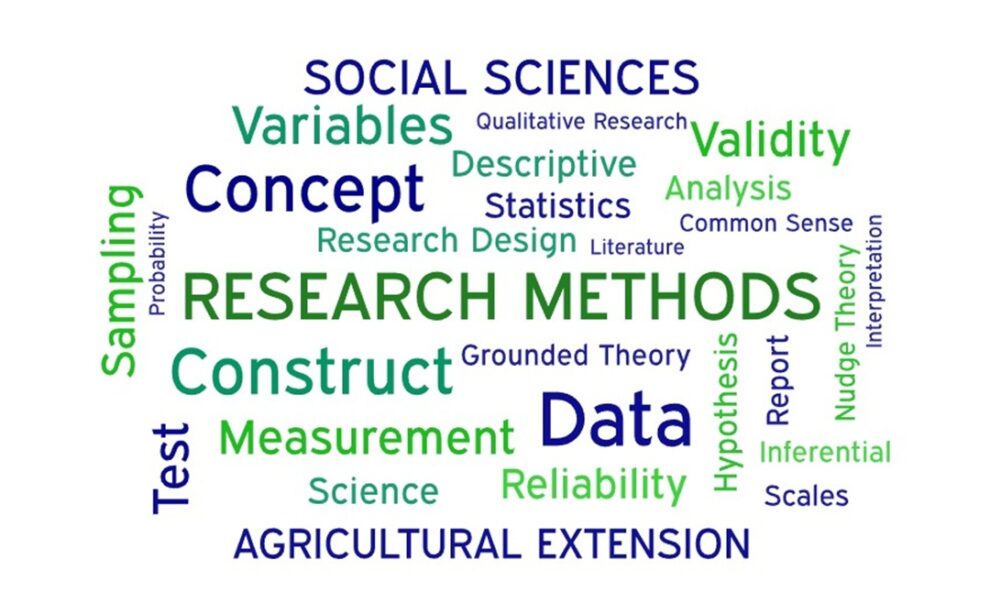
The course ‘Research Methods in Social Sciences and Agricultural Extension’, offered on the SWAYAM platform, provides a comprehensive and systematic introduction to research methodology with a strong focus on social sciences and agricultural extension. The primary objective of the course is to build a solid conceptual foundation in scientific inquiry and equip learners with the skills required to design, conduct, and interpret research in real-world social and agricultural contexts.
Course Outline:
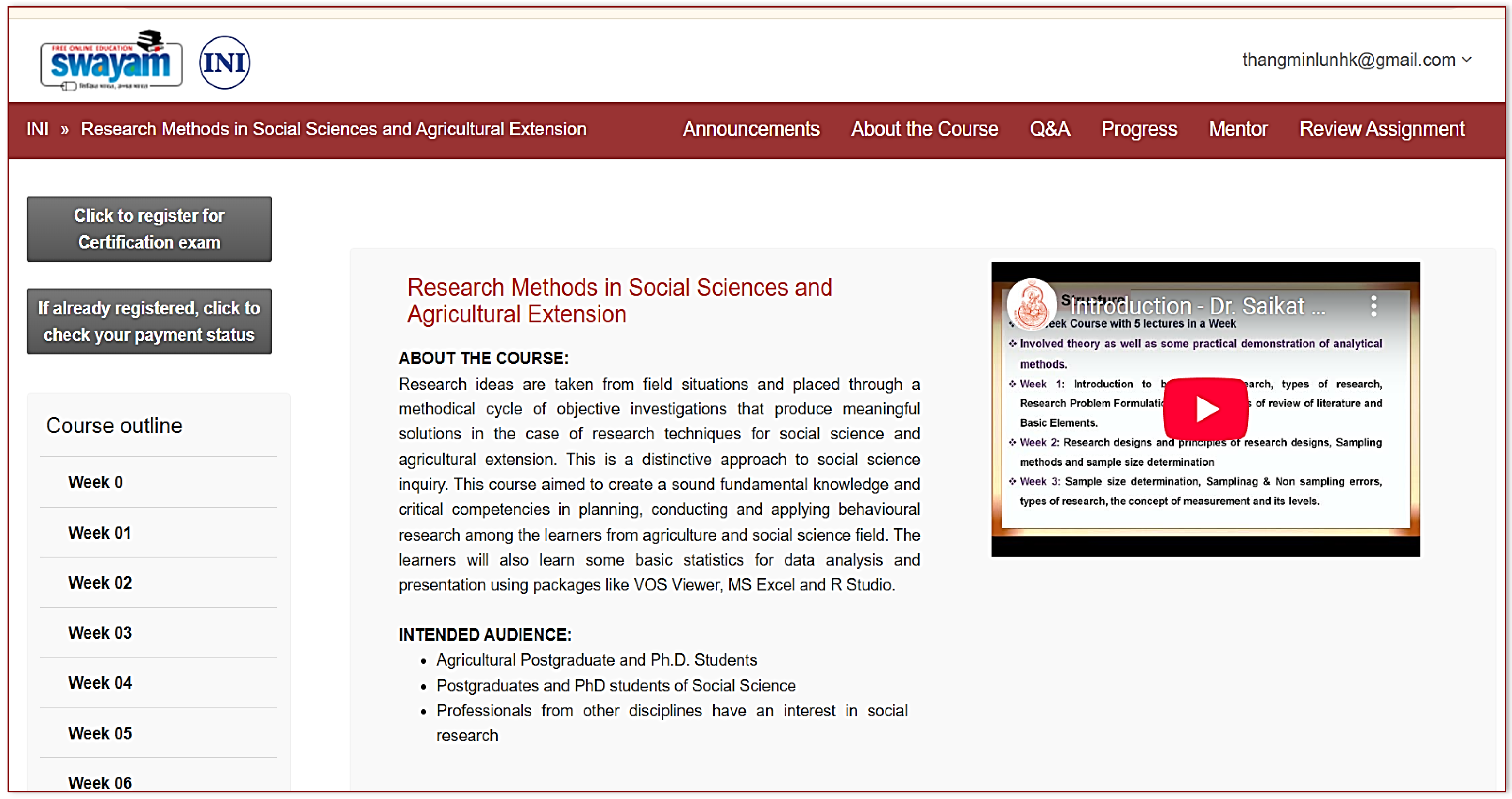
- Science and Common Sense
- Problem Statement and Reviewing Literature
- Basic Elements – Concept and Construct; Hypothesis, and Variable
- Principles of Research Design
- Sampling Methods
- Reliability and Validity of Measurement and Instrument
- Measurement Instruments -Objective Test and Scales
- Methods of Observation and Data Collection
- Qualitative Research: Nudge theory, Grounded theory
- Analysis and Interpretation: Descriptive and Inferential Statistics, and Writing Research Report
The course begins by distinguishing science from common sense, establishing the philosophical foundation of scientific inquiry, and emphasising the importance of systematic, evidence-based research. It then focuses on problem statement formulation and literature review, equipping learners with practical skills to identify researchable problems and critically analyse existing studies, which are essential competencies for academic research and thesis writing.
Core methodological concepts, including concepts, constructs, hypotheses, and variables, are explained to help learners operationalise abstract ideas into measurable components. This is followed by a structured discussion on research design, enabling learners to understand how different designs influence the validity and reliability of research findings. Modules on sampling methods introduce both probability and non-probability techniques relevant to social science and agricultural extension research.
The course places strong emphasis on measurement, covering the reliability and validity of instruments, as well as objective tests and scales, thereby strengthening learners’ understanding of accurate and consistent data collection. It also addresses methods of observation and data collection, offering insights into structured and unstructured approaches. A dedicated module on qualitative research, including nudge theory and grounded theory, broadens methodological perspectives beyond quantitative approaches. The final module on analysis and interpretation, covering descriptive and inferential statistics, as well as research report writing, develops learners’ analytical and academic writing skills to communicate research findings effectively.
The course follows a fully asynchronous learning model, with weekly video lectures (approximately 2.5–4 hours) and assignments that reinforce learning. The learner level is beginner to intermediate, making it suitable for postgraduate students, research scholars, and professionals from other disciplines interested in social research.
The course is well-organised, featuring clear lectures, regular assignments, active discussion forums, and a section on further reading to encourage independent learning. In addition, downloadable PDFs of weekly course materials and assignment solutions are provided, enabling learners to review content as needed and prepare for other examinations related to the subject, such as UGC NET, ASRB NET, and Agricultural Research Service (ARS).
The grading process is transparent, with clearly stated assessment criteria, predefined grading weightages, published minimum qualifying marks, and timely disclosure of assignment and examination scores. Certification is optional and requires appearing for an in-person proctored examination at designated centres. The final score comprises 25% from assignments (best six of eight) and 75% from the final exam, with clearly defined minimum qualifying marks. The quality of lectures, assessments, and evaluations is designed to test reasoning, interpretation, and application of concepts rather than mere factual recall, thereby promoting analytical thinking over rote memorisation.
As a postgraduate student in Agricultural Extension, this course complemented my academic work. It strengthened my understanding of research methodology, from problem statement formulation and research design to data collection and, potentially, data analysis and report writing as I progress in completing my master’s research. Some components, such as qualitative research, which receive relatively less emphasis in the M.Sc. syllabus, were effectively covered in this course. For a master’s student like me, one of the most valuable aspects was the opportunity to relearn and strengthen foundational concepts from previous semesters in a systematic manner. I would highly recommend this course to students in Agricultural Extension, as it is beneficial for both those seeking to enhance their research skills and beginners with little or no prior research experience.
 Thangminlun Haokip is a Research Scholar in Agricultural Extension at ICAR–Indian Agricultural Research Institute (IARI), New Delhi. His research focuses on integrating indigenous knowledge into agroecological farming and food systems, using farmers’ insights and analysis. He also explores how data-driven approaches and sustainability can improve agri-food system resilience. He can be reached at thangminlunhk@gmail.com.

Add Comment