


In this blog, Sahla and Hari discuss the expanding role of agricultural extension in rural green enterprise facilitation.
CONTEXT
India’s agricultural extension system has played a pivotal role in transforming the country’s food production landscape. For decades, extension services acted as a bridge between research institutions and farmers, facilitating the adoption of improved crop varieties, modern farming practices and productivity-enhancing technologies. This approach was instrumental during the Green Revolution era (mid-1960s to early 1980s), when the primary challenge was increasing food production to meet the needs of a growing population.
Today, rural India faces various challenges. Climate change is increasing the frequency of droughts, floods and extreme weather events, while natural resources face pressure from unsustainable production practices. India’s farming population is ageing, with nearly two-thirds of operational landholders in the 41-60 age group, while younger generations are increasingly seeking opportunities beyond agriculture. Reflecting this shift, a survey of 5,000 farm households across 18 states by Centre for Study of Developing Societies (CSDS) found that 76% of farmers would prefer occupations other than farming if viable alternatives were available. At the same time, concerns about waste management, renewable energy, biodiversity conservation and sustainable consumption are creating new opportunities for enterprise development. Across rural and semi-urban India, enterprises are converting agricultural residues into value-added products, producing organic inputs, promoting renewable energy solutions, developing eco-friendly packaging materials and creating climate-smart advisory services.
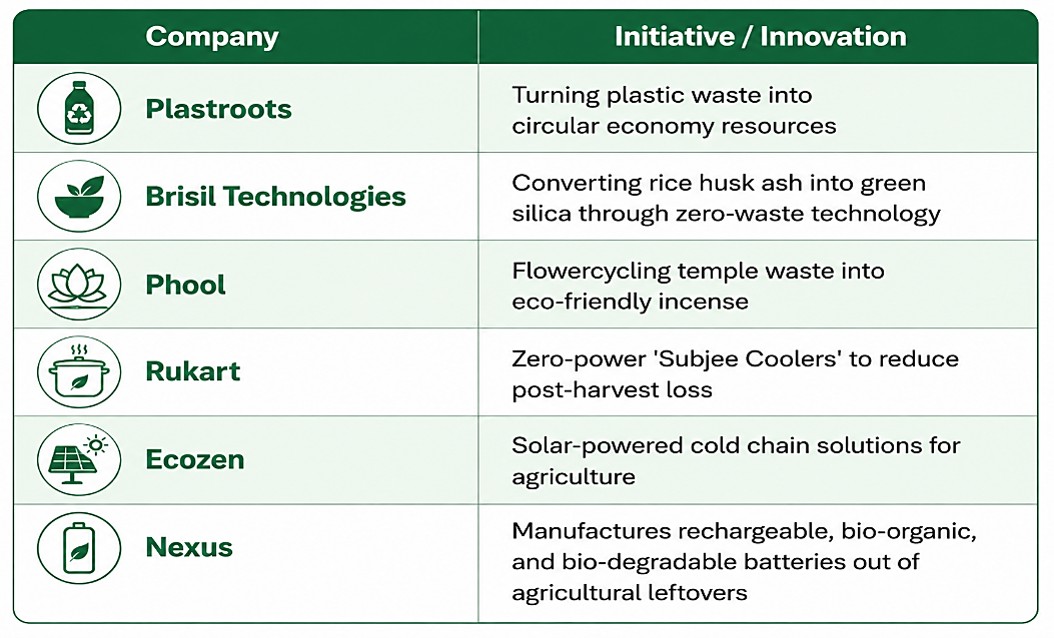
For instance, in Nagpur, entrepreneur Kapil Jangale built Plastroots around an idea that many rural communities overlook: waste as a resource. By training communities to segregate dry waste and creating value from recyclable materials, the enterprise generates livelihoods while addressing environmental challenges. Plastroots represents another growing class of green enterprises that transform local ecological problems into economic opportunities. These ventures are not only generating income and employment but are also addressing pressing environmental concerns. In other words, they represent the emergence of a green rural economy.
Importantly, India is not lacking in entrepreneurship support (Box 1). Yet, despite these efforts, many rural innovators, women entrepreneurs, youth groups and farmer collectives remain disconnected from this ecosystem and such green enterprises often emerge outside the formal agricultural extension system. This raises an important question: Can extension move beyond its traditional role of technology transfer to become a bridge connecting rural communities to the growing ecosystem of green entrepreneurship?
GREEN ENTREPRENEURSHIP: AN OPPORTUNITY FOR RURAL TRANSFORMATION
Green entrepreneurship is about improving human well-being and social equity while reducing environmental risks. It is the convergence of ecological responsibility and the entrepreneurial instinct to identify unmet needs, build solutions and create value – only here, value is measured not merely in revenue but in carbon avoided, waste diverted, water saved and livelihoods created. The green entrepreneur operates at the intersection of two urgent realities: a planet under compounding ecological stress and an economy increasingly recognising that the old model- extract, produce, consume, discard-is neither sustainable nor, in the long run, profitable. Unlike conventional enterprises that often address environmental concerns as an afterthought, green enterprises integrate sustainability into their business models from the outset. This approach aligns closely with the evolving objectives of extension systems. It contributes simultaneously to livelihood diversification, climate resilience, resource conservation, value addition and rural employment generation. Supporting such enterprises, therefore, allows extension to address economic, social, and environmental goals through a single intervention pathway.
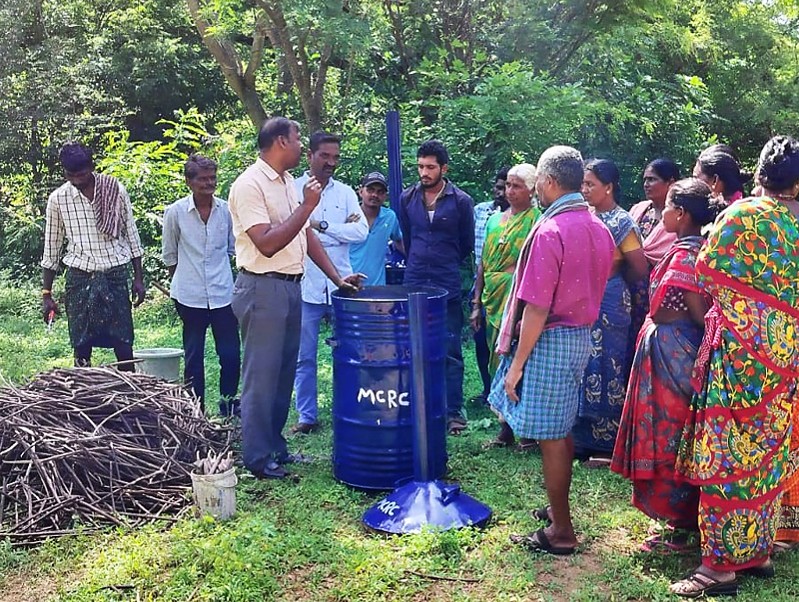
Importantly, many of these opportunities are closely linked to agriculture and rural livelihoods. Crop residues that were once burned can be converted into compost, biochar, or value-added products. Organic waste can be transformed into biofertilizers and vermicompost. Recent studies indicate that biochar production and application can be both agronomically and economically viable when implemented at optimal scales and supported by appropriate technologies and market access. Pilot-scale economic analyses have shown vermicomposting to be a profitable enterprise with favourable benefit-cost ratios, highlighting the potential of biomass-based enterprises in promoting sustainable rural livelihoods. Solar-powered irrigation services can reduce dependence on fossil fuels. Farmer groups can engage in sustainable value addition, eco-labelling and niche marketing of environmentally friendly products. For rural youth, these enterprises offer something agriculture alone often struggles to provide: opportunities for innovation, income diversification and local employment generation. They represent a pathway through which young people can remain connected to rural communities while pursuing economically viable and socially meaningful careers. At a time when concerns about rural youth migration, climate change and resource degradation are growing, green enterprises offer a promising avenue for building more resilient rural economies.
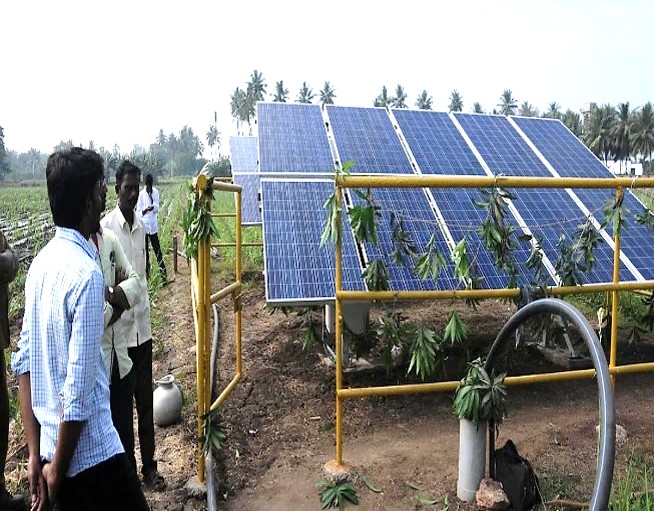
Yet many aspiring green entrepreneurs continue to operate with limited institutional support. While financial schemes, startup missions and incubation initiatives are expanding, extension services have not always been fully integrated into these emerging entrepreneurial ecosystems. This is where extension services can play an important facilitative role.
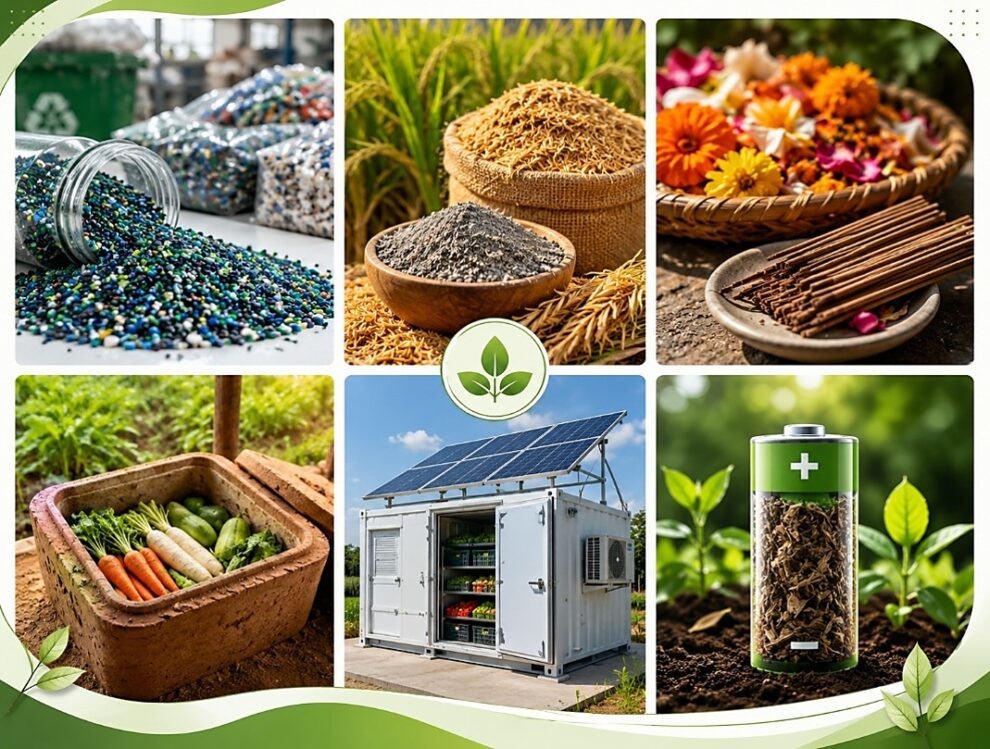
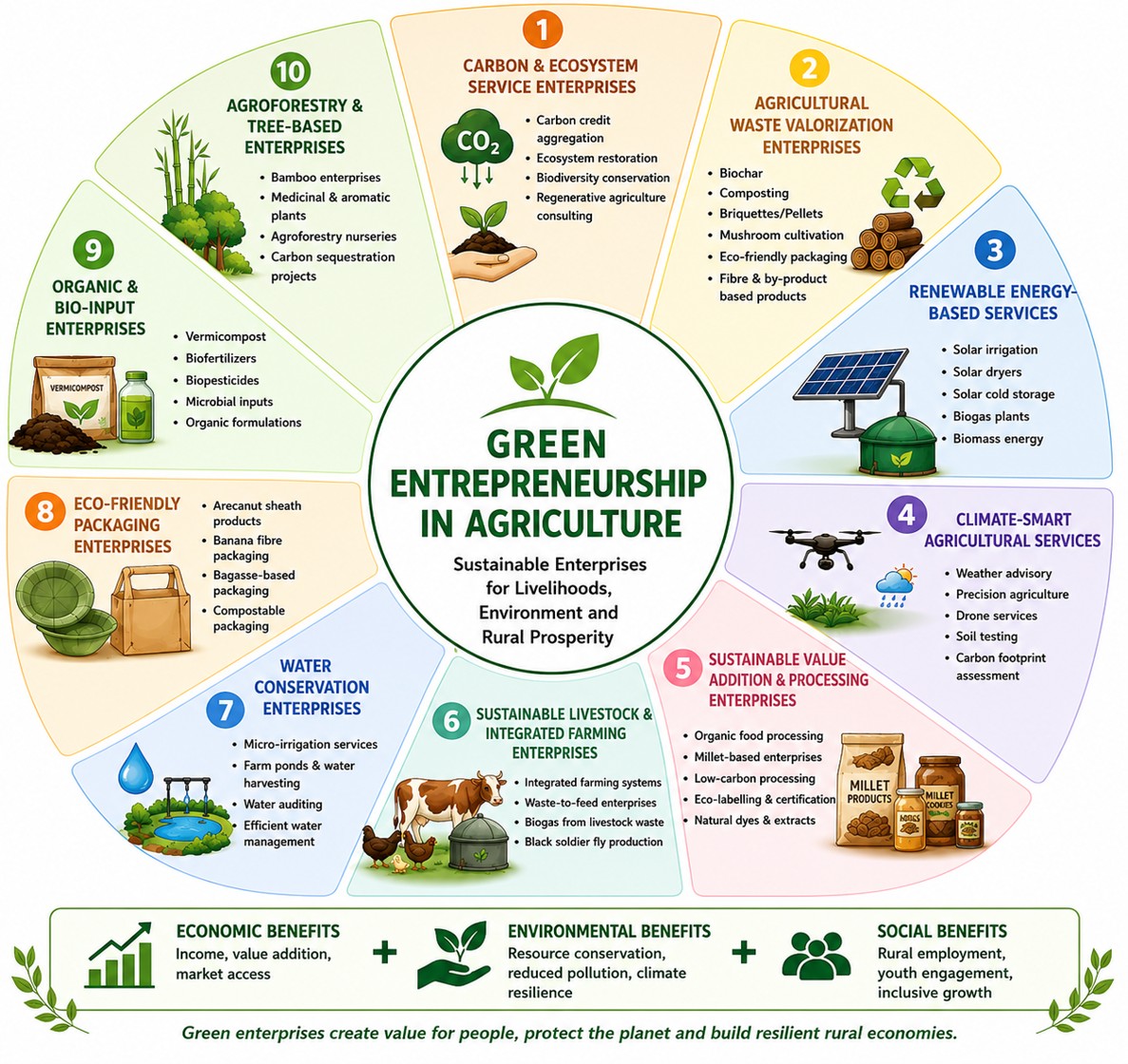 Green Entrepreneurship Opportunities in Agriculture: Potential Enterprise Domains, Source: Author-developed conceptual illustration using ChatGPT
Over the last decade, India has invested substantially in building an entrepreneurship ecosystem through university incubation centres, startup missions and entrepreneurship support programmes. However, access remains uneven, with many rural innovators facing barriers related to awareness, access, mentorship, networking, market information and institutional navigation. Although incubation support, green finance opportunities, certification processes, and market linkages exist, accessing them often requires guidance. This is where extension services can play a transformative role by connecting rural communities with the broader entrepreneurial ecosystem.
The conventional extension model was designed primarily to improve agricultural productivity through the dissemination of technologies and recommended practices. Success was often measured by indicators such as adoption rates, demonstration programs conducted, or the number of farmers reached. These functions continue to remain important. However, the needs of rural communities are becoming increasingly diverse. Today’s rural youth are not only asking how to increase crop yields. They are asking whether they can build businesses around organic inputs, renewable energy solutions, agro-processing, sustainable packaging, waste recycling, or climate-smart advisory services. They are exploring opportunities that combine economic growth with environmental stewardship.
Unfortunately, many extension systems are not fully equipped to support these aspirations. Extension services frequently remain focused on production-oriented advice while the emerging green economy requires a broader range of support mechanisms. The challenge is not that extension is doing the wrong job; rather, it is that the job itself has expanded. If extension aims to remain relevant in the coming decades, it must evolve from primarily being a technology delivery mechanism into a facilitator of innovation, enterprise development, and sustainable rural transformation.
A NEW ROLE FOR EXTENSION: FACILITATOR OF GREEN ENTERPRISES
The future of extension may lie not in replacing its traditional functions but in expanding them (Table 1). Traditionally, extension has served as a bridge between research and farmers. Today, it can evolve into a bridge between rural entrepreneurs and the wider innovation ecosystem. This expanded role could involve four key functions.
Table 1: Proposed Roles of Agricultural Extension in Facilitating Green Enterprises
| Sl No | Roles | Rationale |
| 1. | Extension agents can become an enterprise navigator | Many rural entrepreneurs struggle to convert promising ideas into viable businesses. Extension personnel can help identify opportunities, provide basic enterprise guidance, support business planning processes and connect entrepreneurs with specialised support services when needed. |
| 2. | Extension agents can act as an innovation broker | Valuable green technologies and business models are emerging from research institutions, startups, universities, civil society organisations and farmer innovators. Extension agencies can play a critical role in identifying, validating and disseminating these innovations to rural communities. |
| 3. | Extension agents can serve as a market and ecosystem connector | Stronger operational linkages are needed between extension agencies and existing entrepreneurship support institutions. Agricultural universities, KVKs, incubators, financial institutions, NGOs and private-sector actors already provide specialised services. Extension does not need to duplicate these functions. Instead, it can serve as the last-mile connector that helps rural entrepreneurs navigate and access the support ecosystem more effectively. |
| 4. | Extension agents can promote collective entrepreneurship | FPOs, SHGs, and rural youth groups provide platforms for collective enterprise development. Extension can support these organisations in developing sustainable business models that generate both economic and environmental benefits. |
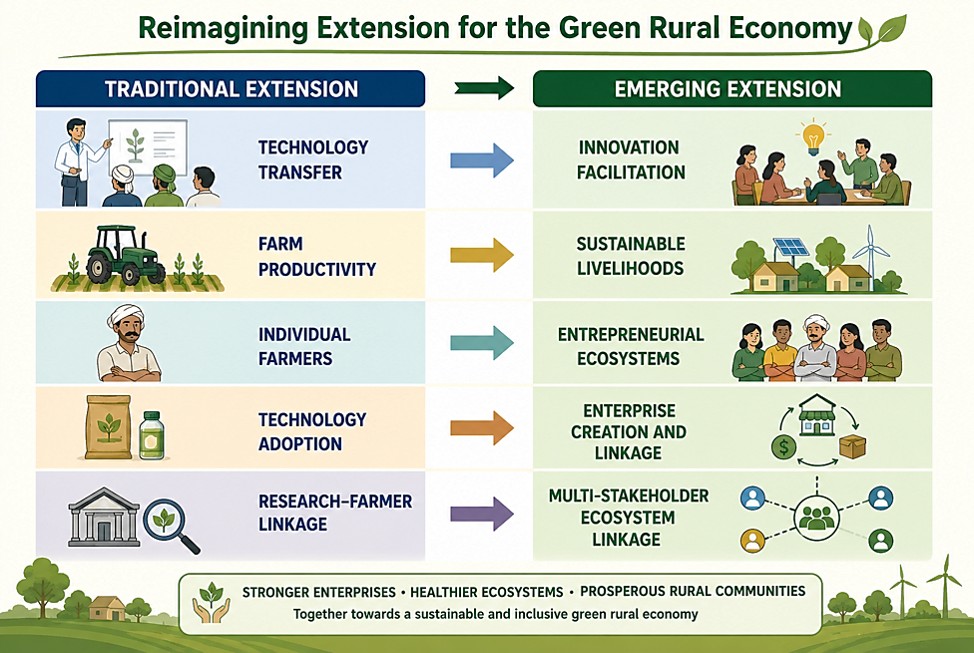
This reflects a shift from a linear knowledge-transfer model to an innovation-ecosystem approach, in which extension serves as a catalyst rather than merely a messenger.
WHAT NEEDS TO CHANGE?
Reimagining extension as a facilitator of green enterprises requires more than expanding its mandate; it also calls for changes in institutional priorities, capacity, partnerships and incentive systems (Table 2). To effectively perform these emerging roles, extension systems themselves must evolve. Although India has made significant investments in promoting entrepreneurship through agricultural universities, Agri-Business Incubators (ABIs), startup missions, financial support programmes, and innovation ecosystems, these opportunities remain only partially integrated into grassroots extension systems. Bridging this gap is essential if extension is to effectively facilitate green enterprise development.
Table 2: Key Priorities for Strengthening Agricultural Extension as a Green Enterprise Facilitator
| Sl No | Key Priorities | Rationale |
| 1. | Build extension capacity for green enterprise facilitation | While entrepreneurship education is increasingly part of agricultural curricula, many field-level extension functionaries are not adequately connected to startup ecosystems, incubation networks, green finance schemes, or sustainability-oriented business models. Strengthening these linkages would enable extension personnel to act as informed facilitators and referral agents. |
| 2. | Recognise facilitation as an extension outcome | Extension systems should broaden their performance frameworks to recognise facilitation functions alongside technology dissemination. Connecting rural youth to incubation centres, linking farmer groups with green enterprise opportunities, facilitating access to relevant schemes and supporting innovation networks are valuable contributions that often remain invisible within conventional extension evaluation systems. |
| 3. | Mainstream green entrepreneurship within extension policy | Green entrepreneurship should be viewed as an important pathway to achieving broader extension objectives, such as sustainable livelihoods, climate resilience, resource conservation, and rural youth engagement. By connecting environmental sustainability with enterprise development, extension can foster a more inclusive and resilient rural economy while contributing to SDG 1 (No Poverty) through livelihood diversification, SDG 8 (Decent Work and Economic Growth) by promoting rural entrepreneurship and green jobs, SDG 12 (Responsible Consumption and Production) through resource-efficient and circular economy practices and SDG 13 (Climate Action) by supporting environmentally sustainable enterprises. |
CONCLUSION
The transition toward a greener rural economy is already underway, with entrepreneurs developing solutions that address environmental challenges while generating income and employment opportunities. When Kapil Jangale established Plastroots, he demonstrated how an environmental challenge could be transformed into a livelihood opportunity. Similarly, enterprises such as Brisil Technologies (by Tanmay Pandya) are converting agricultural residues such as rice husk ash into high-value bio-silica for industrial applications, while Phool (by Ankit Agarwal and Prateek Kumar) has demonstrated how floral waste can be transformed into value-added products through circular business models. Across rural India, similar opportunities exist in agricultural waste management, organic inputs, renewable energy and climate-smart services. The challenge is not a lack of ideas but ensuring that aspiring entrepreneurs have access to the knowledge, networks and support needed to transform those ideas into sustainable enterprises.
By bridging the gap between grassroots innovators and existing entrepreneurship support systems, extension can help ensure that green enterprises become not isolated success stories, but scalable pathways for rural transformation. For a rural economy seeking both prosperity and sustainability, that transition is not merely desirable; it is essential.
 Sahla Salam is currently pursuing a PhD in Agricultural Extension Education at the GKVK Campus, University of Agricultural Sciences, Bangalore. She can be reached at salamsahla422@gmail.com
 Hariraj N. is currently pursuing a PhD in Agricultural Extension Education at Tamil Nadu Agricultural University, Coimbatore. He can be reached at harinagarajan03@gmail.com


This is a timely and insightful blog. Green Enterprise Facilitation has the potential to transform agricultural extension from a technology-transfer approach into a market- and sustainability-oriented support system. By helping farmers identify business opportunities, adopt climate-smart practices, and build stronger market linkages, extension services can contribute to both improved livelihoods and environmental resilience. Equally important is strengthening the capacities of extension professionals to act as facilitators, mentors, and innovation brokers while ensuring that women and youth are meaningfully included in green enterprise development. Thanks to the authors and AESA for highlighting this important direction for the future of agricultural extension.