



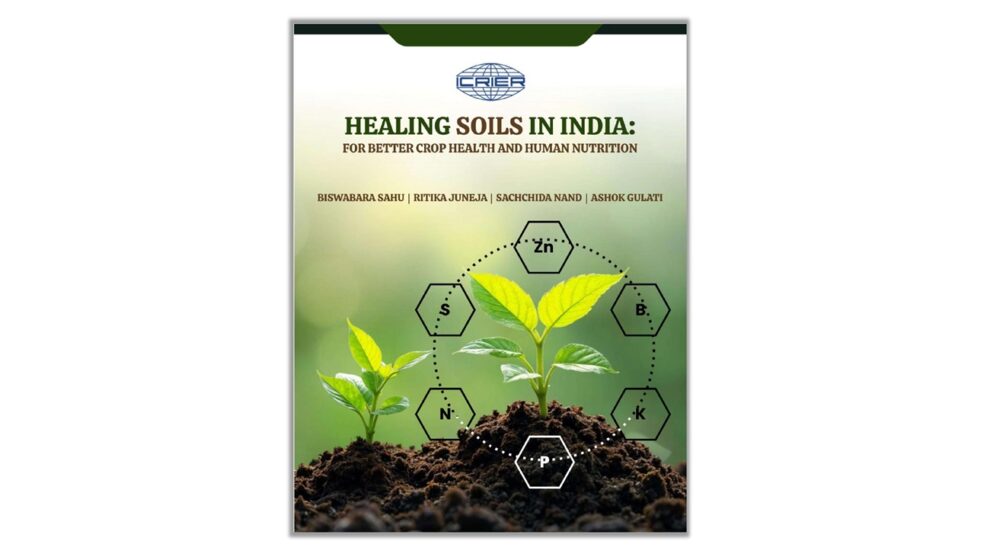
Biswabara Sahu, Ritika Juneja, Sachchida Nand and Ashok Gulati (2026)
Publisher: Indian Council for Research on International Economic Relations (ICRIER), New Delhi
ISBN: 978-81-986536-5-9
Available for free download: https://icrier.org/pdf/Healing-Soils-in-India.pdf
Indian agriculture is currently facing the challenge of ensuring sustainable food production for a growing population amid shrinking agricultural land. In a country where farmlands are reportedly degrading rapidly due to unscientific management practices, the book “Healing Soils in India for Better Crop Health and Human Nutrition” emerges as a timely and valuable contribution. The book argues that the root cause of the “hidden hunger” experienced in the country lies in unhealthy soils and emphasises that poor soil health is no longer merely an agronomic concern but has direct implications for food quality and human health.
What the Book Covers
The book is divided into seven sections, covering basic concepts such as indicators of soil health and ground realities, including the health status of Indian soils, the causes of their degradation, and the linkage of soil health with crop and human health. The book also offers policy suggestions to address current soil health-related challenges in building a sustainable agri-food system. The primary data sources for this book are the Soil Health Card Scheme portal of the Government of India, ICAR research reports, fertiliser statistics, survey reports, and published studies. This gives the book a strong factual base and makes it useful for readers interested in policy as well as research.
What Works Well
One of the notable strengths of this book is its clear presentation of scientific aspects of soil health, such as nutrient imbalance, micronutrient deficiency, and nutrient use efficiency, in a language that is understandable even to readers without a soil science background. Basic concepts of soil health are explained without using much technical jargon.
The authors argue that India’s fertiliser’s subsidy policy is the primary driver of the country’s distorted nutrient application pattern. Heavy subsidies on urea have led to overuse of nitrogenous fertilisers, while the application of phosphorus, potassium, and micronutrients has remained inadequate. This has eventually resulted in declining soil fertility, lower fertiliser use efficiency, and increasing nutrient imbalance.
Another valuable aspect discussed in the book is the linkage between soil nutrient deficiencies and child malnutrition, often referred to as hidden hunger. The authors point out that when soils are deficient in nutrients, especially micronutrients such as zinc, iron, and boron, the food produced from those soils may also be nutritionally poor. This issue is particularly significant in India, where many cases of anaemia, child stunting, and other symptoms of nutritional deficiency have been observed in the population.
The final section presents policy-oriented recommendations, including promoting balanced nutrient application, soil testing, recycling organic matter, customised fertilisers, micro-irrigation, and adopting the 4R principle (right source, right rate, right time, and right place).
What Could Be Better
A prime limitation of the book is its heavy reliance on secondary data, and the voices of farmers are largely absent. While the book clearly explains what soils require, it offers limited insight into how farmers themselves perceive these issues or how such challenges influence their day-to-day decisions. Since soil management happens in the field, it would have been valuable to know how cultivators themselves understand declining soil fertility, what prevents them from changing practices, and what kinds of support they actually need. For readers from social science or rural development, this gap will stand out.
Second, the book at times oversimplifies the causes of nutrient imbalance by emphasising India’s fertiliser subsidy system. Even though the recommendations for major reforms to the urea subsidy are the right idea, the book does not really explain why earlier attempts to reform fertiliser subsidies have failed, or how future governments might implement such changes successfully. Moreover, while subsidies certainly play an important role in the fertiliser use pattern, farmers’ decisions are shaped by a range of other factors such as resource availability, labour constraints, market uncertainty, tenancy arrangements, extension support, and risk aversion. These social and economic dimensions deserve more attention.
Further, the book depends heavily on national data and aggregated statistics. Since soil problems are highly local in nature, this often masks the major regional differences in soil types, climate, cropping systems, and nutrient constraints.
Finally, while the book strongly supports fertiliser innovation, it gives less space to approaches such as mixed cropping, agroecological practices, composting systems, and community-led soil restoration efforts.
Why the Book Matters
Despite these limitations, the book raises an issue that deserves far more public discussion. India has made major progress in food production, yet nutritional problems remain serious. By arguing that healthy soils are essential for healthy food, the authors widen the debate from food security to nutritional security. This shift is both timely and necessary.
Relevance for Social Scientists
For readers from agricultural extension, rural development, sociology, or policy studies, the book offers an important reminder that soil health is not only a technical matter. It is linked with the food and nutritional system, farmers’ livelihood, public health, subsidy structures, institutional delivery, and environmental sustainability. At the same time, the book also shows the need for more interdisciplinary work. Soil science data becomes more meaningful when combined with insights on farmers’ decision-making, gender roles in agriculture, tenancy, communication systems, and rural governance.
Who Should Read It
Healing Soils in India reads less like a typical research book and more like a long, well-argued policy note. This book will be useful for policymakers, agricultural universities, extension professionals, researchers, students, and journalists interested in agriculture and nutrition. It is especially valuable for readers seeking a broad overview of why soil health matters beyond the farm sector. This is not the final word on healing India’s soils, but it is a clear, timely and important step, and deserves a place on the shelf of anyone who cares about how we grow food and what that food does for the people who eat it.
Shinogi K. C
 Dr Shinogi K. C. is a Senior Scientist (Agricultural Extension) at the ICAR-Indian Institute of Soil Science, Bhopal, Madhya Pradesh, India. Her areas of work include participatory technology development, farming system research, and use of ICT tools to make soil information easily available for farmers. She can be reached at shinojikallely@gmail.com

Add Comment