



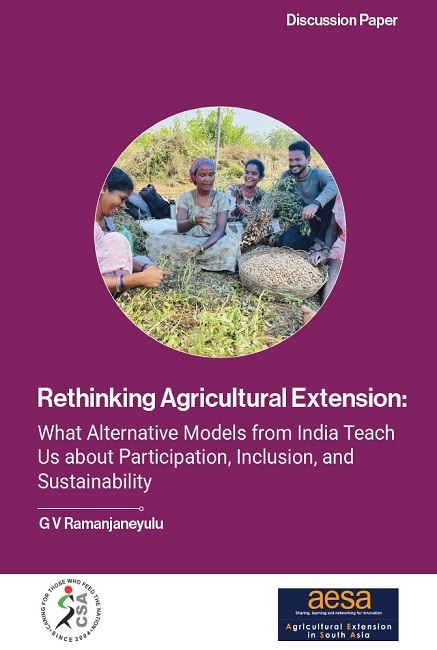
In this discussion paper, G V Ramanjaneyulu explores why India’s public agricultural extension system continues to rely on the widely criticized “top down technology transfer model” and how this persistence comes at a cost to farmers. He argues that India’s public extension system continues to measure its success by the number of trainings conducted and demonstrations organised, never by income stability, soil health, or inclusion.
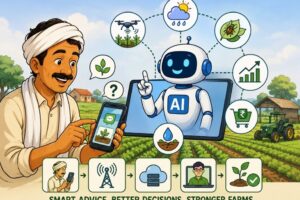
Drawing on ten alternative extension approaches—including Andhra Pradesh’s APCNF programme, PRADAN’s community service providers, Digital Green’s video-based model, and enterprise-led agritech platforms, the paper highlights a shared principle: farmers should be recognized as co-creators of knowledge, not passive recipients. These models also embed inclusion into their design, ensuring that women, tenant farmers, and socially marginalized groups are actively involved rather than treated as an afterthought.
The paper proposes a multi-layered ecosystem: a community cadre layer for trust and inclusion; a service-centre layer for bundled delivery; a digital layer for scale and personalisation; and a rights-based agroecological layer for seed sovereignty and climate resilience. The mandate must also widen, from agronomic advice alone to risk management, climate adaptation, and market intelligence.

Add Comment