



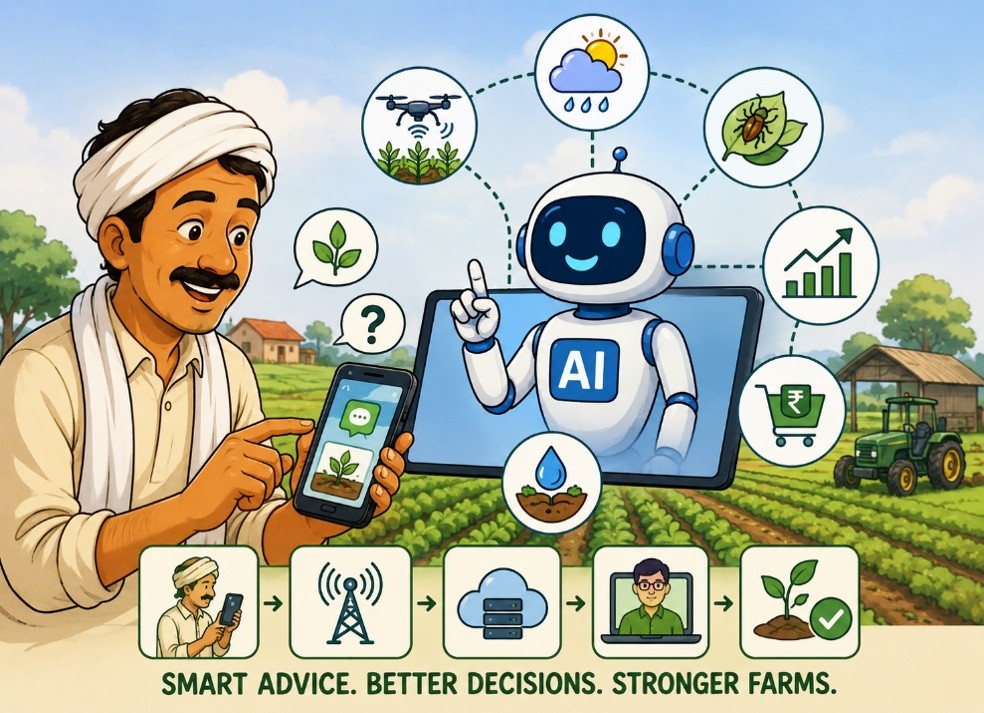
Artificial Intelligence (AI) is rapidly reshaping agricultural advisory systems by enabling faster, more personalised, and more scalable support for farmers. Aswathy, Pratheesh, and Blesson explore how AI can strengthen extension services, the opportunities it offers, and the critical role extension agents play in AI-enabled advisory services.
CONTEXT
AI is a powerful tool and a catalyst, providing opportunities for scale and personalisation, but it carries inherent risks around equity, data quality, and trust. AI has strong potential to reach the unreached, especially the smallholders who constitute a major segment of the agricultural workforce; however, this optimism is tempered by limited empirical evidence. With its endless possibilities and rapidly evolving use cases, this blog explores how AI can be meaningfully used to deliver advisory services. It articulates the key challenges and limitations that persist despite the often-optimistic narrative surrounding its potential.
WHAT DOES AI IN FARM ADVISORY MEAN?
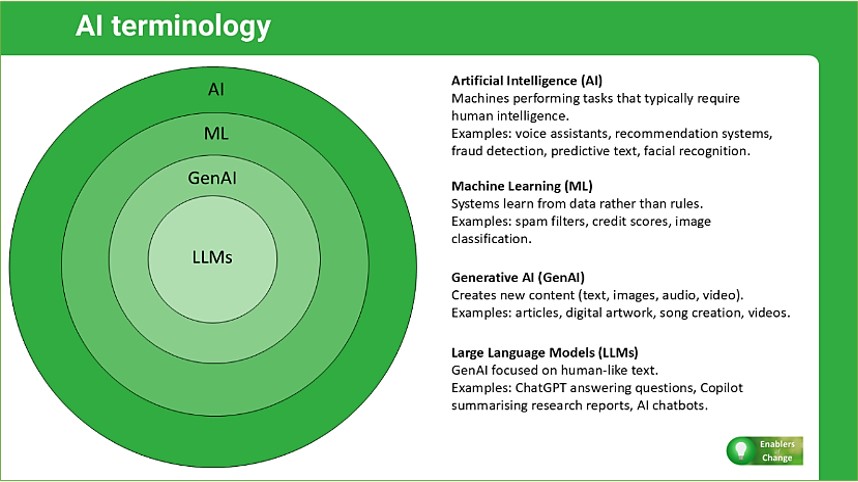
AI, machine learning, generative AI, and large language models (LLMs) are often used interchangeably; however, they represent distinct yet interconnected concepts (see the figure given below).
Artificial Intelligence (AI) in farm advisory refers to the use of data-driven digital technologies to deliver timely, accurate, and context-specific information to farmers. At its simplest, AI enables systems to “learn” from large volumes of data, such as weather patterns, soil conditions, crop performance, and farmer queries and translate that learning into actionable recommendations.
Unlike traditional advisory approaches, which are often generalised and supply-driven, AI-enabled systems are demand-driven and adaptive. A farmer can ask a question, upload an image, or receive location- and crop-stage-tailored alerts. This marks a shift from static information dissemination to dynamic, interactive problem-solving.
HOW IS AI REACHING FARMERS ACROSS INDIA?
Emerging AI-enabled advisory initiatives in India demonstrate the growing potential of artificial intelligence to strengthen agricultural extension through multilingual, accessible, and scalable support systems. Platforms such as Farmer.Chat, Bharat-VISTAAR, Sukharakshak AI, and Krushi Samruddhi Helpline are increasingly integrating conversational and generative AI, as well as voice-based interfaces, to provide farmers with real-time guidance on crop management, weather, markets, and climate risks. A notable trend across these initiatives is a focus on inclusivity through local-language support, mobile access, and voice-enabled services, making digital advisory more accessible to smallholders. While some platforms are still in pilot and early-scaling stages, their expanding reach highlights the growing shift from conventional information dissemination to interactive, data-driven, and farmer-centric advisory ecosystems in Indian agriculture. As AI-powered advisory tools increasingly enter the advisory landscape, understanding how farmers perceive and interact with these technologies becomes critical. AI advisory platforms gain farmer acceptance when they feel less like machines and more like trusted advisors. Local-language chatbots, instant accessibility, and interactive conversations make learning easier and more engaging for farmers. At the same time, issues related to unreliable recommendations, data security, and trust remain major barriers to large-scale adoption.
WILL AI REPLACE EXTENSION AGENTS?
The rapid rise of Artificial Intelligence (AI) in agriculture has sparked a familiar concern- Will AI replace extension agents? This question often emerges in discussions around digital advisory tools, especially as chatbots, predictive systems, and automated platforms become more capable. However, framing this as a replacement debate oversimplifies a much more nuanced reality.
At first glance, AI systems appear to replicate many functions traditionally performed by extension personnel, such as answering queries, diagnosing problems, and providing recommendations. Tools such as Farmer. Chat can respond instantly to thousands of farmers, something no human system can match in scale.
However, agricultural advisory is not merely about information delivery. It involves interpretation, contextualization, trust-building, and behavioural change, areas where human extension agents remain indispensable. Farmers often operate in complex socio-economic and ecological contexts. A technically sound recommendation may not be practically feasible due to labour constraints, financial limitations, or local cultural practices. Extension agents play a critical role in translating generic recommendations into locally relevant solutions, something AI systems are still limited in achieving independently.
Studies on AI-enabled advisory, including chatbot-based interventions, consistently highlight the importance of human-mediated systems. While farmers appreciate the speed and accessibility of AI tools, their trust in the information often increases when it is validated or reinforced by a human expert. There are several reasons for this:
- Contextual Understanding: Extension agents understand local agro-ecological conditions, cropping systems, and farmer realities in ways that AI may not fully capture.
- Trust and Credibility: Long-standing relationships between farmers and extension personnel foster trust, which is critical for the adoption of new practices.
- Handling Complexity: Complex or ambiguous problems often require judgment, experience, and negotiation, all of which are essential to human expertise.
- Capacity Building: Extension agents do more than advice; they train, demonstrate, and build long-term capabilities among farmers.
In this sense, AI can handle routine, repetitive, and data-intensive tasks, while extension agents focus on high-value, context-specific, and relational aspects of advisory.
BEYOND THE MYTH: WHY AI NEEDS EXTENSION AGENTS MORE THAN EVER
The integration of AI into agricultural advisory is not diminishing the role of extension agents. It is, in fact, redefining their significance. Their role is evolving from disseminators of information to orchestrators of knowledge, trust, and technology.
Extension professionals are now positioned to
- Act as Knowledge Curators: Ensuring that AI systems are trained on accurate, locally relevant, and up-to-date information.
- Validate and Interpret AI Outputs: Translating AI-generated advisories into actionable insights tailored to farmer conditions.
- Bridge the Trust Gap: Serving as intermediaries who build farmer confidence in digital tools.
- Facilitate Digital Inclusion: Helping farmers navigate and effectively use AI-enabled platforms.
- Provide Feedback Loops: Continuously improving AI systems by feeding field-level insights back into the technology.
CHALLENGES AHEAD
Lack of Quality Data to Train AI
Although substantial agricultural data are being generated by research institutions, digital platforms, remote sensing, IoT devices, and government databases, significant gaps remain in data quality, standardisation, interoperability, and real-time availability. In many cases, datasets are fragmented, outdated, regionally biased, or insufficiently validated. Moreover, much of the tacit knowledge held by extension personnel and experienced farmer’s remains undocumented and therefore unavailable for training the models.
The challenge becomes even more critical when AI is expected to deliver highly localised and actionable advisories. An inaccurate recommendation on pest management, irrigation, or fertiliser application can directly affect farmers’ livelihoods, making reliability and contextual relevance essential. Therefore, the future effectiveness of AI-driven advisory systems will depend not merely on the sophistication of algorithms but also on the availability of robust, inclusive, and continuously updated agricultural datasets.
Digital Divide
The findings of the National Family Health Survey 2019-21 indicate that only about half of the rural adult population has a smartphone with internet access, and the situation is even worse among rural women and socially marginalised communities. Further, nearly half of rural adults do not effectively use the internet for informational purposes, highlighting significant levels of digital illiteracy. The challenge is particularly important in agriculture, where more than 86% of farmers in India are small and marginal holders. Despite rapid advancements in digital agriculture initiatives, expert assessments suggest that fewer than 20% of Indian farmers actively use digital technologies in farming. Limited affordability of smartphones and internet services, low awareness, language barriers, and lack of trust in digital platforms continue to restrict adoption.
High Cost of Infrastructure and Maintenance
Developing and maintaining AI systems requires investments in cloud infrastructure, sensors, data management systems, satellite integration, and continuous model training, which may not always be economically sustainable.
Data Privacy and Ownership Concerns
Questions regarding who owns farmer data, how data are collected and used, and whether farmers provide informed consent remain largely unresolved. For example, farmer data may be shared with private companies without clear consent, AI systems may promote biased recommendations favouring specific products or firms, and inaccurate advisories on pesticide use or crop management may adversely affect farmer livelihoods. There are also concerns that smallholders and digitally disadvantaged groups could be excluded from AI systems trained on limited or biased datasets. These issues highlight the need for clear policies on data ownership, consent, and responsible use of AI in agriculture.
Policy and Regulatory Gaps
While conventional extension systems also face challenges related to accountability and advisory quality, AI-enabled systems introduce new governance concerns because recommendations may be generated through opaque algorithms, private digital platforms, and automated processes operating at large scale. Questions regarding liability for incorrect advisories, ethical use of farmer data, and standardisation of AI systems, therefore, require clearer regulatory frameworks.
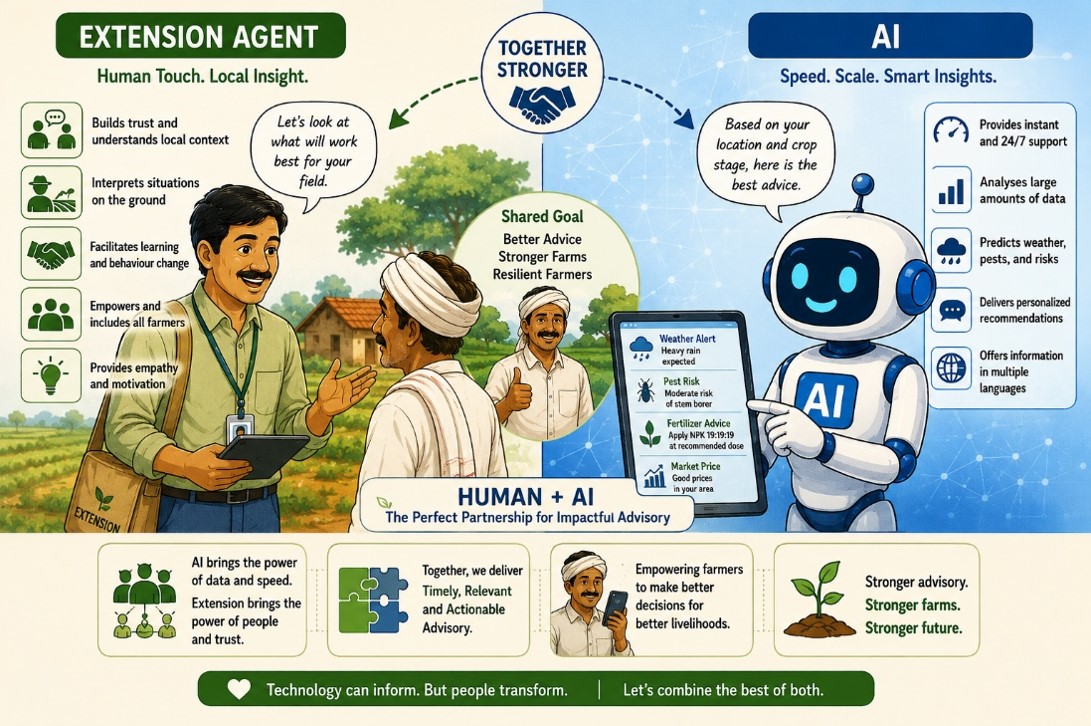 A hybrid model for better delivery of EAS (AI-generated)
CONCLUSION
The future of agricultural advisory is not a contest between humans and machines, but a collaboration between the two. While AI can process data, generate recommendations, and expand outreach at unprecedented scale, extension professionals remain central in interpreting complexity, building trust, and translating knowledge into meaningful action. There is a growing need to equip future extension professionals with the skills to use AI-enabled tools and platforms effectively. Extension personnel of the future will not only disseminate information but also interpret AI-generated advisories, validate recommendations using field realities, and help farmers navigate digital technologies responsibly. It therefore becomes essential to build capacities of extension professionals in areas such as digital literacy, data interpretation, AI-assisted decision-making, and ethical use of technology to ensure that AI-supported advisory systems remain trustworthy, inclusive, and context-specific rather than purely technology-driven.
 Aswathy Chandrakumar is a scientist (Agrl. Extension), presently posted at ICAR-Directorate of Cashew Research, Puttur, Dakshina Kannada, Karnataka. She can be reached at acs14292@gmail.com
 Pratheesh P Gopinath is Assistant Professor & Head, Department of Agricultural Statistics. College of Agriculture, Vellayani, Kerala and he can be reached at pratheesh.pg@kau.in
 Blesson B Varghese completed his M.Sc in agricultural statistics from College of Agriculture, Vellayani, Kerala and currently works as a Data Analytical Officer at Plant Lipids Pvt. Ltd. He can be reached at blessonvarghese1234@gmail.com


“Congratulations to Dr Aswathy and co-authors for the timely discussion on the topic of AI and Agricultural Extension. AI is going to stand tall influencing social transformation and equitable access. The points discussed in this blog are very relevant to consider in planning, designing and taking forward agricultural extension services, customized and appropriate to the stakeholder ecosystem across the globe. There is also a need to include this topic in the extension education curriculum, in training and development policies and discuss its implications on gender dimensions. Another concern to be addressed is the strategic placing of the indigenous knowledge and wisdom in the AI driven environment. Similarly, how do we use different knowledge types, skills and facilitate co-creation of knowledge. Thanks to the authors and to AESA for publishing this important topic to elicit further discussions on this topic”.
Thanks to the authors for this timely and insightful blog on AI and EAS.
As rightly pointed out, there is no chance of complete replacement of Agricultural Extension professionals by AI. However, there is a chance that they may be replaced by someone who knows how to use, understand and interpret AI effectively. Therefore, practical capacity building on AI is much needed for extension students and professionals.
The availability of reliable field data is also important for making AI work well in agriculture. In this regard, the national-level surveys carried out by NSO (MoSPI) play an important role. I also understand that efforts are underway to integrate AI into their microdata systems.
Further research and development is needed to integrate AI into primary data collection. This can make data collection, storage and accessibility easier and help generate reliable datasets for AI-driven agricultural advisory services.
“First of all my congratulations to Aswathy et al for this informative, relevant and very much contextual blog.
Below, I also share some of my suggestions/views on the blog.
• In the section, “What does AI in farm advisory mean?”, I think the authors could have included Predictive AI and Agentic AI too. You included Generative AI. Agentic AI is now relevant, as indicated in the NITI Aayog reports
• In the section “How is AI reaching farmers across India,” a reference to NITI Aayog Report could highlight the policy support for AI from the Govt of India. NITI Aayog envisions AI as a primary driver to enhance farm productivity, reduce wastage and secure farmers’ income. It released a strategic roadmap titled “Reimagining Agriculture: A roadmap for Frontier Technology-Led Transformation,” focusing on integrating five key pillars. Agentic AI and Digital twins are included as two pillars. Kindly see: https://niti.gov.in/sites/default/files/2025-10/Reimagining_Agriculture_Roadmap_for_Frontier_Technology_Led_Transformation.pdf
• The section “Will AI replace Extension Agents?” is well written and provides conceptual clarity. Digital trust is an important factor. The importance of human-mediated extension service is highlighted.
• Under the challenges ahead, the following points are important:
– With more and more OEMs emerging with innovative agricultural IoT tools and platforms, interoperability is rapidly becoming a point of concern.
– Agricultural cybersecurity issues
– Lack of adequate data business platforms in the agricultural sector
• The concluding remarks are very valid and I hope policymakers will consider them seriously”.
Congratulations, Aswathi et al for posting a blog on the happening thing. Agri advisory cannot afford to be insulated from the AI revolution. You have mentioned the challenges in embracing AI by agri extension systems. A strong education and capacity building are a must for both at the academic and practice levels. Normally, the public extension systems react very late to mainstreaming innovative methods. A comprehensive policy must be developed and adopted at the national level which calls for close coordination between MoAFW and IT Ministry. Besides, this also needs champions like your team who keep reinforcing the need for AI integration at every opportunity. All the best in your endeavour.
The AI applications are no doubt inevitable and as Dixit said many times the MoA is slow in updating. Buliding AI platforms to record and interpret field data can certainly complement ” Feed back Research ” presently being emphasised to redirect research agenda. One such illustration I have come acroos a model of ” Closed loop coffee intellegence system ” developed by a farmer from Chickmagalore which interprets real time field data for yield prediction and diagnistics interventions. Such innovations by ” early adopters ” are path finding and need to be encouraged.
Congratulations to the authors for the relevant blog, with excellent conceptual clarity. In the context of extension advisory have the use of AI, scaled beyond Gen AI other than in a few cases of ML modelling? If so what is the scale of adoption? I hope these important questions will be answered in the near future through research.