



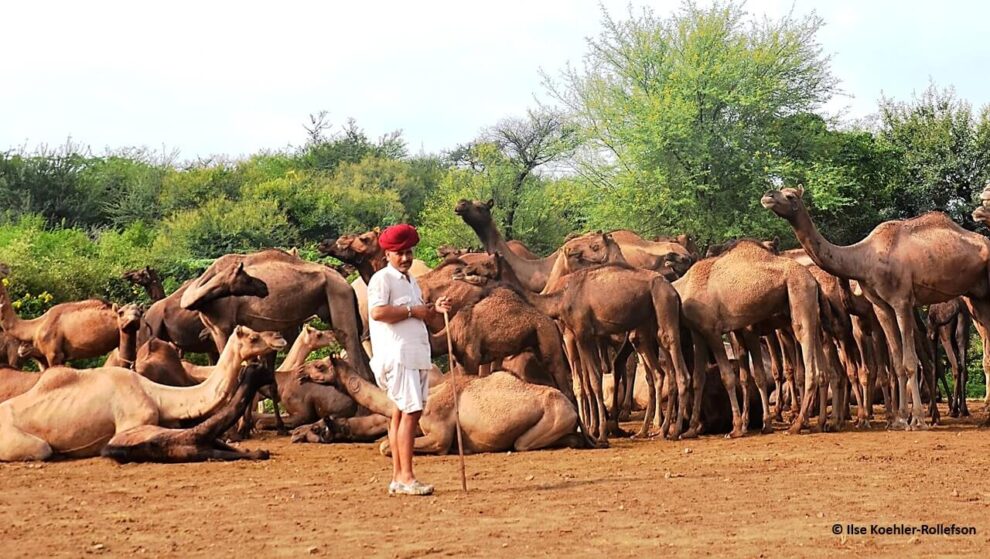
In this blog, Ilse, Ajinkya, Sajal and Hanwant argue for formally recognising camels as essential working animals for pastoral livelihoods and for facilitating their movement across state borders.
CONTEXT
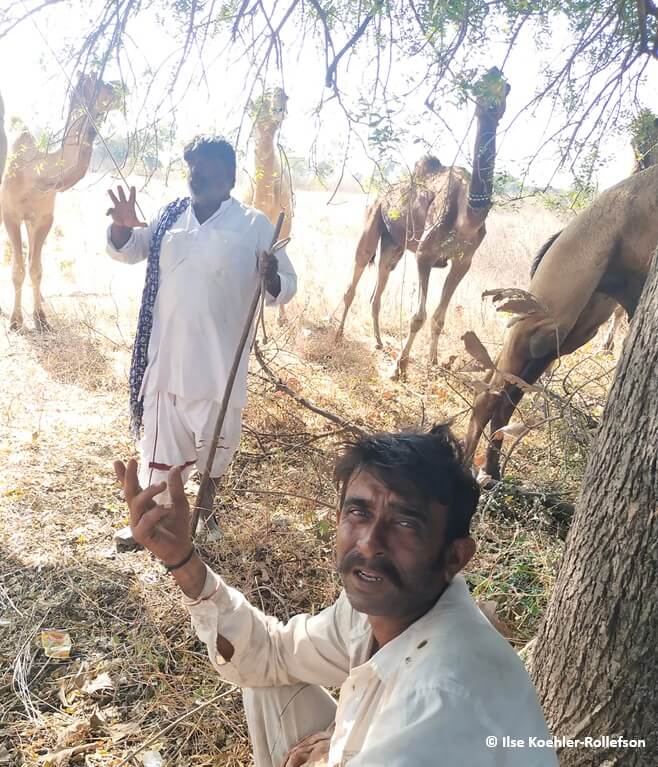
“Camels are vital for our migration and our livelihoods”, emphasises Mammu Rebari, a shepherd and continues “, We don’t want to, but in the future, we might have to move with bullock carts instead, if the situation does not change.”
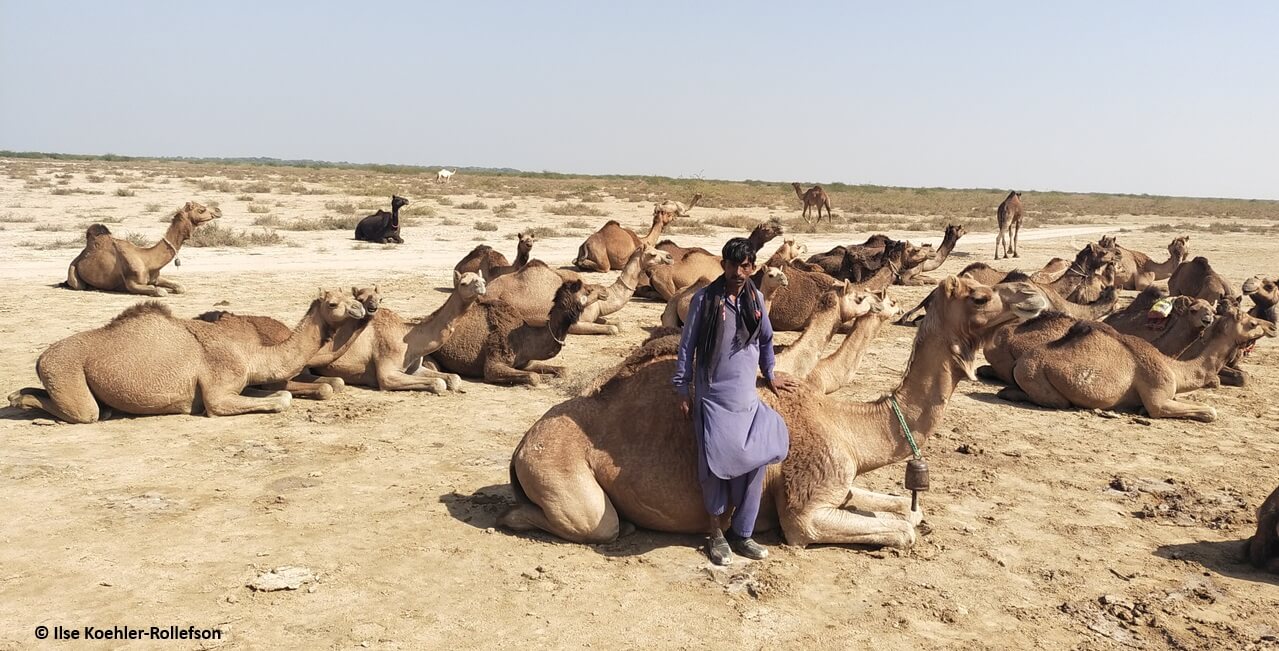
Sitting at the edge of a talab in Sakhara village of Bhivapur Taluka about 40 km from Nagpur in Maharashtra, surrounded by eight camels that transport the belongings of the four families in his herding group, he is referring to the seizure of 32 camels and the FIR issued against two people from his community who had walked them from Anjar district in Kutch to replace old camels. The complainant is an animal welfare organisation that claims the camels were destined for slaughter and that it is cruel to make camels walk such long distances.
This was not an isolated incident. In 2022, several camels belonging to Rebari pastoralists were seized in the Amravati district of Maharashtra under similar allegations of illegal transport and suspected slaughter, despite the animals being clearly used as working camels for migration. Again, in 2024, camels brought from Kutch to replace ageing animals were detained, and FIRs were registered, disrupting pastoral movements. These repeated seizures point to a systemic misunderstanding of pastoral livelihoods and the role of camels.
ROLE OF CAMELS IN PASTORAL LIVELIHOODS
The allegations made by the complainants are clearly false. Firstly, it is not cruel to make camels walk – when free-ranging, they can cover up to 70 km a day, which is good for their health, much better than being confined in a gaushala.
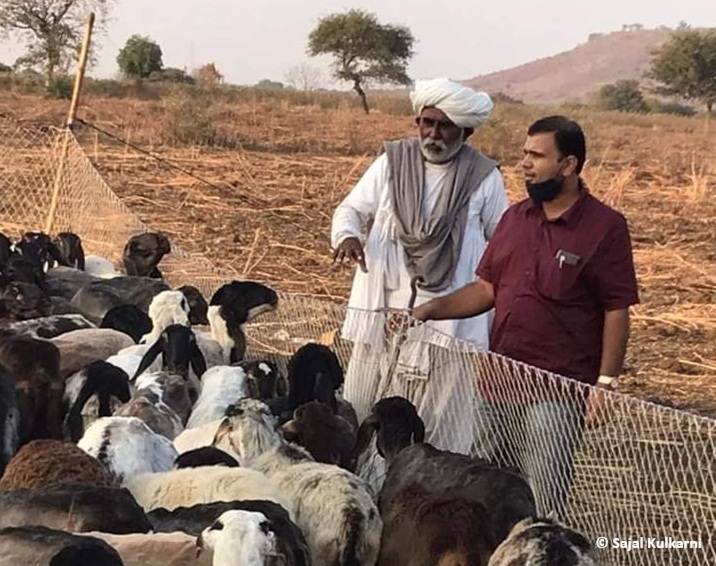
Secondly, in Maharashtra (and not only there, but also in Chhattisgarh, Andhra Pradesh and Telangana), Rebari shepherds use thousands of male camels to move their household equipment from one night halt to the next. These pastoralists cover at least 400 kilometres in their annual cycle. In the winter, they sustain their flocks on harvested cotton fields, which they provide with organic manure. During the monsoon, they move deep into forests, and they also camp out on harvested vegetable fields, especially those cultivated with chilis. The farmers who grow the famous Bhivapuri chilli especially appreciate sheep urine and manure and have observed that they improve yields and pungency.
| Box 1: Pastoral Livelihoods in India There are an estimated 13 million pastoralists in India who manage 77% of the nation’s livestock under extensive, mobile systems. They contribute significantly to the economy, producing around 53% of the milk and 74% of the nation’s meat, but remain unrecognised in official statistics until now. The 21st livestock census sought to count them and their livestock to understand their role in the national economy better. Pastoralists, too, need extension activities geared towards addressing their situation and mobility. More info: Accounting for Pastoralists in India Moo’ing Forward: Supporting Pastoralism in India |
The Rebari have a social taboo on taking female camels out of Kutch and using them for work, as they regard them as seats of the mother goddess, so one can only find male camels in Maharashtra. Being unable to breed replacement camels themselves, the shepherds in Maharashtra therefor depend on a continuous supply of animals from their community members in Gujarat to replace camels that become unfit for work.
The Centre for People’s Collective, based in Nagpur, has monitored camel population numbers and documented developments over the last few years. “In 2022-2023, there were at least 1000 camels around Nagpur; now there are hardly any”, says Sajal Kulkarni, and his colleague Ajinkya Shahane explains that replacing camels with bullock carts affects mobility: certain crucial grazing areas become difficult or impossible to access. This impacts the health of the sheep flocks and, thereby, household income.
While shepherds in Maharashtra suffer from the unavailability of burden camels, the livelihoods of camel breeders in Rajasthan and Gujarat are undermined and threatened by their inability to sell r male camels.
IMPACT OF 2015 POLICY
The Rajasthan Camel (Prohibition of Slaughter and Regulation of Temporary Migration or Export) Act, 2015, prohibits the movement of camels across state borders without special permission, which requires a lengthy bureaucratic process. Although this legal instrument was put into place to save Rajasthan’s dwindling camel population, it has had the opposite effect, says Hanwant Singh Rathore, secretary of Lokhit Pashu-Palak Sansthan, which represents the interests of Rajasthan’s camel breeders. “The traders who used to buy camels at the Pushkar Fair have stopped coming. Because male camels cannot be sold, breeders let them run free, and then they are often captured and illegally trucked away for slaughter to U.P.,” he says. “Even if they are rescued, this too involves a lot of cruelty, as many of them die soon after due to being loaded into trucks by crane, which damages their internal organs and leads to internal bleeding”.
In Kutch, Gujarat, Fakirani Jat camel herders also face difficulties selling male camels, especially those who breed the Kharai camel and are not linked to the camel milk market. As a consequence, its population is endangered, as was discussed during a recent national consultation held at Bhuj by the Kachchh Unt Ucherak Maldhari Sangathan (KUUMS) and the NGO Sahjeevan.
ENDNOTE
There is an urgent need for rational central and state policies that facilitate the movement of people across state borders. Camels should be formally recognised in policy as essential working animals for pastoral livelihoods. Finding ‘work’ for male camels is a necessary prerequisite for their conservation. If the consensus is that they cannot be used for meat, then other purposes must be found. That should be possible. After all, they are a source of physical energy and do not require any fossil fuels: in fact, their keepers should be eligible for carbon credits. They can pull carts, plough, power oil mills, and draw water from wells. If such uses are subsidised as the use of bullocks is, rather than prevented, much would be gained. Such an approach must be an essential component of the overall camel conservation strategy that India is currently developing, and it need not conflict with camel well-being.
 Dr. Ilse Koehler-Rollefson is a veterinarian originating in Germany who has worked in Rajasthan since 1991. Together with Hanwant Singh Rathore she is the co-founder of Camel Charisma, a social enterprise that develops and markets camel products. She is author of “Hoofprints on the Land: How traditional Herding and Grazing can restore the soil and bring animal agriculture back in balance with the Earth” which provides a global overview of pastoralism and a recipient of the Nari Shakti Award by the President of India. ilse.koehlerroll@googlemail.com
 Ajinkya Shahane works with the Centre for People’s Collective on pastoral communities in Vidarbha, Maharashtra. His work focuses on their culture, livelihoods, livestock production systems, and key issues affecting pastoralists. ajinkyashahane6@gmail.com
 Sajal Kulkarni is the Director of the Centre for People’s Collective, Nagpur, working with pastoral and traditional livestock keepers in Vidarbha, Maharashtra. sajalskulkarni@gmail.com
 Hanwant Singh Rathore is the secretary of Lokhit Pashu-Palak Sansthan, a Rajasthan based NGO that supports pastoralists, with a special focus on camel breeders. He has advocated for the rights of pastoralists at many national and UN level meetings. lpps.sadri1996@gmail.com


This is an insightful piece. It successfully highlights the urgent need for targeted policy frameworks that protect camel populations and the pastoral livelihoods tied to them. I particularly appreciated how the blog explores the intersection of social mores and taboos with livestock management, showing that economic survival is often inseparable from cultural norms.
This blog brings out the often overlooked policy implications for sustainable pastoralism and the livelihoods of camel herders facing growing hardships. Camels are not just cultural symbols but essential working animals that support mobility, rangeland management, and resilience in dryland ecosystems.
At a time when we are celebrating the International Year of Rangelands and Pastoralism, this piece is a timely reminder that policies must be informed by the lived realities of pastoral communities. Congratulations to the authors and AESA for drawing much-needed attention to the voices of camel herders—one hopes policymakers and administrators will give these perspectives a patient and thoughtful hearing. I wish to see many such posts covering the various dimensions of pastoralism in coming months.