




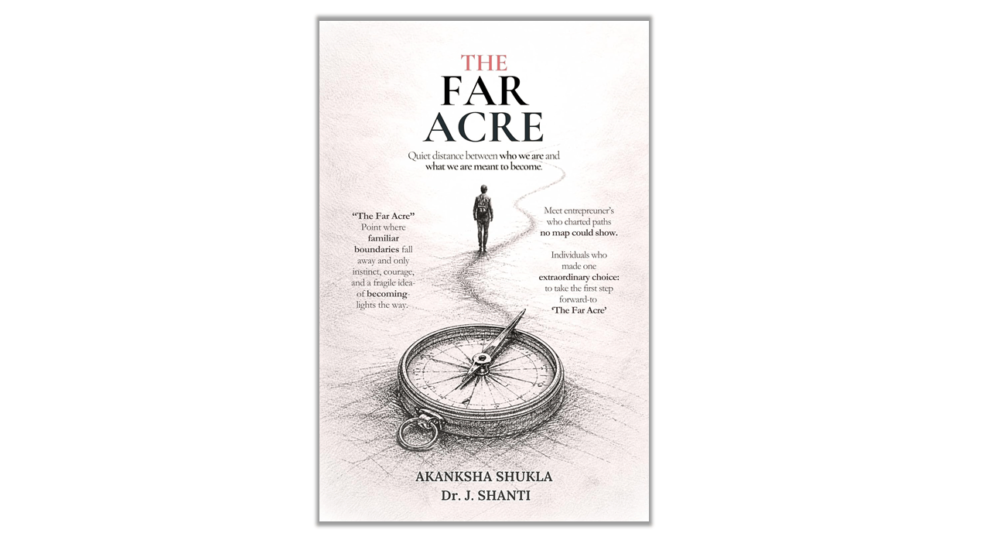
Akanksha Shukla and J. Shanti (2026)
Publisher: Evince Publishing House In collaboration with Manage Alumni Association (MAA).
ISBN: 978-93-7335-064-6
Pages: 368
Price: INR: 599/-
“I shall be telling this with a sigh Somewhere ages and ages hence
Two roads diverged in a wood, and I—I took the one less travelled by,
And that has made all the difference”.
– quoted from the poem ‘The Road Not Taken’ by Robert Frost, August 1915.
In South Asia, including the Indian subcontinent, agricultural entrepreneurship is steadily emerging beyond traditional extension systems through new models of technology-driven innovation in agribusiness. However, narratives of real-time experiences of risk‑taking and innovation are still rare and few in numbers. April 26, 2026, marked a new milestone in agricultural entrepreneurship sector with the launch of the book ‘The Far Acre’ by Akanksha Shukla and J. Shanti. It brought forth ten captivating, concurrent stories of ten heroes who chose to take the ‘road less travelled.’ In an ecosystem lacking any candid documentation of agri-entrepreneurial efforts, this consolidation of ten real-world experiences marked by grit, determination, courage, and confidence brings a fresh hope and cheer. Each story navigates through a hazy, uncertain maze with the promise of faraway success.
Quoting S. Shiv Kumar, an icon in agri-business and innovation ecosystem, The Far Acre is not a place on any map. It is the unseen stretch beyond comfort, the quiet distance between who we are and what we are meant to become.” This book is a true capture of fascinating experiences that mirror the rapid transition from subsistence‑oriented agriculture to knowledge‑driven enterprise creation in this region and anchors the learnings across the broader ecosystem of agri-innovation and entrepreneurship.
True to its title, the book takes the reader from a known comfort zone to an unfamiliar golf course, full of holes waiting for players to strike at each distinct tee. The golfers here are simple young minds who dared to embark on this journey as they manoeuvred across 9-hole or even 18-hole golf courses, shaping their ideas into enterprises. Each of these ten minds is different and special. That is the beauty of the book, and it strengthens the narrative eloquently written by the authors, Akansha and Shanti.
Treating each story as a distinct type, the authors creatively captured their thoughts, giving each creator the space and respect they needed. So, while Anand Chandra built system-based reform through his sheer grit, Salil’s story began with identifying a felt need and building a simplified solution through ‘Scimplify.’ Ashutosh Sinha’s approach varied, and he used his education and the rich experience he gained in the early years of his professional work at the rural grassroots as stepping stones to shape ERGOS.
‘Abhihaara’s innovative interwoven tapestries did not stop at more income or better livelihoods. Its founder, Sudha Rani, wove into this venture, the threads of social and societal impact while bringing dignity to those hidden talents behind the looms. She chose to build a sustainable loom as part of a credibility story, far beyond a traditional success-story saga. The challenges of the glass ceiling, so often voiced by women in most workplaces, did not leave Sudha alone, but the story of her resilience pushed her to break it. This is what makes this story so iconic and worth a detailed read.
Dharmender Mortha’s hunger to soar as a free bird was the push he had as he pulled into markets beyond his native land. He struggled at every stage, but with his tenacity and deep-rooted values, he struck the golf balls into the correct holes in his journey in the wild, open golf course. ‘Feedsco’, started by Vijendra Kumar, is a narrative of collective wisdom from observation and real-time challenges, as young workmen like him translate them into solutions. The creation of hyperlocal models and the disruption of market channels in small towns were new then and brought new cheer across rural markets. From a single mind to two minds, and then to a coalition, this journey illustrates inclusivity and collective wisdom in practice. It echoes about team building, scouting, mentoring, and negotiating-many abstract things learnt in classrooms and often left behind there without practising.
Rajeev Saraswat’s ‘Solvera’ or Vamsi Krishna’s ‘Agrisensei’ are consulting ventures stepping into the agri space that have helped demystify the conventional notion that the agricultural sector is only about growing crops or tending livestock. They broke down barriers to build knowledge-driven businesses in this sector. Taking it further, Kavitha David’s efforts led to creation of ‘Unicorpus Healthcare Foundation’ as a business beyond the agricultural sector. This step speaks volumes about courage and her visualisation of her learning and formal education across new domains. Her story speaks of courage, foresight and finding the untouched opportunities lying there at a suitable time. Her strides across the golf course to ‘The Far Acre’ are different, but she was successful. Finally, Chandrasekhar Gajula’s story, through the interweaving of wellness and farming interludes, brings new hope for sustainable solutions.
Yes, each of the ten stories is different, with an inherent variation in their approaches. For all of them, the approach road was hazy and, in most cases, the end uncertain. But the commonality across all was the value they had harnessed through their education at MANAGE and their passion to turn it into reality as their journeys began to take shape. ‘The Far Acre’ brings out this crucial point very vividly. The unseen, often unvoiced values system ingrained into the curriculum by educational institutions like MANAGE plays a crucial role in the lives of the students. The narratives of each founder clearly show that the realisation of gains from their formal learning was not immediate. Each story revealed the deep-seated influence that their early education at MANAGE, along with their individual experiences at an early age or during professional growth stages, had on their own journeys.
What also distinguishes this book from earlier compilations of entrepreneurial journeys is its democratization of real‑time field realities rather than retrospective glorification. The authors avoid the trap of romanticising success; instead, they present entrepreneurship as a sequence of informed risks, iterative learning, and value‑based decision‑making. This positions the book as a credible, practice‑oriented resource. As India’s agri‑innovation ecosystem expands, multiplication of more incubators, accelerators, and rural enterprise hubs, such a documentation becomes essential. Books like ‘The Far Acre’ not only inspire but also serve as reference points for designing curricula, incubation models, and policy frameworks that nurture neo‑generation agri‑entrepreneurs.
For me, as a person deeply involved in agri-innovation and the entrepreneurial ecosystem, it was exciting to read each story and a pleasure to see the authors’ arduous work, which shines all through. Some confusing moments cropped up while flipping through the book, making the reader wish for a style that separated each story by its look alone. Very often, there was a need to go back to understand the context of the conclusions placed at the end of each story. Avoiding sudden page breaks within each case may give a continuity as the reader reaches the playbook page at the end of each narrative. There was a pace in each story that kept the reader engaged, but the breaks and formatting styles often lacked enough depth to sustain engagement without looking back. Use of caricatures describing each story, in the same black-and-white tones used to illustrate the founders on the opening pages, could have helped break the monotony.
A final word: “If you are passionate about agri-innovation as I am, you’ll probably love this one.” It is a book I would recommend to all: To those trying to demystify the tenets of agri-innovation and entrepreneurship; to those scores of young students who are hoping venture beyond traditional agri-education; to the new age teachers/faculty in agri-business management scouting for new, real-time based case studies in their teaching programs and to the shapers of agri-policies yearning to carve the much needed space for game changing decision making in a rapidly evolving agri-innovation and entrepreneurship ecosystem.
An absolutely needed book to read for all, with a “4 out of 5” score!!
 Dr. R. Kalpana Sastry is a distinguished agricultural scientist with more than three decades of expertise in agricultural research, technology, and innovation management. She played a key role in developing the agribusiness incubation system in the Indian National Agricultural Research, Education, and Extension System (NAREES). She served as the Managing Director at AgHub Foundation, Professor Jayasankar Telangana Agricultural University (PJTAU), Hyderabad (2020-2025) and previously led the a-IDEA Technology Business Incubator at ICAR-National Academy of Agricultural Research Management (NAARM). Currently she is associated with Society of Technology Management (STEM) a non-profit association of technology transfer professionals which nurtures professional development, networking and best practices promulgating for successful technology transfer. Contact at: kalpanas.regulagedda@gmail.com

Add Comment