




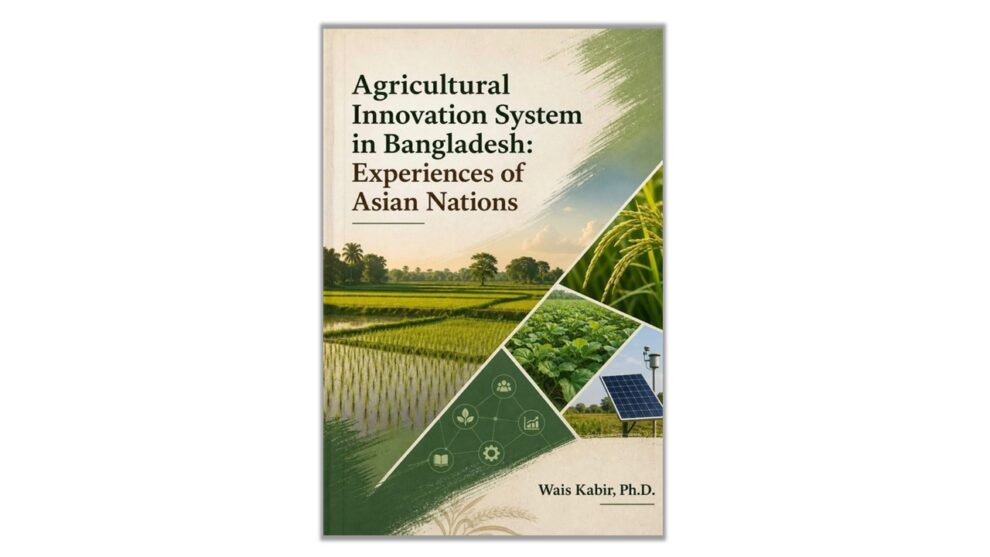
Dr Wais Kabir
Publisher: Ahmed Masudul Haque, Uttaran, 39/1 Banglabazar, Dhaka 1100, Bangladesh
ISBN: 978-984-29537-4-3
Distributor: Nowla Brothers, Banglabazar, Dhaka
Price: 300 Tk
Agricultural Innovation System in Bangladesh: Experiences of Asian Nations, by Dr Wais Kabir, is a timely and significant contribution to the literature on agricultural research and innovation systems. It is arguably the first comprehensive volume devoted specifically to the institutional dimensions of Bangladesh’s Agricultural Innovation System (AIS) within the broader context of Asian experiences. The book convincingly argues that strong institutions form the foundation of an effective innovation system and that institutional capacity is fundamental to improving research quality, service delivery, accountability, and long-term sustainability.
The author examines Bangladesh’s Agricultural Innovation System through a comparative analysis of the institutional arrangements, governance structures, and best practices of major rice-producing Asian countries. Drawing upon official reports, published literature, consultations with experts, and the Agricultural Science and Technology Indicators (ASTI) database, Dr Kabir presents a valuable comparative perspective on agricultural research governance across Asia. He openly acknowledges the challenges encountered during data collection, including language barriers, inconsistencies in publicly available information, and the lack of real-time data in several countries. Consequently, the statistics presented should be regarded as indicative rather than definitive.
The book is organised into six well-structured chapters covering: (i) methodology, (ii) country profiles, (iii) lessons from international good practices, (iv) institutional limitations and gaps within Bangladesh’s research system, (v) institutional innovations, and (vi) conclusions and recommendations. Throughout the book, the central theme remains strengthening institutional capacity, improving research quality, and enhancing accountability within Bangladesh’s National Agricultural Research System (NARS).
One of the book’s major strengths is its comparative analysis of agricultural research systems in India, Pakistan, Nepal, Sri Lanka, Thailand, Indonesia, the Philippines, China, and Vietnam. The author demonstrates that these countries have adopted diverse institutional models. While some operate primarily through autonomous agricultural research councils or academies, others rely largely on government departments.
Among the autonomous institutions discussed are the Pakistan Agricultural Research Council (PARC), the Indian Council of Agricultural Research (ICAR), the Sri Lanka Agricultural Research Council (SLARC), the Bangladesh Agricultural Research Council (BARC), the Chinese Academy of Agricultural Sciences (CAAS), and the Vietnam Academy of Agricultural Sciences (VAAS). In contrast, Sri Lanka’s Department of Agriculture, Thailand’s Department of Agriculture and Department of Rice, the Philippines’ research agencies, and Pakistan’s provincial agricultural research organisations function mainly as government departments.
The book also documents recent institutional reforms across Asia. Indonesia has consolidated its research organisations under the National Research and Innovation Agency (BRIN), integrating agricultural research institutions previously managed by the Ministry of Agriculture into a unified national system. Vietnam has reorganised its Ministry of Agriculture and Rural Development into the Ministry of Agriculture and Environment. China and Vietnam have also introduced policies encouraging expatriate scientists to contribute to national agricultural research and innovation.
Institutional innovation is one of the book’s most valuable contributions. Dr Kabir highlights the establishment of specialised institutions focusing on post-harvest technology, agricultural policy research, mechanisation, biotechnology, and other emerging disciplines. Equally noteworthy is his discussion of technology commercialisation mechanisms. Pakistan has established PATCO, India operates Agro Innovate India, and Indonesia has created the Intellectual Property and Technology Transfer Management Office (IPTTMO) to facilitate commercialisation of research outputs. Bangladesh’s Krishi Gobeshona Foundation (KGF) is also recognised for promoting competitive research grants, public-private partnerships, and capacity development.
India’s institutional innovations receive particular attention. As Asia’s largest agricultural research system, ICAR has established an extensive network of Krishi Vigyan Kendras (KVKs) to facilitate technology assessment, refinement, validation, and dissemination. The Independent Agricultural Scientists Recruitment Board (ASRB) provides a transparent, merit-based recruitment system for scientists. At the same time, the institutional linkage between ICAR and the Department of Agricultural Research and Education (DARE), with the Director General of ICAR simultaneously serving as Secretary of DARE, exemplifies strong integration between scientific leadership and government policymaking. The appointment of the Director General through a high-level Search Committee chaired by the Cabinet Secretary further reflects the strategic importance attached to agricultural research leadership.
The book also compares human resource policies across countries. Recruitment of senior scientific managers generally follows open competitive procedures. Entry-level scientific positions require a bachelor’s degree in Bangladesh, Thailand, and Sri Lanka, whereas Pakistan, India, the Philippines, and China generally require Master’s or PhD qualifications. The author further notes the increasing role of private-sector investment in agricultural research, particularly in Vietnam and several other Asian countries.
A particularly innovative contribution is the proposed institutional performance framework for cross-country comparison. Dr Kabir recommends evaluating agricultural research institutions using indicators such as technology generation, technology adoption, patent production, human resource development, institutional innovation, and research productivity. Such a framework could provide policymakers with practical tools for benchmarking institutional performance and guiding future reforms.
The book presents a balanced yet critical assessment of Bangladesh’s National Agricultural Research System. According to the author, the existing system is institutionally fragmented, legally heterogeneous, and administratively complex. The thirteen NARS institutes, coordinated by BARC, operate under different legal frameworks, creating challenges for effective governance and coordination. In addition, several agricultural research organisations outside the formal NARS structure contribute significantly to national research efforts, further complicating institutional coordination. In contrast, many of the countries reviewed operate under more integrated governance arrangements and unified service systems.
Another valuable contribution is the comparative governance matrix developed by the author. The matrix encompasses institutional governance, service structures, recruitment systems, human resource development, institutional innovation, research investment, private-sector participation, and mechanisms for retaining scientific talent. Dr Kabir expresses concern that research careers are becoming progressively less attractive in Bangladesh and strongly advocates legal and institutional reforms to improve incentives, career progression, and talent retention.
The book concludes that Bangladesh can learn substantially from the institutional evolution of neighbouring Asian countries. Rather than replicating foreign models, however, the author recommends adapting successful institutional practices to Bangladesh’s own socio-economic realities and governance context. He further argues that agricultural extension services should function as strategic partners of research organisations to strengthen technology dissemination, adaptive research, and field-level validation.
Overall, the book provides valuable insights into institutional development, governance reform, and innovation management within agricultural research systems. It offers important lessons for policymakers, researchers, development practitioners, university teachers, students, and institutional leaders seeking to strengthen agricultural innovation systems in Bangladesh and other developing countries.
Despite its many strengths, a few areas could be strengthened in future editions.
First, the institutional landscapes of several countries are considerably more diverse and dynamic than can be captured within the scope of this volume. Readers may benefit from a broader discussion of each country’s agricultural sector, governance structure, socio-economic context, and historical evolution to better appreciate the rationale behind institutional reforms.
Second, because information was compiled from different periods and data sources, some recent institutional changes may not be fully reflected, making direct cross-country comparisons somewhat difficult.
Third, the discussion would be further strengthened by incorporating additional evidence on how institutional reforms have translated into measurable improvements in research productivity, technology adoption, agricultural growth, food security, and farmers’ livelihoods. More detailed case studies illustrating successful institutional transformation would provide stronger empirical support for the proposed governance framework.
Finally, given the rapidly evolving institutional landscape across Asia, the author may consider facilitating regional consultations involving policymakers, research managers, institutional leaders, and development partners. Such consultations could help validate the proposed governance indicators, refine comparative analyses, and contribute to developing a practical regional roadmap for strengthening agricultural innovation systems. As the author rightly emphasises, there is no universal institutional model; successful reforms must always be adapted to national circumstances. Nevertheless, stronger institutional awareness and evidence-based policymaking remain essential for improving governance, enhancing accountability, and ensuring sustainable agricultural innovation.
Overall Assessment
Dr Wais Kabir has produced a thoughtful, timely, and policy-relevant volume that fills an important gap in the literature on agricultural innovation systems. By combining comparative institutional analysis with practical policy recommendations, the book significantly advances our understanding of how governance, organisational structures, and institutional innovation influence agricultural research performance. It is highly recommended for policymakers, research managers, scientists, university teachers, students, development practitioners, and institutional leaders interested in strengthening agricultural innovation systems in Bangladesh and across Asia.
 Dr Md. Baktear Hossain is a Former Member Director (Natural Resources Management), Bangladesh Agricultural Research Council (BARC) and Former Director, SAARC Agriculture Centre (SAC), baktear.sac@gmail.com



Add Comment