


Platform: World Bank Group Institute for Economic Development – AgriConnect Learning Ecosystem
Duration: Approximately 3 hours (Self-paced)
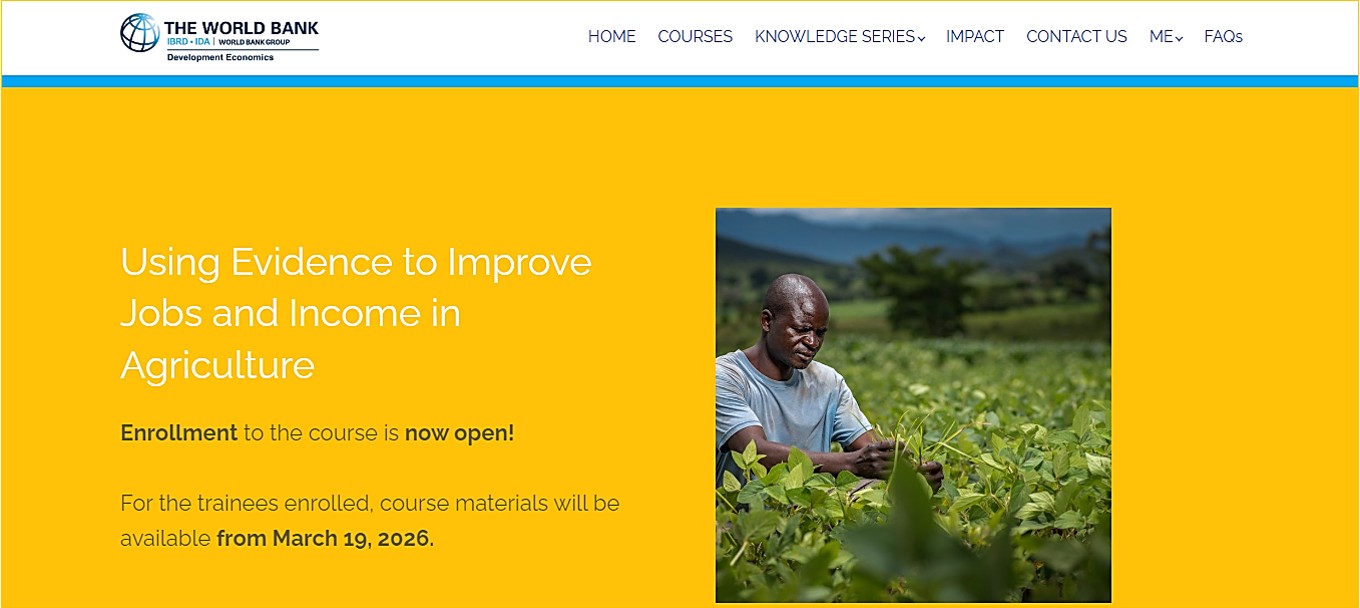
Certification: Yes, free Certificate upon completion Course
Why This Course Matters
Agriculture today faces a dual challenge: improving rural livelihoods while responding to the growing threats of climate change, resource degradation and environmental stress. Although governments and development agencies invest substantially in agricultural programmes, many interventions fail to achieve their intended outcomes because they are designed without systematically incorporating evidence on what works, for whom, and under what conditions. Using Evidence to Improve Jobs and Income in Agriculture addresses this challenge by introducing participants to an evidence-based framework for designing agricultural policies and development programmes.
I enrolled in this course to strengthen my understanding of how rigorous research can inform agricultural extension, technology dissemination, and rural development planning. As a doctoral researcher in Agricultural Extension Education, I found the course particularly valuable because it demonstrates how empirical evidence can be translated into practical operational decisions. Rather than prescribing universal solutions, the course encourages learners to critically evaluate interventions and adapt them to diverse local contexts.
Learning Experience and Course Design
The course primarily follows an asynchronous e-learning model, complemented by discussion forums and peer-learning opportunities that encourage interaction among participants. It is well suited for learners with beginner to intermediate knowledge of agricultural development, including extension professionals, policymakers, development practitioners, researchers, and postgraduate students.
Structured into seven well-sequenced modules namely,
- Welcome and Introduction
- Agricultural Extension and Knowledge Diffusion
- Input subsidies and Smart Support
- Irrigation, Infrastructure, and Complementary Services
- Climate Resilience and Shock-Responsive Support
- Markets and Value Chains
- Conclusion
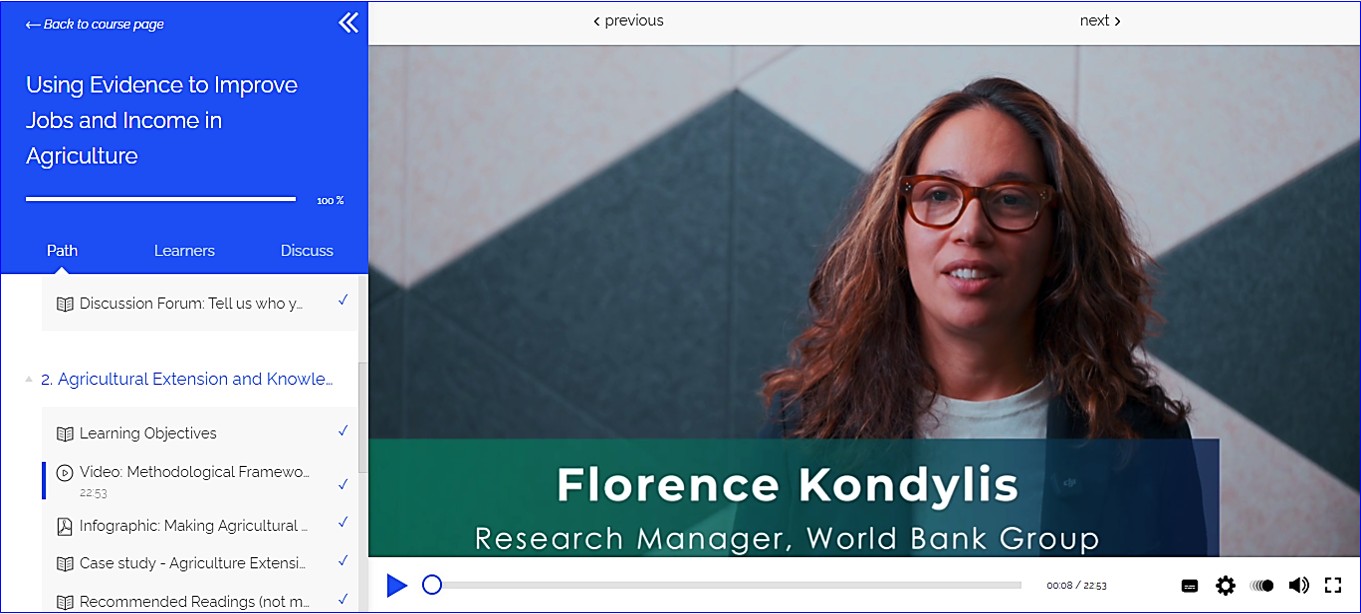
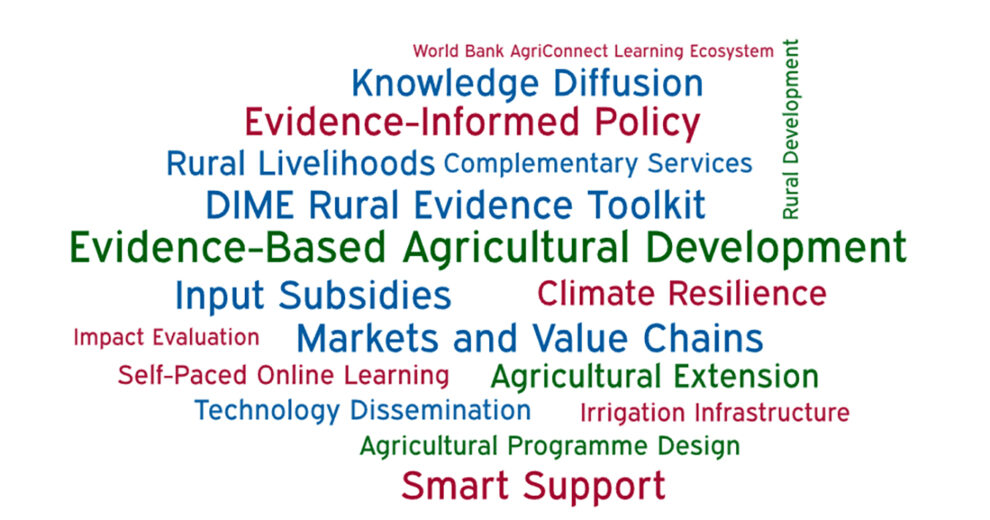
The course requires approximately three hours to complete. Each module begins with clearly defined learning objectives and combines concise expert-led video lectures with visually engaging infographics, real-world case studies, supporting readings, self-reflection activities, and knowledge assessments. The progression of topics—from agricultural extension and knowledge diffusion to input subsidy programmes, irrigation and complementary services, climate resilience, and markets and value chains—allows participants to appreciate how different interventions interact to improve agricultural productivity and rural livelihoods.
One of the course’s greatest strengths is its ability to transform complex research findings into practical lessons. Instead of overwhelming participants with theoretical discussions, each module focuses on operational decisions that practitioners regularly encounter while designing or implementing agricultural development programmes.
Assessment and Certification
The assessment strategy is thoughtfully designed to promote active learning rather than simple course completion. At the end of every module, participants must complete a mandatory knowledge-check quiz before progressing further. Each quiz requires a minimum passing score of 75%, while allowing unlimited attempts, encouraging learners to revisit the material until they fully understand the concepts.
After completing all seven modules, participants must undertake a mandatory post-course assessment to qualify for the Certificate of Completion. The final assessment also requires a minimum score of 75%, but only three attempts are permitted, making it a more rigorous evaluation of the knowledge gained throughout the course. Since the course is offered free of charge and can be completed at one’s own pace, it remains highly accessible to students and professionals with demanding schedules.
Evidence at the Core: The DIME Rural Evidence Toolkit
The defining feature of this course is its foundation in the DIME Rural Evidence Toolkit, developed by the World Bank Group Institute for Economic Development. Rather than functioning as a repository of research findings, the toolkit synthesises evidence from rigorous impact evaluations into practical guidance for designing rural development programmes with greater effectiveness and higher returns on investment.
The course demonstrates how global evidence can be translated into actionable design principles across key intervention areas such as agricultural extension, input subsidies, irrigation, climate resilience, and value chain development. Importantly, it emphasises that successful interventions should not simply replicate practices that have worked elsewhere. Instead, practitioners are encouraged to diagnose local constraints, identify complementary interventions, and adapt proven approaches to specific institutional, economic, and environmental contexts. This emphasis on contextual adaptation distinguishes the course from many conventional online agricultural training programmes.
Perhaps the most important insight I gained was that agricultural extension should no longer be viewed merely as a technology transfer mechanism. Rather, it should function as one component within a broader evidence-informed system where advisory services, complementary investments, market access, and climate resilience collectively determine development outcomes.
Quality of Learning Resources
The overall quality of the learning materials is excellent. The lectures are concise, logically organised, and delivered in a manner that is both accessible and intellectually stimulating. The accompanying infographics effectively simplify complex concepts, while the case studies successfully connect research evidence with practical implementation challenges. Recommended readings offer opportunities for deeper exploration, and the quizzes are appropriately aligned with the learning objectives, reinforcing conceptual understanding rather than rote memorisation.
The instructors and core team: Florence Kondylis (Research Manager); Paul Christian (Senior Economist); Dahyeon Jeong (Economist); Benedetta Lerva (Economist); John Loeser (Economist); Astrid Maria Theresia Zwager (Research Program Coordinator); Roshni Khincha (Research Officer) adopted a clear and evidence-oriented teaching style. Rather than advocating one-size-fits-all solutions, they consistently encourage learners to think critically about why certain interventions succeed, under what circumstances they are most effective, and how evidence should inform context-specific decision-making. This balanced and analytical approach makes the course particularly valuable for professionals involved in agricultural programme design and policy implementation.
Personal Reflections
The course was both engaging and intellectually rewarding. As someone working in Agricultural Extension Education, I particularly appreciated the module on agricultural extension and knowledge diffusion, which challenged the traditional perception of extension as an isolated advisory service. The course convincingly demonstrates that extension becomes significantly more effective when integrated with complementary investments such as irrigation, market access, input support, and climate-resilient practices.
Final Thoughts
Using Evidence to Improve Jobs and Income in Agriculture is much more than a short online certification course—it is a practical introduction to evidence-informed agricultural programme design. Despite its relatively brief duration, it provides a comprehensive framework for understanding how research evidence can guide better decisions in agricultural extension, rural development, and public policy.
I would highly recommend this course to agricultural extension professionals, postgraduate students, researchers, development practitioners, and policymakers seeking to strengthen their evidence-based decision-making skills. At a time when agricultural development demands greater accountability, efficiency, and measurable impact, this course provides a valuable roadmap for designing interventions that are scientifically informed, responsive to local realities, and ultimately more capable of improving farmers’ livelihoods.
 Mohamed Aseemudheen M is currently pursuing Ph.D. in Agricultural Extension Education at Tamil Nadu Agricultural University, Coimbatore. He can be reached at aseem1264@gmail.com.

Add Comment