

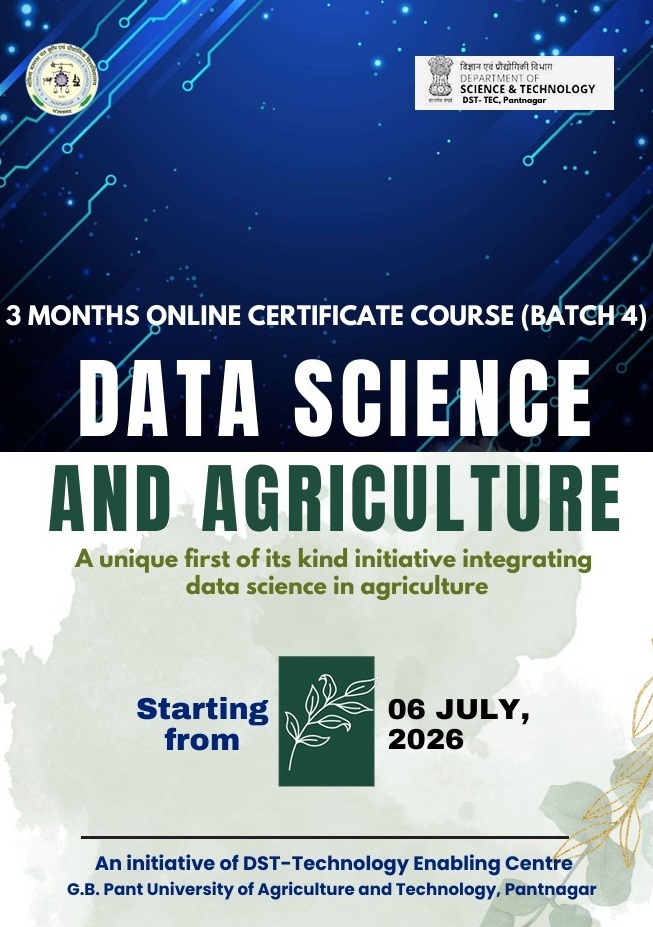
Platform: DST-Technology Enabling Centre (TEC)
G. B. Pant University of Agriculture & Technology, Pantnagar
Duration: 3 Months (July-October)
Certification: Yes, upon payment of the registration fee of ₹5,000
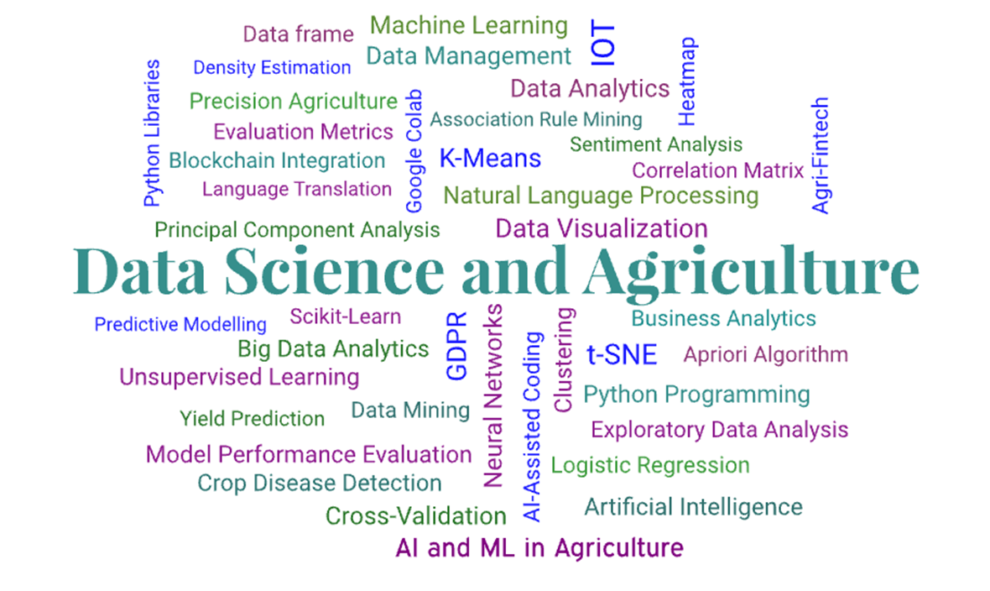
As researchers in Agricultural and Allied Extension, our experience of working with primary and secondary agricultural datasets highlighted the need to develop competencies in modern data analysis and visualisation tools, while the growing demand for data analytics skills across research and agri-tech sectors motivated us to enrol in the three-month Data Science and Agriculture certificate course. The programme systematically progressed from foundational to intermediate concepts, covering Python programming, data management, visualisation, regression, clustering, predictive modelling, machine learning, artificial intelligence, evaluation metrics, and IoT-enabled agricultural applications through a blended online format comprising live sessions on Google Meet and Zoom, hands-on coding exercises, quizzes, assignments, projects, case studies, peer reviews, and expert lectures.
Despite being conducted entirely online, the course provided a highly interactive, classroom-like learning experience, facilitated by the DST-Technology Enabling Centre at GBPUAT, which ensured continuous communication and active participation through a WhatsApp group. The modules were systematically organised, beginning with conceptual explanations and progressing to hands-on applications using Python and Google Colab, enabling participants to code, interpret outputs, and analyse agricultural datasets. Assignments and quizzes were moderately challenging and reinforced the concepts, while occasional programming exercises encouraged critical thinking. Whenever participants encountered difficulties, data science experts Mr Bohitesh Misra (CTO & Co-founder, Avexa Systems Pvt. Ltd.) and Mr Gaurav Pant (Microsoft Certified Trainer, ACTECAL) patiently revisited the concepts. They explained the solutions step by step, ensuring a clear understanding of the underlying principles.
Assessment comprised attendance, assignments, quizzes, project work, peer reviews, and a final examination. A minimum attendance of 85% was mandatory for successful course completion and eligibility for certification. Participants were graded based on their overall performance, with the following grading scheme: A+ (>90%), A (80–90%), B+ (70–80%), B (60–70%), and Satisfactory (<60%). Participants with unsatisfactory performance were provided an opportunity to resubmit assignments and project work for reassessment. Successful participants received a course completion certificate. The final examination was entirely practical, requiring participants to develop Python scripts for data analysis and submit the completed notebook with detailed explanations of the code. In addition, we had to submit a Word document describing the analytical process, interpreting the results, and explaining the methodology used throughout the analysis. Although we had no formal background in computer science or large-scale data analytics, the learner-friendly assessment design, combined with the instructors’ patient guidance and supportive teaching approach, made the course approachable and enabled us to complete all assessment components. They revisited complex concepts as needed, held extended sessions, and remained available after class to clarify doubts, ensuring participants developed a strong conceptual understanding. The learning experience was further enriched by expert lectures and case studies from professionals representing ISRO, IIRS, IITs, academia, and industry, such as Dr Goldi Tewari, who offered valuable insights into the practical applications of data science in agriculture and allied sectors.
Among all the modules, we found data visualisation particularly engaging, as learning to create insightful visualisations and leverage AI-assisted coding through platforms such as Google Colab significantly accelerated our learning. The course demonstrated that, with appropriate guidance and modern AI tools, programming and data analytics are accessible even to researchers without an engineering background. The knowledge and practical skills gained through this course strengthened our ability to work in interdisciplinary research. They reinforced the growing importance of data science for agricultural, veterinary, and extension professionals in the era of digital agriculture and artificial intelligence. One suggestion for improvement would be to provide secure access to recorded lectures, allowing participants to revisit complex concepts and reinforce their learning after the course.
Overall, we recommend this course to students, researchers, faculty members, and extension professionals seeking practical, interdisciplinary training to enhance their research capabilities and career prospects.
 Dr R. S. Ghasura is an Associate Professor and Head at the Pashu Vigyan Kendra, Limkheda, College of Veterinary Science & Animal Husbandry, Kamdhenu University, Anand. He was part of Batch 3 of the Data Science and Agriculture course. His work focuses on teaching, farmer training, capacity-building programmes, and field demonstrations for livestock development. He can be contacted at rghasura21@kamdhenuuni.edu.in.
 Basu Anand is a Research Assistant in an ICSSR-funded project at SART, IIT Guwahati, an AESA Volunteer, and a SAGE Senior Ambassador 2025. He was part of Batch 2 of the Data Science and Agriculture course. He is actively engaged in research and technical report writing. He actively participates in academic outreach and volunteer initiatives. He can be contacted at basuanand.edu@gmail.com
Add Comment