

Drawing on research from India’s Northern Himalayan region, Trent Brown, Devesh Thakur, and Manoj Sharma explore how extensionists act as “mediators” within agri-skill ecosystems and what can be done to strengthen this vital role.
CONTEXT
Agricultural extension helps farmers build skills and, crucially, put skills into practice. Yet farmers do not acquire skills through training programmes alone; they acquire them gradually, through experience and interactions with family, community, and institutions. What role can extensionists play in helping farmers navigate this skill ecosystem? In a paper we published earlier, based on research in India’s Northern Himalayan region, we argued that extensionists can be understood as ‘mediators’ of agri-skill ecosystems.
In this blog, we summarise the research findings and, drawing also on the professional experience of Thakur and Sharma as practising extensionists, offer policy recommendations to strengthen this mediation role. Our study focused on the mediating role of extensionists in State Agricultural Universities (SAUs) and Krishi Vigyan Kendras (KVKs). Further research is needed to explore mediation by other categories of agricultural extensionists – including line department officials.
SOCIAL ECOSYSTEMS MODEL?
The social ecosystems model (SEM) was developed by Ken Spours and colleagues in the United Kingdom and later expanded by researchers in South Africa. The model recognises the importance of interconnections between the worlds of living, learning, and working, and provides tools for analysing how skills are formed across these settings. One of these tools is the distinction between ‘horizontalities’ and ‘verticalities.’ Horizontalities refer to community-level relationships that support skill formation and give skills a (cultural) sense of meaning and purpose. Verticalities are supports that come from government and other top-down institutions, such as subsidies, services, loans, and training programmes.
This distinction matters in the Indian context, where agricultural skills are usually developed in family and community settings (horizontal supports) but also depend on assistance from government, banks, NGOs, and other institutions (vertical supports).
A key insight of the SEM is how horizontalities and verticalities connect. In agricultural extension, this relates to two key questions: how do rural communities learn about available institutional support, and how do institutions learn about the challenges farmers face in using new skills? To address such questions, Spours and colleagues offer the concept of ‘mediation.’
MEDIATION?
In the SEM, mediation refers to the process of bridging community life and institutional support. It adds dynamism to the model by encouraging the identification of actors who occupy strategic positions between formal institutions and the everyday contexts where skills are applied. A good mediator helps practitioners learn about opportunities from government and other institutions and helps institutional actors understand conditions on the ground.
Previous research using the SEM identified vocational education providers as key skill ecosystem mediators. In agriculture, extensionists can be seen as mediators because they connect government policy, funding, and agricultural science with the local realities of rural communities.
WHAT MEDIATION WORK DO EXTENSIONISTS DO?
Our research found that extensionists in the SAU/KVK system already perform many mediation activities, often informally. In many cases, these activities were not part of formal job descriptions but extra work that extensionists saw as necessary to make training useful in farmers’ fields and everyday lives.
We identified two types of mediation:
Institutional mediation: Connecting farmers to institutional support. This includes explaining government schemes, subsidies, bank loans, NGO support, etc.; linking farmers to these institutions; and helping them complete forms or apply through government portals. These activities help farmers access the training and/or financial support they need to put their skills to productive use.
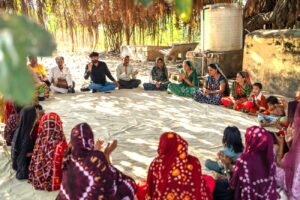
Social mediation: Helping farmers to overcome social barriers to learning and using skills. These obstacles include family- or community-based restrictions shaped by gender or caste, such as household rules that prevent women from selling food products in markets. Other obstacles may include socio-cultural aversions to certain types of agricultural technologies (whether based on religious/cultural beliefs or simply prejudice). Extensionists may persuade or negotiate with family and community members to relax these restrictions, and they may also create platforms for role models who use empowering skills in unconventional ways.
Our research found that institutional mediation was common, while social mediation was relatively rare and sometimes met with ambivalence. Social mediation varied widely across the study group.
ARE AGRICULTURAL EXTENSIONISTS EFFECTIVE MEDIATORS?
Extensionists play a wide range of roles that help farmers not only learn skills but also use them by connecting them to services, institutional support, and, in some cases, helping them overcome social barriers.
However, we also identified several barriers that limit their ability to mediate effectively. These included:
- Lack of time to engage in mediation due to chronic understaffing in SAUs and KVKs.
- Many extensionists within the SAU and KVK system lack up-to-date knowledge of support schemes and eligibility criteria.
- Some extensionists were unaware of social barriers, dismissed them, or lacked the skills to address them.
Moreover, mediation work is often not recognised or rewarded (explicitly or implicitly) in career advancement, reducing extensionists’ incentives to engage in such activities.

WHO ELSE MEDIATES?
Although the SEM assumes actors with a formal mandate carry out mediation, extensionists in our study also identified many other actors who play mediation roles. Possible mediators include:
- Government officials from the Departments of Agriculture, Horticulture, and Animal
- Progressive or experienced farmers.
- Farmer groups and cooperatives.
- NGO’s
- Banks and financial institutions.
- Agricultural input dealers (who sell seeds, fertilisers, pesticides, etc.).
- Local leaders and community members.
While these actors may connect farmers to support or reduce social barriers, it is not always clear whether they are well placed to mediate effectively. Some actors, such as input vendors or private firms, have commercial interests that may shape their advice, while others may hold biased views on social issues. It is also unclear how these actors work together—whether their efforts are complementary, competitive, or out of sync. Often, their work lacks coherence, and actors work in parallel without synergy.
WAY FORWARD
Our research showed that extensionists working in SAUs and KVKs already do important mediation work, but there is much potential to bolster their role as mediators in general and social mediators in particular. Based on our research and professional experience, we would like to offer the following recommendations, especially to the Indian Council for Agricultural Research (ICAR), as the key decision-making body governing the training, employment and regulation of SAU/KVK agricultural extension. Other government departments dealing with other categories of extensionists may consider undertaking similar initiatives.
1. Chronic understaffing, especially in KVKs, should be addressed. Extensionists already carry out mediation work that is critical to the success of training programmes – but our research suggested understaffing is reducing their effectiveness. With limited staff to share the workload, extensionists spend their time on training and reporting/compliance, leaving little time for community-based mediation.
2. Strengthen social mediation by involving social scientists in the extension team. Many extensionists are either unaware of social mediation, dismiss its importance, or feel unprepared to do it. At the same time, rural sociology programmes at agricultural universities, which could be a vital source of information on how social factors shape extension programme outcomes, are in decline.
This suggests the following course of action:
(a) Include modules that explicitly attend to social conditions in both pre-service and in-service extension training. This should include a focus on gender and caste relations that shape agri-skill development and utilisation; how religious and other cultural beliefs can influence extension programme outcomes; and strategies for navigating complex social environments.
(b) Revitalise rural sociology (and/or other social science) programmes at SAUs and bring them into closer dialogue with other experts when extension programmes are designed; and
(c) Employ social scientists (beyond agricultural extensionists to include rural sociologists, social workers, human geographers, etc.) as part of the extension teams at KVKs. Begin with a pilot phase and expand the model if it proves effective.
3. Map ‘mediator ecologies’ more systematically. Extensionists work alongside many other mediators such as NGOs, agri-chemical retailers, and various government departments. More research is needed to identify unreliable mediators, duplication of effort, opportunities for coordination, and conflicting roles that need to be resolved.
4. Recognise mediation work formally. To raise the status of extension work, a national ‘Community Champion’ award or similar could recognise extensionists who go beyond training delivery to ensure real impact. Short documentaries could highlight their work and help make them role models. Further, mediation work may be credited in career advancement and appraisal scoring for extension scientists and included in KVK reporting formats, making the work visible and legitimate.
5. Strengthen knowledge of institutional support systems. Some extensionists in our study said they are not up to date on current government, bank, or NGO schemes available in their regions. National scheme portals exist; what is missing is regular updating with eligibility details, the inclusion of non-government schemes alongside government ones and regional filters.
 Dr. Trent Brown is Associate Professor at Tokyo College at the University of Tokyo, where he leads the Sustainability and Society Collaborative Project and (with Balawansuk Lynrah) the Rethinking Skills Collaborative Project. He is the author of Farmers, Subalterns, and Activists: Social Politics of Sustainable Agriculture in India (Cambridge University Press, 2018) and (with John Harriss and Craig Jeffrey), India: Continuity and Change in the Twenty-First Century (Polity Press, 2020). He can be reached at trent.brown@tc.u-tokyo.ac.jp
 Dr. Devesh Thakur is an Assistant Professor of Veterinary and Animal Husbandry Extension Education at DGCN College of Veterinary and Animal Sciences, CSK Himachal Pradesh Krishi Vishvavidyalaya (CSKHPKV) Palampur, India. An alumnus of ICAR-Indian Veterinary Research Institute, Izatnagar (MVSc, PhD), he has over 18 years of experience in teaching, research, and extension. He has authored nine books and developed two MOOC courses. His interests include livestock advisory systems, the socio-economics of Himalayan livestock farming, gender dynamics in animal husbandry, and communication skills for extension professionals. He can be reached at drdth4@gmail.com
 Dr. Manoj Sharma, is an Assistant Professor at Department of Veterinary & Animal Husbandry Extension Education, CSK Himachal Pradesh Krishi Vishvavidyalaya (CSKHPKV) Palampur -176062 (HP), India. He can be reached at manojsharma2808@gmail.com
Add Comment