




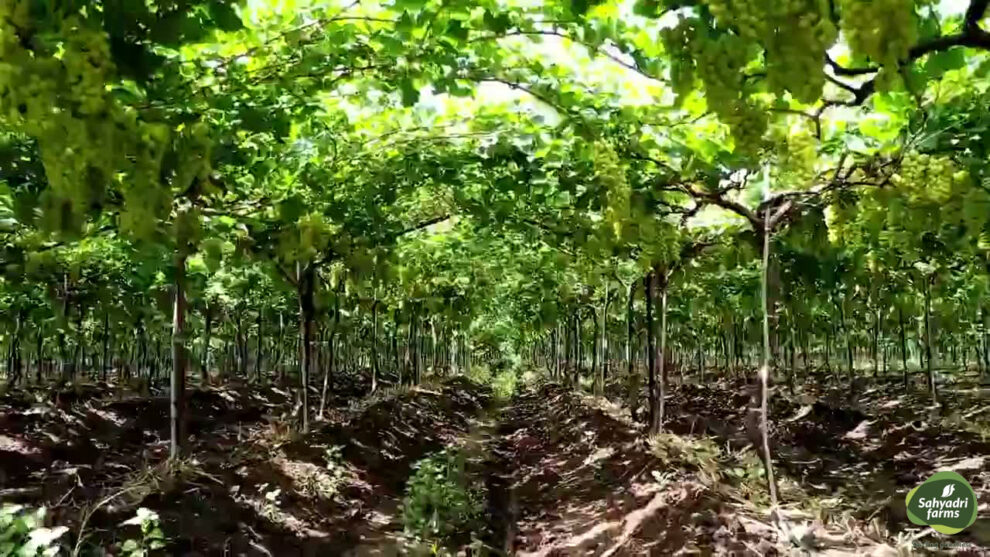
In this Good Practice Note, Fawaz and Kowshika draw on the experience of Sahyadri Farms to illustrate how Farmer Producer Organisations can play a vital role in enhancing climate resilience.
CONTEXT
Sahyadri Farms is one of India’s most innovative and impactful farmer-owned agricultural enterprises, established on the principle of collective ownership. It was established in 2010 and has evolved into a fully integrated horticulture platform that manages everything from soil health and seed selection to post-harvest processing and international export logistics. Sahyadri Farms brings together over 30,000 affiliated farmers, including 21,500 equity shareholders, creating a unique model that effectively combines cooperative values with corporate efficiency. It has built a model that is simultaneously farmer-empowering, commercially viable, and deeply climate-conscious, positioning it as a benchmark for sustainable agriculture in emerging markets.
Their approach is highly relevant today due to the escalating climate pressures on agriculture. Extreme weather events such as heavy rainfall, droughts, hailstorms, heat waves, erratic monsoon, and extended drought periods disproportionately affect smallholder farmers. Their approach to these threats is not reactive but through a deeply embedded climate resilience framework that spans every aspect of its operations.
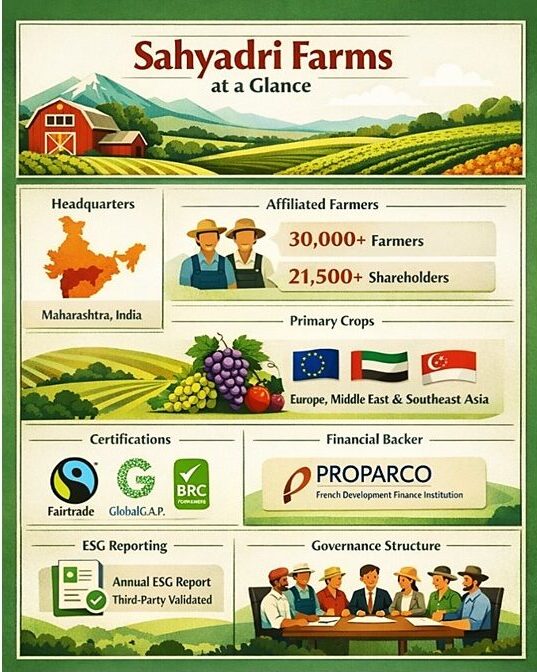 Organisational Structure of Sahyadri Farms
Sahyadri Farms operates through two primary legal entities:
- Sahyadri Farms Post Harvest Care Limited: handles processing, storage, and exports
- Sahyadri Farmers Producer Company Limited: represents farmer-shareholders and manages agricultural inputs, advisory, and production
Together, these entities form a seamlessly integrated cooperative-corporate hybrid, with institutional investors and farmer representatives sitting on the same boards. This governance model ensures that climate and sustainability commitments are not just aspirational statements but are embedded in investment decisions and operational priorities (https://www.sahyadrifarms.com/).
GOOD PRACTICES
Business and Finance Model
a. The Integrated Value Chain
What makes Sahyadri Farms distinct is the end-to-end ownership of its value chain. Most farmer cooperatives focus on either production or marketing, whereas Sahyadri controls everything, ranging from production to marketing.
- Pre-harvest: Soil testing, certified nurseries, bio-input supply, irrigation systems, satellite-based crop advisories
- Harvest: Standardised harvesting protocols, quality controls, traceability from farm to packing house
- Post-harvest: Solar-powered cold storage, micro-processing units, extraction facilities, packaging, waste reduction via circular economy initiatives
- Market Access: Exports with FairTrade, A.P. and British Retail Consortium (BRC Certification: Pyramid Certifications), ensuring premium pricing
b. Green Finance Integration
By directly linking its financial products to environmental and climatic performance, Sahyadri has pioneered what it calls “Green Finance.” This includes:
- Access to concessional loans tied to Environmental, Social, and Governance (ESG) benchmarks
- Carbon credit development in collaboration with PricewaterhouseCoopers (PwC) for carbon analysis
- Risk-linked insurance products co-developed with Axa Climate
- Fairtrade premium reinvestment into farmer welfare and environmental programs
Proparco’s backing adds a strategic layer of development finance, enabling long-term investments in infrastructure and climate adaptation that purely commercial lenders might shy away from.
c. Governance for Sustainability
Both boards of Sahyadri Farms include institutional investors and farmer-elected representatives. This structure creates an accountability loop, in which farmer-shareholders have voting rights over decisions that affect their land and livelihoods, while institutional investors demand transparent ESG performance. Moreover, environmental impact assessments are a routine part of capital allocation decisions.
Strategic Partnerships
Sahyadri Farms has assembled a world-class ecosystem of partners, each contributing a distinct dimension of climate and commercial capability:
| Partner | Area of Collaboration |
| Hindustan Unilever Foundation | Soil regeneration programs and sustainable water management |
| EnviroAlgae | Microbiology-based soil processing and bio-inputs |
| Axa Climate | Climate risk assessments and insurance product design |
| PwC | Carbon footprint analysis and carbon credit development |
| GIZ | Agro-photovoltaic systems and renewable energy integration |
| Fairtrade | Certification, premium pricing, and supply chain traceability |
| GlobalGAP | Good agricultural practices and food safety certification |
| BRC | Retail-grade quality and traceability standards for export |
| Proparco | Development finance for long-term climate and infrastructure investment |
Climate Resilience – A Strategic Priority
Maharashtra is one of India’s most agriculturally diverse yet climate-vulnerable states. The region faces recurrent droughts (the Marathwada sub-region is among the most drought-prone in Asia), unpredictable monsoon patterns, heat stress on crops, and soil degradation. Therefore, Sahyadri Farms has made “climate resilience its strategic priority.”
a. Climate Risks Facing the Business
Sahyadri Farms has formally identified and systematically addressed the following climate risks:
| Climate Risk | Business Impact & Response |
| Erratic monsoon/drought | Reduced irrigation water availability; addressed through water-efficient drip irrigation and aquifer management |
| Heat stress on grapevines | Yield and quality losses are mitigated by selecting resilient crop varieties and using shading technologies. |
| Pest and disease pressure | Intensified by warming, managed through Integrated Pest Management (IPM) and bio-inputs |
| Soil degradation | Reduced fertility and water retention; addressed through soil testing, organic inputs, and regeneration partnerships |
| Supply chain disruption | Post-harvest losses from temperature excursions are mitigated by solar cold storage infrastructure. |
| Price volatility | Climate shocks drive commodity price swings, buffered through export diversification and Fairtrade premiums. |
b. Resilience Through Agronomic Practices
Sahyadri approaches climate variability as a systemic risk, building resilience through a foundation of ecological health and high-tech intervention. The toolkit integrates soil health, resilient crops, precision irrigation, and satellite-based intelligence to transform agriculture into a proactive, adaptive system.
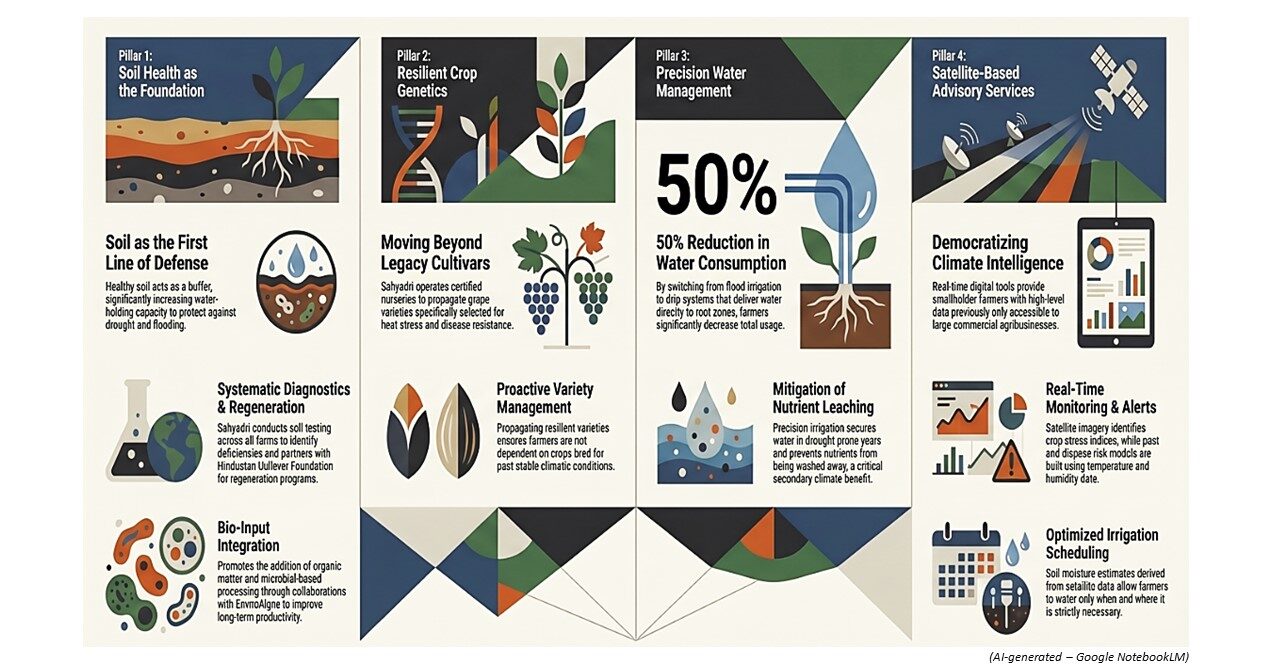 Climate Resilience through Agronomic Practises
c. Infrastructure for Climate Resilience
- Solar Energy for Cold Chain: Sahyadri Farms has installed solar power plants at its post-harvest facilities, ensuring uninterrupted cold chain operations regardless of grid reliability. This also decarbonises the energy-intensive cold storage and processing operations.
- Agro-Photovoltaics with GIZ: In partnership with GIZ (the German development agency), Sahyadri Farms is exploring agro-photovoltaic systems and dual-use installations where solar panels are mounted above crops. This innovative approach reduces evapotranspiration from crops by providing partial shading and improves water-use efficiency in the microclimate beneath panels.
- Micro-Processing Units: By placing micro-processing infrastructure closer to farm clusters, the time between harvest and processing is reduced to avoid quality degradation.
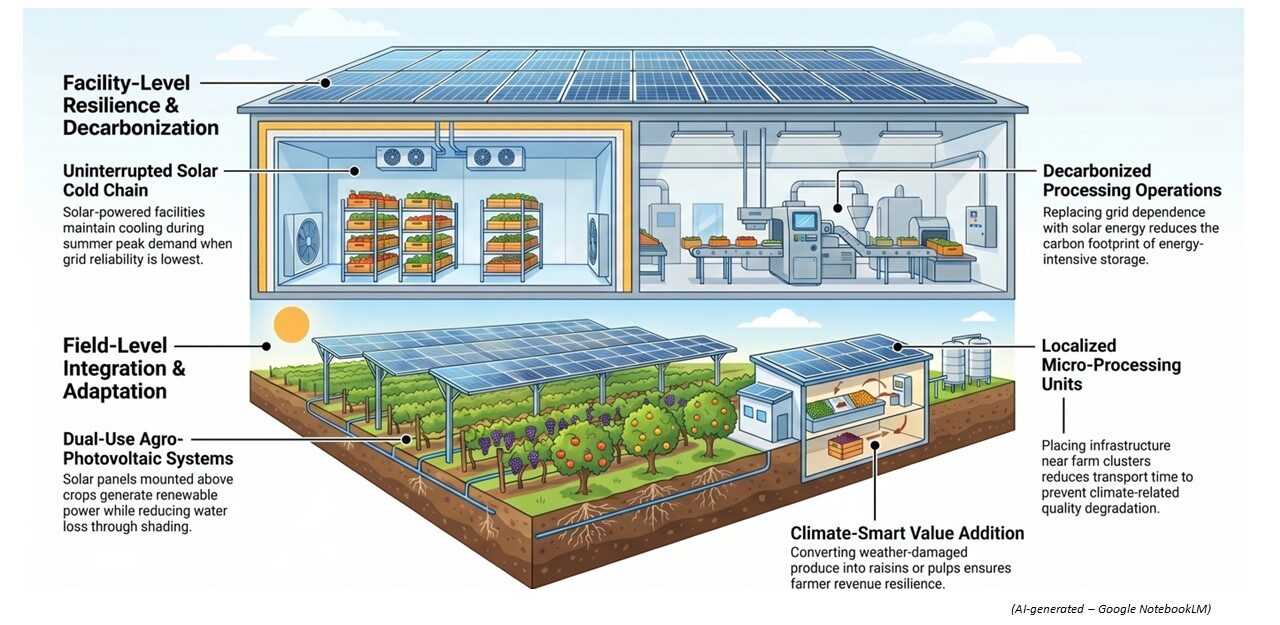 Sahyadri Farms’ Infrastructure Model
Financial Instruments for Climate Risk Management
a. Climate Risk Assessments with Axa Climate
Sahyadri Farms has engaged AXA Climate to conduct structured climate risk assessments across its operations and farmer network. These assessments quantify:
- Farm-level exposure to specific climate hazards (drought intensity, flood probability, heat index projections)
- Estimated financial losses under various climate scenarios
- Prioritisation of adaptation investments by risk-adjusted return
This data directly informs capital allocation decisions, ensuring that climate risk is treated as a financial risk and not just an environmental externality.
b. Carbon Analysis with PwC
Sahyadri has partnered with PwC to conduct rigorous carbon accounting across its value chain. This generates verified carbon credits from sequestration activities such as soil carbon improvement and agroforestry. Further, carbon credits can provide supplemental income to farmer-shareholders, directly linking climate action to farmer financial well-being.
Climate Measurement, Reporting & Verification
Sahyadri measures its climate and sustainability performance through a multi-layered system:
- Dedicated ESG team overseeing climate data collection and analysis
- Integrated Management System (IMS) Policy establishing organisational standards
- Digital sustainability dashboards tracking key metrics in real-time
- Annual ESG Report with third-party verification for credibility and transparency
This reporting infrastructure is not merely a compliance exercise; rather, it enables management to track progress, identify gaps, and redirect resources toward the highest-impact climate interventions. It also provides the transparency that institutional funders like Proparco require to continue deploying development capital.
SOCIAL IMPACT & FARMER EMPOWERMENT
a. Smallholder Inclusion
Sahyadri Farms’ impact extends beyond its 21,500 shareholders to encompass over 50,000 smallholder farmers across Maharashtra. The company’s services, namely, soil testing, nursery access, irrigation guidance, and market linkages, are made available to affiliated farmers regardless of equity ownership, democratizing access to climate-smart technologies.
b. Economic Resilience for Farmers
Climate-resilient agriculture is only meaningful if it translates into sustained or improved farmer incomes. Sahyadri Farms achieves this through:
- Reduction in input costs through group purchasing of bio-inputs and seeds, complemented by a 25% yield improvement from precision agronomic support.
- Minimised post-harvest losses via solar-powered cold chain, which is very essential in countries like India because 8.1% of fruits and 7.3% of vegetables are lost at the post-harvest stage annually. However, Sahyadri’s integrated cold storage directly balances this loss.
- Carbon credit revenue from PwC-verified soil sequestration activities passed directly to farmer shareholders, linking climate action to financial reward (an emerging income stream as Sahyadri builds toward its net-zero target)
c. Gender and Social Equity
While not always foregrounded in financial reporting, Sahyadri Farms’ cooperative structure ensures that governance benefits extend to women farmers and smallholders who might otherwise be excluded from commercial value chains. Fairtrade certification requirements around labour standards and fair wages also support broader social equity outcomes.
ECONOMIC IMPACT & FARMER EMPOWERMENT
a. Price and Yield Gains
Sahyadri farmers earn an average of ₹67/kg for their grapes, compared to ₹35/kg at wholesale mandis, and yields have improved by 25% through the company’s agronomic support. In essence, there is a simultaneous yield multiplier and a price premium of around 92%.
b. Income shares from exports
Sahyadri’s organised value chain model raises farmers’ incomes to 55% of the Free on Board (FOB) export price, far above what unorganised smallholders typically receive.
c. Revenue scale
The company reached a turnover of ₹1,954.7 crore in the FY25 (financial year 2025), growing at a 26% CAGR (Compound Annual Growth Rate) since inception in 2010, with 30,000 small and marginal farmers holding 100% equity. The ₹1,000 crore milestone in FY23 also created approximately 1,300 full-time jobs and 4,000 seasonal jobs.
CHALLENGES AND AREAS FOR CONTINUED DEVELOPMENT
a. Scaling Climate Intelligence
Satellite advisories and digital tools are powerful but require consistent connectivity and digital literacy across a dispersed network of farmers. Continuous investment in training and infrastructure is needed to ensure these tools reach all 30,000+ affiliated farmers effectively.
b. Water Table Depletion
Even with drip irrigation, the aggregate water demand of horticulture in water-stressed Maharashtra poses long-term sustainability questions. Future climate scenarios project further reduction in groundwater recharge. Sahyadri Farms will need to continue investing in water harvesting, aquifer recharge, and potentially crop diversification away from water-intensive varieties.
c. Carbon Market Volatility
While carbon credits offer an exciting revenue stream, voluntary carbon markets have seen significant price volatility and credibility concerns. Therefore, Sahyadri’s climate finance model should not become overly dependent on carbon revenues that may fluctuate unpredictably.
d. Climate Change Trajectory
Even the best adaptation measures face limits if global temperatures continue rising on current trajectories. The long-term viability of grape cultivation in certain Maharashtra micro-regions may come under question under high warming scenarios, necessitating ongoing scenario planning and potential geographic or crop diversification over the coming decades.
FINALLY, IS SAHYADRI FARM A MODEL FOR CLIMATE-SMART AGRICULTURE?
Yes, Sahyadri Farms represents a rare convergence of farmer ownership, commercial discipline, and genuine ecological commitment. Its model is not anchored in any single innovation but in the systematic layering of soil science, precision irrigation, renewable energy, satellite-based advisory, international certification, and development. With a turnover growing at 26% CAGR to reach ₹1,955 crore in FY25, and over 30,000 farmers retaining 100% equity, it demonstrates that climate resilience and commercial viability can be structurally aligned, not traded off.
- Sustainability of the model
Sahyadri’s long-term sustainability rests on three reinforcing pillars. First, farmer equity ownership creates alignment of incentives, where shareholders have a direct stake in maintaining the organisation’s quality standards and ESG commitments. Second, its diversified revenue base (fresh exports, processed products, domestic FMCG, and emerging carbon credits) reduces dependence on any single commodity or market. Third, its development finance relationships with Proparco and FMO create an accountability loop that embeds sustainability into capital allocation decisions. However, risks remain: voluntary carbon markets are volatile, groundwater depletion in Maharashtra poses a structural water-security threat, and the model’s long-term viability in a high-warming scenario may require crop diversification beyond grapes in certain micro-regions.
- Scalability and replication
Sahyadri is already extending its model beyond Nashik, mentoring 200 FPOs across India, signing an MoU with Karnataka’s Centre of Excellence for FPOs to support 1,460 FPOs across the state, and hosting exposure visits by Odisha’s horticulture FPOs to explore replication in crops such as pineapple, citrus, and banana. This horizontal spread signal institutional confidence in the model’s portability. Yet full replication is non-trivial. Most Indian FPOs remain financially weak and managerially thin. The NAAS 2026 policy paper identifies limited institutional credit, weak governance, and poor digital infrastructure as systemic barriers that Sahyadri itself took over a decade and significant external capital to overcome.
- Prerequisites for replication
For other FPOs or regions to replicate the Sahyadri approach, three conditions appear foundational:
- A critical mass of aggregated farmers to achieve economies of scale in inputs, logistics, and market negotiation
- Visionary, professionally trained leadership willing to operate a cooperative with corporate-grade discipline
- Access to impact-oriented capital because commercial lenders are unlikely to fund the long gestation periods that climate-smart infrastructure requires
- Proximity to export-viable crops with international certification pathways (Fairtrade, GlobalGAP, BRC).
Overall, a supportive policy environment that enables land-use for dual-purpose installations such as agro-photovoltaics and facilitates FPO access to carbon markets.
Future Goals
Looking ahead, Sahyadri is well-positioned to expand its climate leadership in several directions:
- Deepening agro-photovoltaic deployments across the farmer network
- Scaling verified carbon sequestration programs and carbon credit revenues
- Extending satellite advisory coverage to new districts and crops
- Developing climate-linked financial products for wider smallholder access
- Building on Proparco’s backing to attract additional development and impact finance
 Fawaz Parapurath is a PhD scholar in Agricultural Meteorology at Tamil Nadu Agricultural University, Coimbatore, and a Senior Research Fellow on an industry-funded project supported by Netafim Irrigation India Pvt. Ltd. He has over five years of research experience in Agricultural Meteorology, Climate Change, and Geospatial applications. He also serves as Assistant Editor of SABUJEEMA Agri Newsletter and a Reviewer for Science Publishing Group. He can be reached at faazzz96here@gmail.com
 Dr N. Kowshika is an accomplished Agrometeorology professional with over 5 years of hands-on experience in climate science, weather forecasting, and agricultural advisory services. She can be reached at kowshirajanagmet@gmail.com

Add Comment