


Mahesh Chander attended the Brainstorming Session on “Future of Next Generation Small Farms: Ensuring Profitability and Viability”, organised by the National Academy of Agricultural Sciences (NAAS), New Delhi, on 26 September 2026. He shares his experience here.
CONTEXT
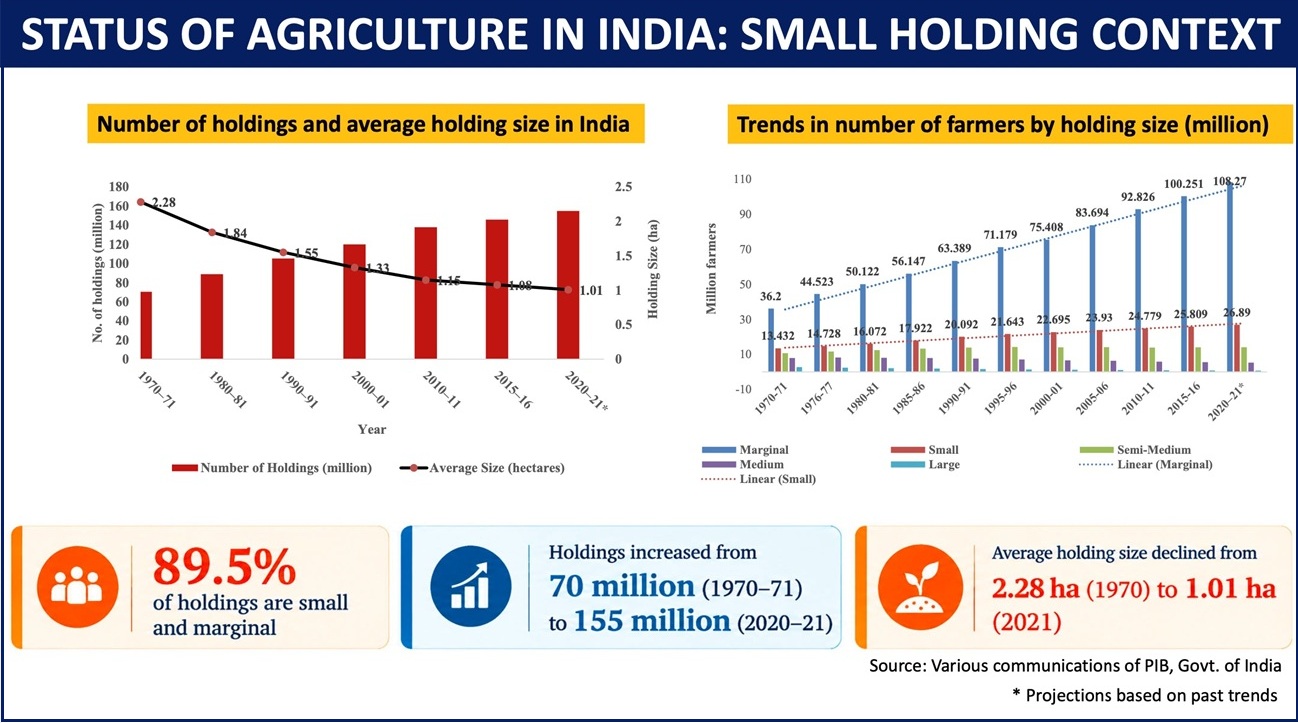
Small and marginal farms constitute the overwhelming majority of operational holdings in India, while average holding sizes continue to decline, raising concerns about their future viability. The challenge extends beyond increasing productivity: farming must generate adequate, stable, and sustainable returns to land, labour, and capital while helping households manage climatic, market, and financial risks.
The brainstorming session organized by the NAAS on 26 October 2026 was therefore timely, focusing on the “power of small farms” and moving beyond the conventional view of smallholders as fragmented, resource-constrained units. Discussions explored how organised clusters, collectives, and value chains can help farmers access technologies, infrastructure, finance, services, and markets.
The session also recognised that small-farm viability cannot be assessed through crop production alone. Farm households increasingly combine agriculture with livestock, horticulture, wage employment, and other livelihood activities. Viability must therefore be understood in terms of household income, resilience, diversification, and intergenerational continuity.
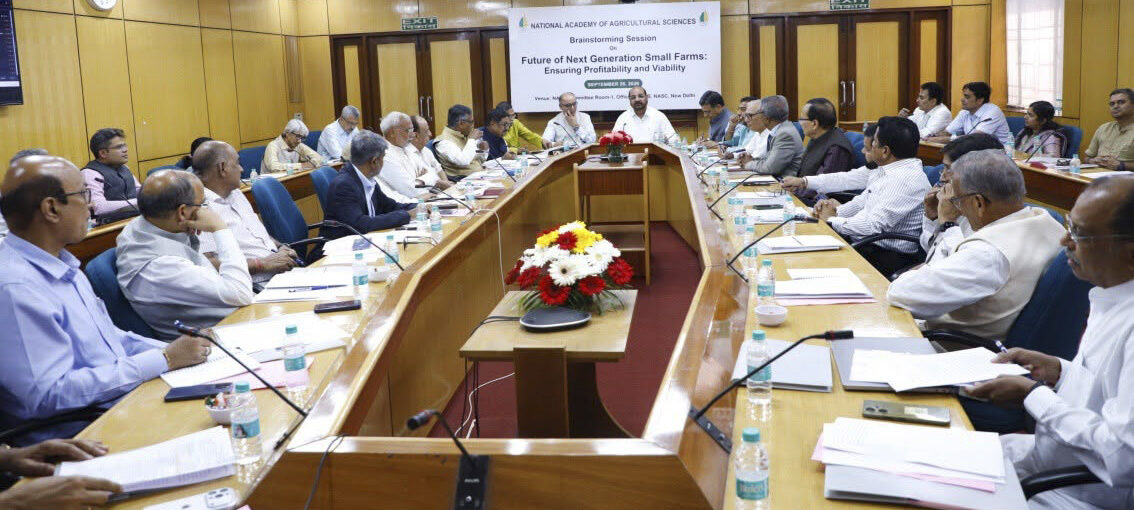
The programme brought together participants from research and extension institutions, government, civil society, farmers’ organisations, industry, and policy institutions to deliberate on pathways for keeping small and marginal farms profitable, resilient, and viable amid India’s changing agricultural landscape. Appreciably, the organisers circulated the Concept Note of the Brainstorming Session, including the rationale and Agenda of the BSS, well in advance to all invited participants, which was helpful.
ABOUT THE BRAINSTORMING SESSION
Dr A. K. Singh, Hon’ble Vice Chancellor, RLBCAU, Jhansi, served as Convenor and presented the session’s comprehensive base paper, supported by relevant data and cases from India and other Asian countries. He reviewed the current status and future prospects of small farms, highlighting challenges and opportunities for their profitability and long-term viability. Drawing on Asian experiences, he identified lessons adaptable to India and emphasised farmer aggregation, cluster-based services, and integrated value chains as pathways to strengthen profitability, resilience, and sustainability. Dr R. Roy Burman, ADG (AE), ICAR, and Dr Sridhar Patil, Head (Agricultural Extension & Communication), RLBCAU, served as Co-Conveners, while Dr B. S. Dwivedi, Secretary, NAAS, moderated the session.
THE POWER OF SMALL FARMS
A major message from the session was that small farms should not necessarily mean small economic opportunities. In his opening remarks, Dr. M. L. Jat, who chaired the session, emphasised that small farmers should not be viewed merely as individual production units, but organised into clusters and collectives that can benefit from shared services, technologies, infrastructure, finance, and markets. Individual smallholders often lack the scale to access modern machinery, quality inputs, storage, processing, and organised markets economically. Aggregation can create this scale without requiring physical consolidation of land. The focus was therefore on sustainable, scalable, and locally adaptable models of farmer aggregation, cluster-based services, and integrated value chains.
Dr. Jat also referred to their recent paper, “Beyond the Green Revolution: Unravelling New Dynamics of India’s Agrifood System Transformation,” published in the August 2026 issue of The Indian Journal of Agricultural Sciences. It highlights broad-based growth across cereals, horticulture, livestock, and fisheries, alongside the need to align productivity and food security with resource conservation, climate resilience, sustainability, and farmers’ incomes. The NAAS session built on this transformation by examining how small and marginal farms can participate profitably in a diversified, sustainable, and market-oriented agrifood system.
FROM INDIVIDUAL FARMERS TO CLUSTERS AND COLLECTIVES
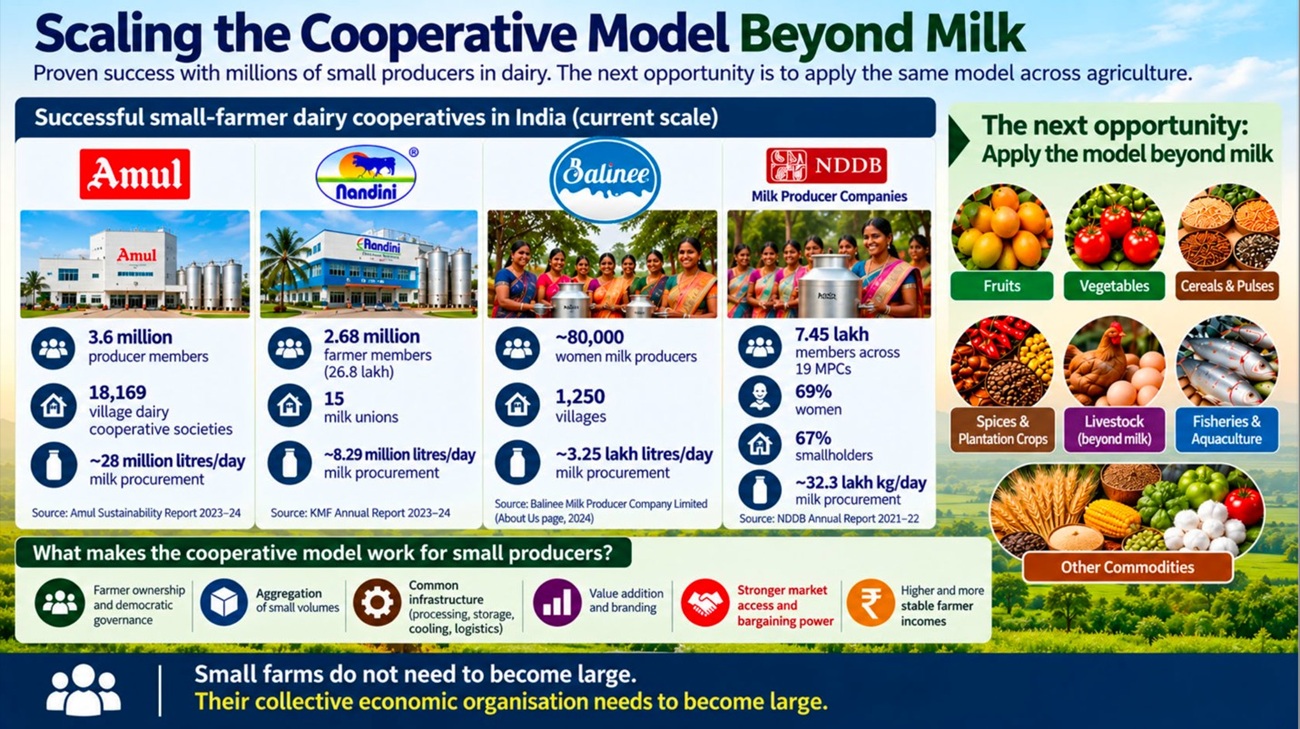
One of the strongest messages from the deliberations was the need to shift from individual farmers towards organised clusters, collectives and producer institutions. Aggregation can create economies of scale by enabling farmers to collectively access machinery, procure inputs, aggregate produce, undertake grading and primary processing, access storage, and negotiate with buyers. Collective action can strengthen bargaining power and improve access to finance and technology. Farmer Producer Organisations, cooperatives, Self-Help Groups and other institutions can create operational scale for small farms. However, successful aggregation also requires viable business models, professional management, market linkages, and appropriate technical and financial services.
EXTENSION AS A CRITICAL ENABLER
The discussions highlighted the importance of extension systems in shaping the future of smallholder agriculture. Small farmers need timely, location-specific information on technologies, crop and livestock management, weather, markets, finance, and government programmes. As production systems and markets become more complex, extension must evolve. Frontline Extension emphasised knowledge generation, technology assessment, and transfer of appropriate technologies, while Field Extension focused on last-mile delivery and continuous institutional support. Digital tools can complement, but not replace, trusted local advisory systems. Smallholders also need problem-solving support, demonstrations, technical services, and market intelligence to make informed decisions.
WHAT DID CIVIL SOCIETY AND FARMERS’ ORGANISATIONS HIGHLIGHT?
The civil society and farmers’ organisations’ perspective highlighted the importance of collective action and farmer ownership of institutions. Farmer aggregation can improve access to markets and services, but producer organisations must remain responsive and deliver tangible economic benefits. Strong institutions can help overcome the disadvantages of small holdings by aggregating demand and supply and connecting farmers with financial institutions, input suppliers, processors, and buyers. However, institutional development takes time. Creating an FPO or farmer group alone does not ensure collective economic action. Effective institutions require capacity building, good governance, business planning, and sustained professional support.
INDUSTRY PERSPECTIVE: CONNECTING FARMERS TO MARKETS
The industry perspective brought the discussion closer to market viability. Improving farm productivity does not necessarily increase incomes unless farmers have access to reliable, remunerative markets. Participants highlighted stronger farmer–market linkages, quality inputs, appropriate technologies, value addition, and integration into competitive value chains. Market demands require quality, consistency, traceability, volume, and timely delivery. For small farmers, market integration must begin before harvest, linking production planning, technology choices, aggregation, grading, storage, processing, and logistics with market opportunities.
POLICY PERSPECTIVE: COLLECTIVISATION FOR HIGHER INCOME
The policy perspective highlighted collectivisation as a pathway to improving small farm incomes. Declining operational holding sizes make economies of scale difficult for individual farmers. Collective mechanisms can address these constraints without changing land ownership. Policy should therefore focus beyond individual schemes on collective infrastructure, shared services, cluster development, and value-chain integration, linking credit, mechanisation, extension, digital agriculture, insurance, storage, processing, and market access.
PROFITABILITY RATHER THAN PRODUCTIVITY ALONE
Another important takeaway was the need to distinguish between productivity and profitability. Higher yields do not automatically translate into higher farm incomes. Small-farm profitability depends on output prices, input costs, labour use, production risks, post-harvest losses, and market access. Therefore, small-farm performance should increasingly be assessed through broader indicators, including net farm income, returns to family labour, labour productivity, total factor productivity, income stability, risk-adjusted returns, and resilience to climatic and market shocks. This perspective is particularly relevant for the next generation of small farms, where the objective should be not merely to produce more, but to earn better, more consistently, and with greater resilience.
DIVERSIFICATION AND RESILIENCE
The discussions highlighted diversification as an important strategy for strengthening small farm households. Crop diversification, livestock, horticulture, and allied activities can provide additional income and reduce dependence on a single crop. For marginal farmers, land-light enterprises and integrated farming systems may offer opportunities to increase incomes. However, diversification must be market-linked and suited to local agro-ecology, household resources, demand, technical capacity, and risk. The goal is diversified, resilient farm households rather than narrowly specialised farms.
WHAT WAS NEW AND APPRECIABLE?
A particularly valuable feature of the session was its integration of multiple perspectives on the future of small farms. The discussion moved beyond production and technology to connect extension, farmer institutions, markets, industry, policy, and household incomes. The emphasis on the “power of small farms” was significant, showing how aggregation, collectivisation, and shared services can transform numerous small farms into viable production and market clusters. Importantly, operational scale need not require changes in land ownership. Clusters, FPOs, shared machinery, common infrastructure, coordinated production, and collective marketing can help smallholders capture economies of scale while retaining ownership. Extension will remain essential for connecting farmers with knowledge, finance, services, and markets.
KEY TAKEAWAYS
The following messages emerged strongly from the deliberations:
- The future of Indian agriculture will substantially depend on the viability of small and marginal farms.
- Small farms need to be viewed as part of clusters and collectives, rather than only as individual production units.
- Aggregation can create operational scale without necessarily changing land ownership.
- FPOs and other producer institutions need viable business models and sustained professional support.
- Extension must provide more than technology transfer; it must connect farmers with knowledge, services, finance and markets.
- Farm profitability, rather than productivity alone, should become a central measure of agricultural performance.
- Diversification can strengthen household income and resilience when linked to appropriate markets.
- Industry can play a greater role in connecting organised farmer groups with quality inputs, technologies, processing and competitive markets.
- Policy interventions need greater convergence around farm household income and resilience.
- The viability of next-generation small farms will depend on combining profitability, risk reduction, aggregation, value addition and market integration.
CONCLUSION
The brainstorming session made clear that the future of small farms requires more than productivity enhancement. Smallholders need an enabling ecosystem that provides economies of scale while retaining ownership and flexibility. Discussions pointed towards organised clusters, profitability, integrated value chains, and coordinated farm-household support. The “power of small farms” lies in effective collective institutions and locally appropriate value chains. Their viability will depend on stable profitability, reduced risks, resilience, aggregation, value addition, and stronger market linkages. Achieving this requires coordinated action among extension and research systems, farmer organisations, government, civil society, industry, and financial institutions. Small farms can remain viable when farmers organise, aggregate, innovate, and participate meaningfully in modern agricultural value chains.
 Dr Mahesh Chander is Fellow, National Academy of Agricultural Sciences (NAAS) – India. He served as an ICAR-ARS scientist for over 35 years and recently retired as Principal Scientist (Agricultural Extension) from the ICAR-Indian Veterinary Research Institute (ICAR-IVRI), Izatnagar, Uttar Pradesh, India. He has been Head of the Division of Extension Education at ICAR-IVRI for nearly 17 years and also served as In-charge Joint Director (Extension Education) at the Institute for over six years. He can be contacted at drmahesh.chander@gmail.com.

The NAAS Base Document very appropriately brought out the broad issues, and necessary needed interventions. It is proposed that Document may have four main actions-Review, Reforms, Performance, and expected Transformation.
A few aspects that worth considering as follows:
• Do we really know who is a small farmer? Are available data reliable? Nation’s hereditary system contributes to division of holdings, thus increasing number of small farmers. However, it need to be kept in mind that farmers with small holdings either give their land on lease or higher adjoining small farms on lease, to make it a profitable unit for business. This fact needs further research studies. My Advocate friend told me that recently the Highest Court has ordered that if a parcel of land is to be sold, then the first right will be of the hereditary person, and if he is not ready then it can be sold to someone from outside or within. Such a decision will help in less small farms.
• Should the country have different MSP of produce from small farmers? Let’s look at the return of different size of holdings in Odisha, groundnut crop. Return/rupee on small farmers was 2.04, the mean for all sizes was 2.13. Why so? We need to identify the practices where the cost on small farms was high. A participatory scientist’s team, including from Extension Education discipline, be formed. Such a participatory discussion can contribute to change in practice , including location specific concerns.
• As per 77th round NSSO-only 3.38 % farmers access KVKs ( national average), though the differences varied among States ( Kerala-12.5 -14%, Tamil Nadu-8 to 10%, HP-7-9%, Punjab & Haryana-2.5%, UP & Bihar-1.5%, Assam, Nagaland , Mizoram-5-8%). There is need to enhance the number of staff members from 16 to 22 (which earlier Existed) in the KVK. There is also a need to establish Block Level KVK Units under the main District KVK. We need to ensure that the KVK remains a science based district level institution and not like a state department of agriculture functionary and efforts should be made to fill up vacant posts in KVKs on priority. As KVK is an Extension Education focused institution, the Head of the KVK preferably from the Discipline of Extension Education.
• There is a need to focus on coordination issues among SAMETI ( under MANAGE), ATMA ( SREP), ATICs ( ICAR Institutes and SAUs) and ensure their meaningful participation in SAC meetings of the KVKs.
• Overseeing responsibility of Director of Extension Education of the SAU for all the KVKs in the jurisdiction of the University and there is a need for critical examination of this role and finding a methodology for strengthening this.
• The ICAR may organize a 3- day training for KVK scientific staff on ‘Knowledge Management and integration for ‘problem solving mode ‘ in place of operating in subject mode.
• In place of ‘Package of Practices’ published by SAUs and ICAR Institutes, it should be ‘Good Agricultural Practices’ ensuring that any recommendation may also include ‘Desirable and essential conditions’ for best results.
• The Agricultural Research and its Transfer to the targeted users no more operates in a linear way as was till 1970s, but now functions in a curvilinear way, whereby the targeted users (farmers and other stakeholders) participate during conceptualization, experimentation, finalization etc. The ICAR Division of Agricultural Extension earlier mandate included ‘Technology Refinement’, but got changed to ‘Technology Assessment, Demonstration, and Capacity Development’. A serious consideration is required to reword it as ‘Participatory technology refinement as per local needs’.
• As per the Economic Survey 2025-26, unconditional cash transfers (freebies) cost States around Rs. 1.7 lakh crore annually. Unmetered fee electricity leads to environmental hazards like severe depletion of ground water resources, development of soil salinity, etc. Freebies may be necessary during natural calamities, etc., but not otherwise. The funds so saved may be used for training of farmers. There is an Axiom-If you want to help someone for a day. Give fish to eat, but if you want to help life-long, train him how to fish.