



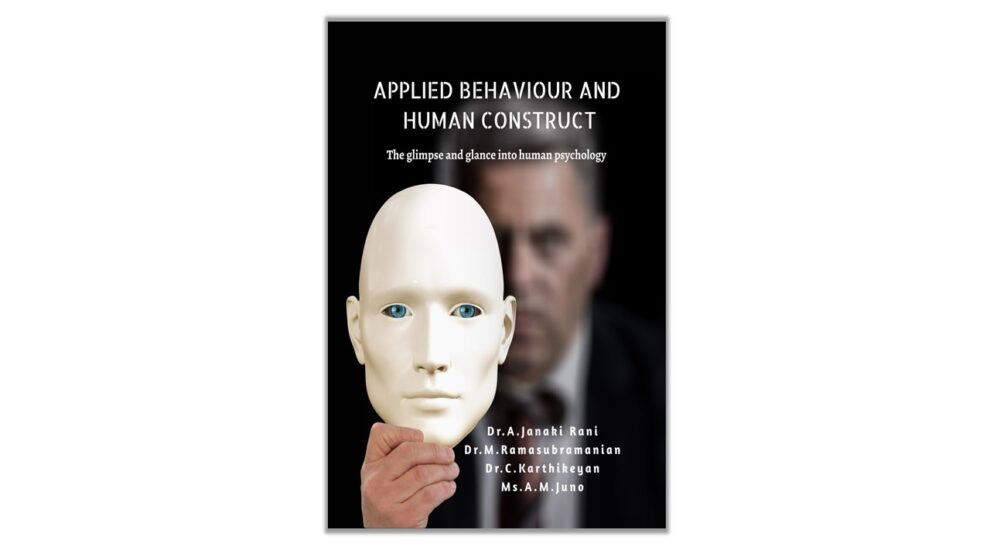
Janaki Rani, M. Ramasubramanian, C. Karthikeyan and A. M. Juno (2025)
Pages: 190
Price: INR 510
Publisher: Notion Press
ISBN: 13 979-8897770724
In domains such as extension education, rural development, and behaviour change communication, understanding how individuals think, decide, and act is fundamental because development outcomes are ultimately shaped by human behaviour. The success of extension programmes, technology dissemination, policy interventions, and community-based initiatives often depends not only on technical innovations but also on people’s perceptions, motivations, attitudes, beliefs, and willingness to adopt change. In rural contexts, behavioural understanding helps explain why individuals accept or resist innovations, participate in collective action, respond differently to risk, and make livelihood decisions under varying socio-economic and environmental conditions. Similarly, behaviour change communication relies on insights into cognition, social influence, and motivation to design effective strategies that encourage desirable practices and sustained transformation. Therefore, knowledge of behavioural processes is increasingly recognised as essential for addressing complex developmental challenges and improving the effectiveness of interventions across agricultural, social, and community systems. Against this backdrop, resources that simplify and synthesise core behavioural concepts become valuable for students, educators, and practitioners alike.
From Foundations to Application: How the Book Unfolds
The book Applied Behaviour and Human Construct offers a structured synthesis of key psychological concepts that is clearly relevant to the agricultural social sciences. It positions itself as a foundational guide that equips learners with conceptual tools for interpreting behavioural processes that shape development outcomes.
The book follows a logically progressive structure, beginning with the meaning, importance, and determinants of human behaviour, including cognitive, social, and environmental influences. It then moves on to the biological bases of behaviour, explaining the roles of the nervous system, endocrine functions, and genetic factors.
Subsequent sections explore individual variations through intelligence, creativity, and abilities, supported by well-established theoretical frameworks. The discussion on personality integrates multiple perspectives, psychoanalytic, trait, humanistic, behavioural, and cognitive, along with methods of personality assessment.
The book further examines personal, social, and moral development, including self-concept, self-esteem, and stages of moral reasoning. The concluding section on motivation presents both content and process theories, such as Maslow, Herzberg, McClelland, and expectancy theory, linking them to behavioural outcomes and decision-making processes.
Conceptual Strength with Practical Relevance
One of the book’s notable strengths is its clarity and pedagogical rigour. Concepts are presented in a structured and accessible manner, making it particularly suitable for students and early learners. The organisation supports cumulative understanding, enabling readers to build from foundational ideas to more complex behavioural frameworks.
Importantly, the book is implicitly relevant to agricultural extension and rural systems. Concepts such as motivation, attitude, perception, and social influence are central to understanding farmer decision-making, technology adoption, and participatory engagement. The integration of these concepts makes the book useful not only as a theoretical resource but also as a preparatory guide for field-oriented disciplines.
Additionally, the breadth of coverage, ranging from biological foundations to social and moral development, provides a holistic perspective on human behaviour. This interdisciplinary approach strengthens its utility across multiple domains within agricultural social sciences.
Relevance and Contribution to Agricultural Social Sciences
The book makes a meaningful contribution as a foundational resource in behavioural science within agricultural social sciences. Its interdisciplinary scope aligns closely with the needs of extension education, where behavioural understanding is essential for designing interventions, facilitating communication, and improving adoption outcomes.
Rather than proposing new theoretical models, the book contributes by synthesising essential concepts in a coherent and structured format. This consolidation is particularly valuable for students, enabling them to access a wide range of behavioural theories within a single volume. It also supports emerging areas such as behaviour change communication and participatory development approaches.
Readable, Structured, and Learner-Oriented
The writing style is clear, direct, and well-suited for academic use. The use of structured explanations, headings, and classifications enhances readability and makes the text effective for both learning and revision. The progression of ideas is logical, supporting conceptual continuity.
At times, the presentation adopts a highly segmented format, which aids clarity but can limit deeper integration across topics. A slightly more narrative linkage between sections could enhance conceptual flow while retaining the book’s strengths in organisation.
The book’s strengths lie in its comprehensive coverage, clarity, and strong alignment with educational needs in agricultural and social sciences. It serves effectively as an introductory and reference text, particularly for students in extension education and related fields.
Where the Book Can Evolve Further
While the book effectively consolidates core theories, it primarily adopts a descriptive approach. The emphasis is on presenting established knowledge rather than critically comparing or contextualising theories in specific field settings. For readers seeking deeper analytical engagement, the inclusion of comparative insights or synthesis across theories would add further value.
Similarly, the practical applicability of the concepts could be enhanced by including brief case illustrations, particularly from agricultural or rural development contexts. Linking theoretical constructs explicitly to field situations, such as farmer behaviour, extension strategies, or adoption dynamics, would strengthen its applied dimension. These aspects represent opportunities for further enrichment rather than fundamental limitations.
Opportunities for further strengthening include deeper analytical engagement and more explicit contextualization in applied settings. Addressing these aspects in future editions would enhance its relevance for advanced learners and practitioners while building on its current strengths.
Final Assessment and Recommendation
This book stands as a well-structured and accessible contribution to the behavioural science literature, with clear relevance to the agricultural social sciences. It succeeds in consolidating key concepts and presenting them in a manner that supports both academic understanding and foundational field orientation.
The book is recommended for undergraduate and postgraduate students in agricultural extension, rural development, sociology, and communication studies. It will also be useful for educators as a teaching resource and for early-career professionals seeking a structured entry point into behavioural science. With further integration of applied illustrations, the book has strong potential to serve as an even more effective bridge between theory and practice.
 R. K. Dhanush is a first-year M.Sc. scholar in Agricultural Extension Education at the Department of Agricultural Extension and Rural Sociology, Tamil Nadu Agricultural University, Coimbatore. His academic interests focus on farmers’ perceptions, satisfaction with extension services, and research on agricultural development and rural advisory systems. He can be contacted at dhanushrajeshkumarrkd03@gmail.com


Add Comment