


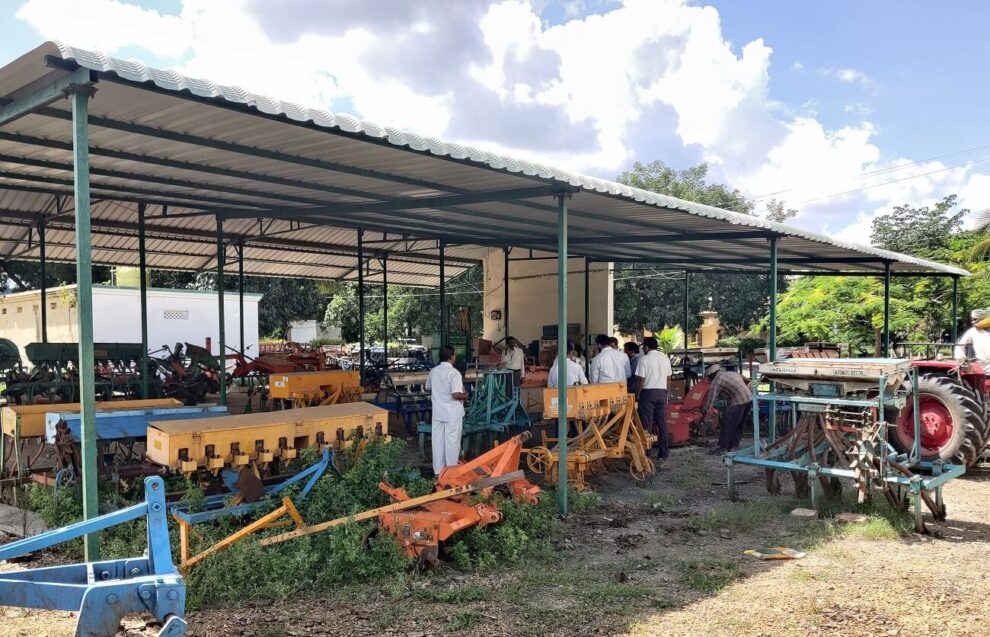
In this good practice note, E Ravi Goud, M. Sohail and M Sudhakar discuss how a CHC is enhancing access to farm machinery for small and marginal farmers of the Banaganapalli division of Nandyal District.
CONTEXT
Small and marginal farmers in Banaganapalli division of Nandyal district, Andhra Pradesh, practice highly diversified agriculture under rainfed and wetland conditions, cultivating cereals, pulses, oilseeds, vegetables, flowers and fruit crops. Such crop diversity requires access to different types of farm machinery for timely and efficient farm operations. However, purchasing modern farm machinery is costly and often uneconomical for small landholdings. Consequently, many farmers depend on manual labour, bullocks and private machinery owners for operations such as land preparation, sowing, inter-cultivation, harvesting and threshing. Under both rainfed and wetland conditions, timely completion of farm operations is critical, particularly within the narrow sowing window, while limited access to machinery during peak periods can delay operations and increase cultivation costs. Farmers also often lack adequate knowledge to select machinery and horsepower based on their land type, crop, soil condition, and specific operation. Using unsuitable or higher-capacity machinery can lead to inefficient operation, excessive load on tractors and implements, machine damage, and additional repair expenses.
To address these challenges, the Krishi Vigyan Kendra (KVK), Yagantipalle, working under the ICAR-ATARI Zone-X, Hyderabad, established a Custom Hiring Centre (CHC) in 2017 through the RKVY project, equipped with advanced farm machinery and implements suitable for both rainfed and wetland farming. The CHC has improved access to modern farm machinery, reduced dependence on private machinery operators, facilitated timely farm operations and reduced labour and machinery-related costs.
GOOD PRACTICES
Understanding Farmer Mechanisation Needs
The KVK initiated farm mechanisation interventions in June 2017 in response to farmers’ requests to address mechanisation needs and the limited availability of primary, secondary, and intercultural farm machinery for major crops in the division. Group discussions and field consultations revealed limited awareness of modern farm machinery and high dependence on private machinery operators, particularly during peak agricultural seasons, resulting in higher operational costs. These consultations enabled KVK to identify crop-wise mechanisation requirements, critical farm operations, suitable machinery, and gaps in local machinery services, thereby facilitating the development of a farmer-centric farm mechanisation intervention.
Establishing a Farmer-Centred Custom Hiring Service
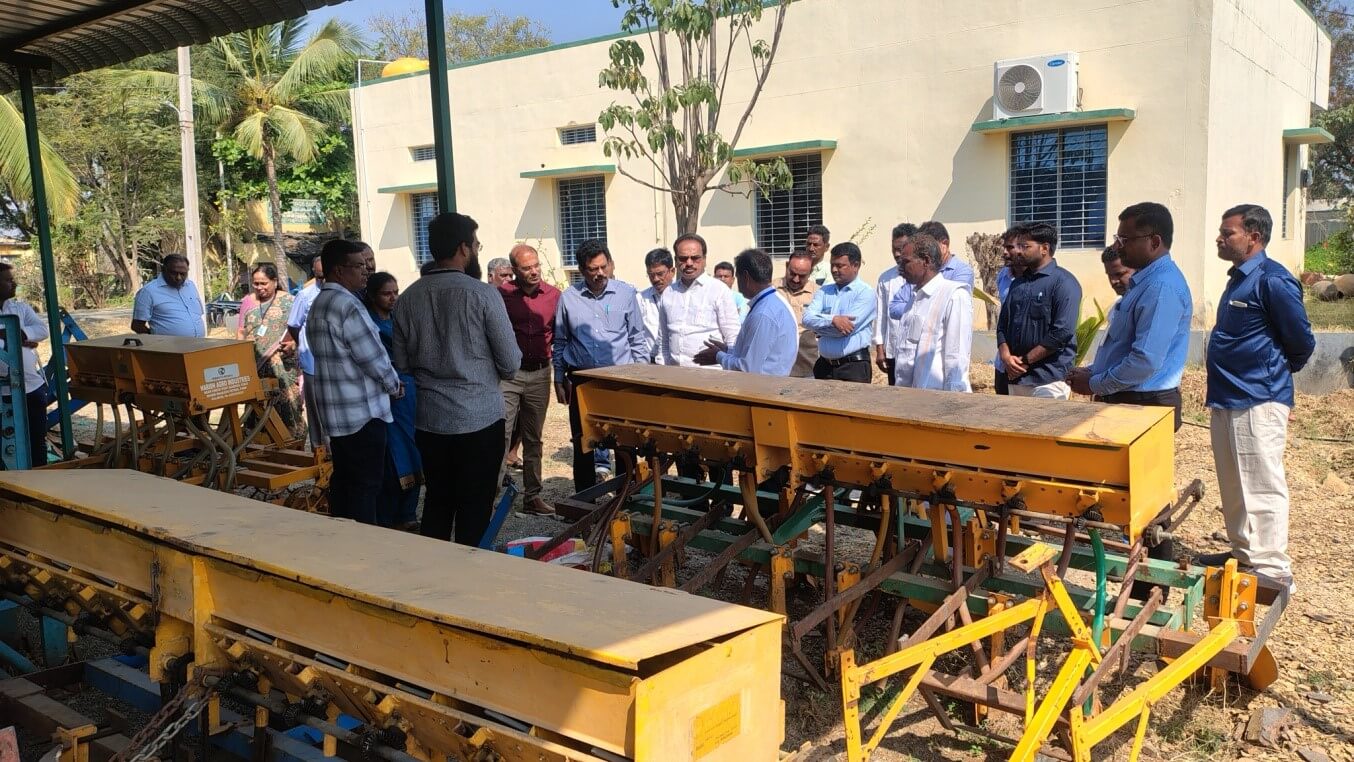
In 2017, the KVK established a Custom Hiring Centre (CHC) to improve access to farm machinery, particularly for small and marginal farmers in Banaganapalli division. Initially, the CHC provided tractor-operated implements at affordable daily hiring charges to farmers who owned or had access to tractors. Later, the CHC introduced a hybrid model, providing implements along with tractor services to farmers without tractors. The CHC covers tillage, inter-cultivation and residue management, supported by machinery selection guidance and field demonstrations.
Building a Machinery Portfolio for Local Farming Systems
The CHC machinery portfolio was developed based on local cropping patterns and farmers’ mechanisation needs through regular consultations with farmers, private machinery operators, and CHC users. It was progressively strengthened through financial and technical support of ICAR Projects and institutions.
Under the ICAR-NICRA project, the KVK received INR 15.98 lakh from 2016-17 to 2024-25 to procure farm machinery and implements to promote climate-resilient agricultural practices. Further, under the Consortium Research Platform on Conservation Agriculture (CRP-CA) project, INR 4.45 lakh was received to procure specialised implements, including a Broad Bed Furrow (BBF) planter, seventy-tyne bottom duck-foot cultivator, MB plough, and bund former, to promote conservation agriculture practices in rainfed situations. Power weeders were mobilised through ICAR-Indian Institute of Oilseeds Research (IIOR), Hyderabad, as a grant.
Since its establishment, CHC has invested INR 32.52 lakh for machinery portfolio, comprising INR 20.52 lakh through ICAR Projects and INR 12 lakh reinvested from CHC revenue. The portfolio is reviewed annually based on farmers’ evolving mechanisation needs.
Table-1. List of equipment maintained in CHC
| Category | Implement |
| Primary tillage: | Cultivator-9-tynecultivator, 7-tynecultivator, 9-tyne spring type cultivator, Boot type cultivator; MB Plough-2 & 3 bottom mould board plough, 2 Reversible MB plough, & Disc plough (Hydraulic) |
| Secondary tillage | Rotavator, land leveller, Blade Harrow |
| Sowing equipment | Zero till drill, Vertical seed drill, Inclined seed metering plate, Footed roller mechanism, Manual push planter, & Tractor operated seed planter |
| Inter cultivation | Power weeder (4 & 6 HP), Brush cutter & chain weeders |
| Sprayers | Tractor-operated sprayer, Portable sprayer & Drone sprayer |
| Residue management | Chaff cutter, Rotary slasher, Rotary shredder, Straw bealer, & Cotton shredder |
| Conservation agriculture | Subsoiler, BBF Planter (6 & 4 row), and Bund former |
Machinery on Demand: Timely Custom Hiring Services
Provides Custom Hiring Services within a 30-km radius of Banaganapalli division during office hours on working days. An Agricultural Engineering graduate oversees the machinery and coordinates hiring services. Farmers can book the required machinery by visiting the KVK with original identity proof and paying an advance amount based on the intended period of use. Before delivery, staff inspect each implement and conduct a trial run to ensure proper functioning. Tractor operators are also briefed on safe operating practices and correct use of the machinery.
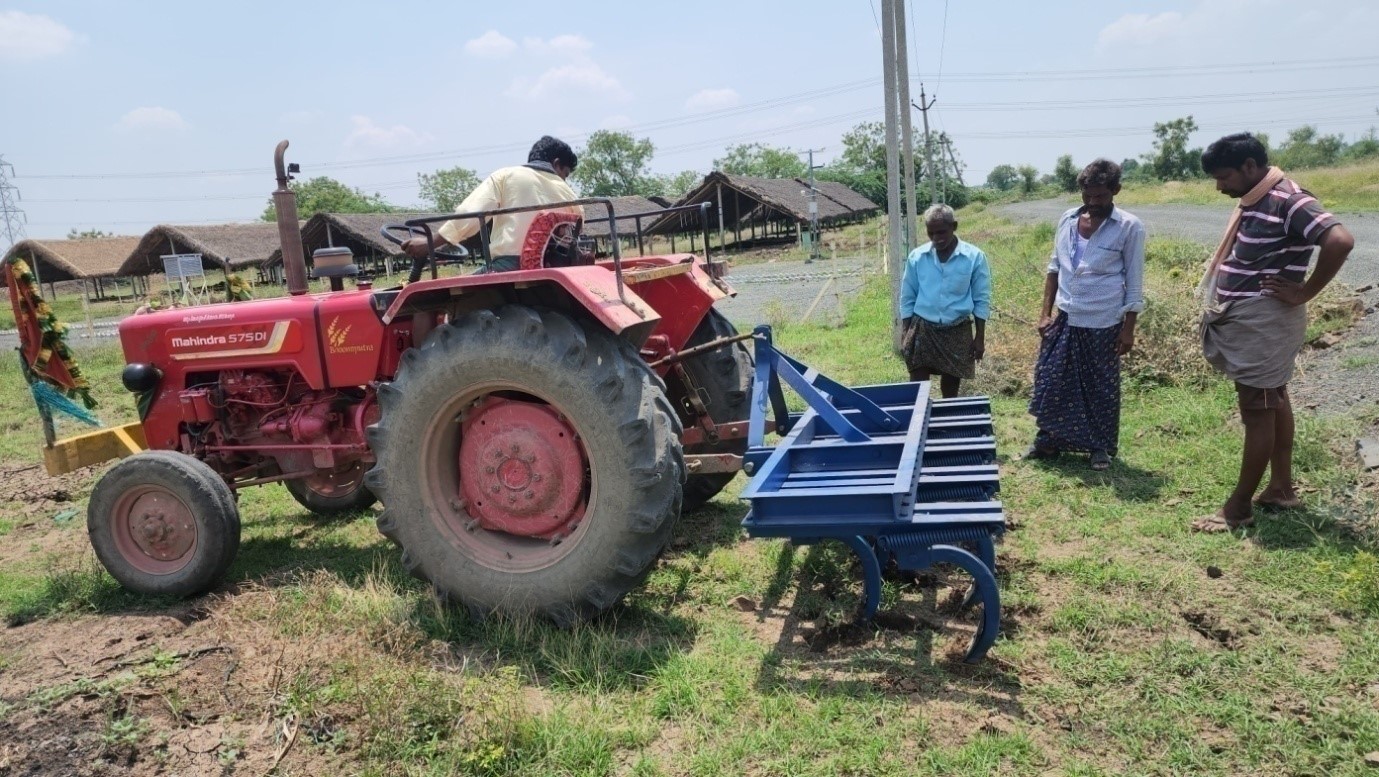
To improve access during periods of high demand, if the required implement is unavailable, the farmer’s name and contact details are registered, and he is informed as soon as the machinery becomes available. Based on previous bookings, we also communicate an indicative availability date, enabling farmers to plan their farm operations accordingly.
Beyond Hiring: Technical Guidance at the Farm Level
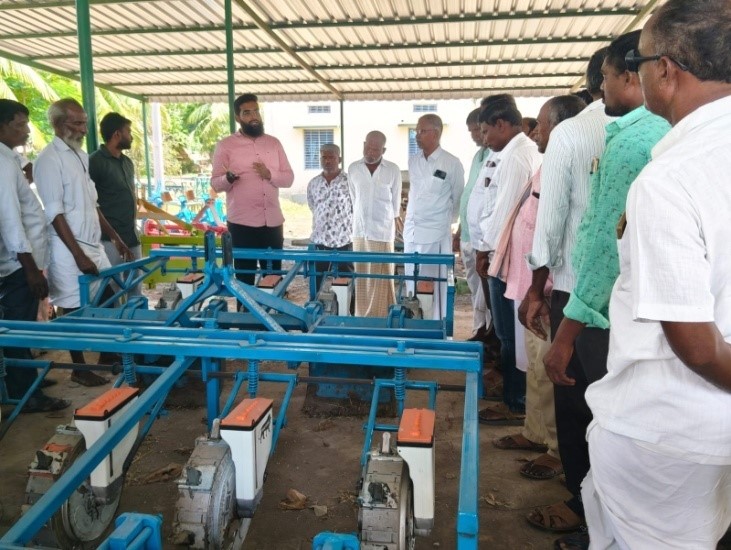
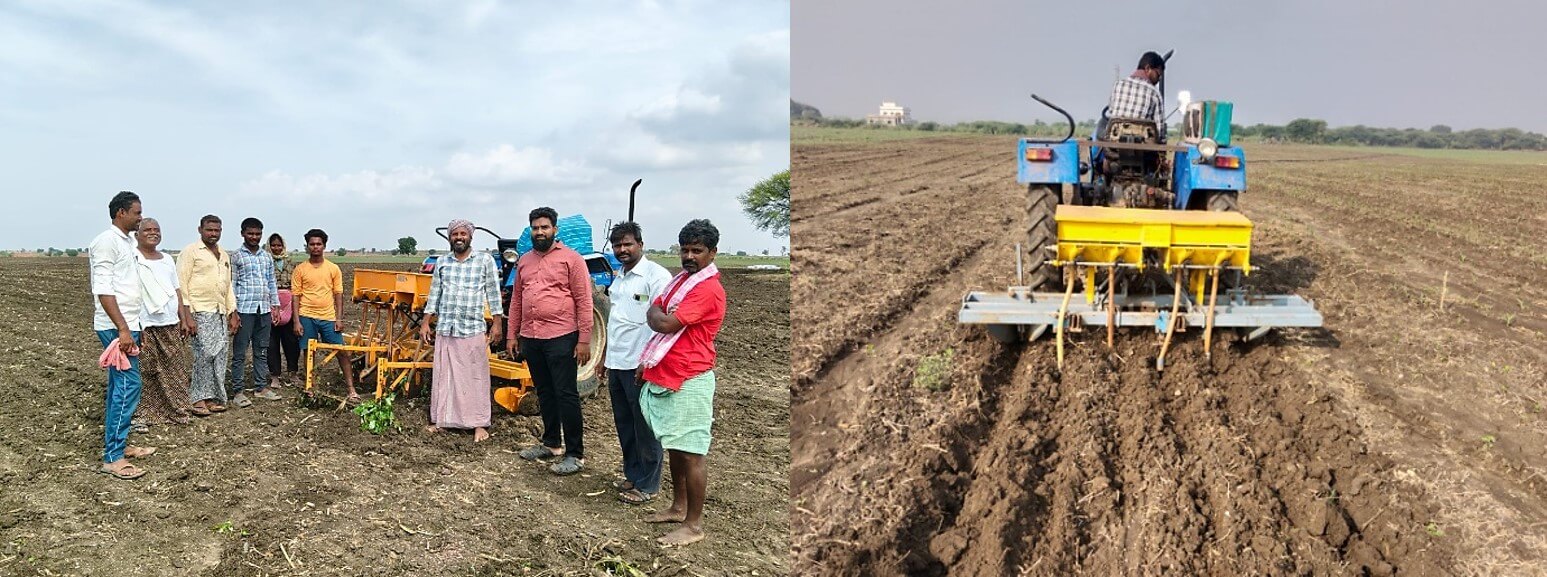
Beyond machinery hiring, KVK provides technical guidance on appropriate mechanisation for conservation agriculture and sustainable crop production. KVK promotes broad bed and Furrow (BBF) planters and subsoilers for moisture conservation; bund former-cum-seed planters for maize and sunflower; rotary slashers, rotary mulchers, and cotton shredders for crop-residue management and reducing residue burning; and power pruners for horticultural crops. KVK also guides farmers on machinery selection, dealers and investment costs for purchase. In addition, KVK provided drone service technician training to rural youth under Skill India and has facilitated drone spraying across about 4,500 ha of field and horticultural crops over the last three years.
CHALLENGES
A major initial challenge was that farmers occasionally returned implements without reporting field-level damage, which was detected only during subsequent hiring. Resulting, unexpected repair and maintenance costs for the CHC and delays in service delivery. To address this, I engaged a dedicated Agricultural Engineering graduate to inspect implements before issuance and after return. If any damage was identified during inspection, farmers were made responsible for repairing and returning the implement in proper condition. This system improved accountability, reduced maintenance costs, minimised equipment downtime and ensured that implements remained ready for subsequent users.
During peak agricultural seasons, concentrated demand and limited availability of high-demand farm machinery resulted in booking delays, particularly within short sowing windows. To address this constraint, KVK progressively increased the number of high-demand implements in the CHC based on booking records and seasonal demand, thereby improving timely access to machinery during critical farm operations.
Initially, the CHC provided farm implements on a standalone hiring basis, requiring farmers to arrange a tractor separately. This created difficulties for farmers who did not own or have access to tractors. To address this challenge, the CHC introduced a hybrid hiring model, offering implements either independently for farmers with tractor access or with tractor services, with charges adjusted accordingly. This expanded access to CHC services across different farmer categories.
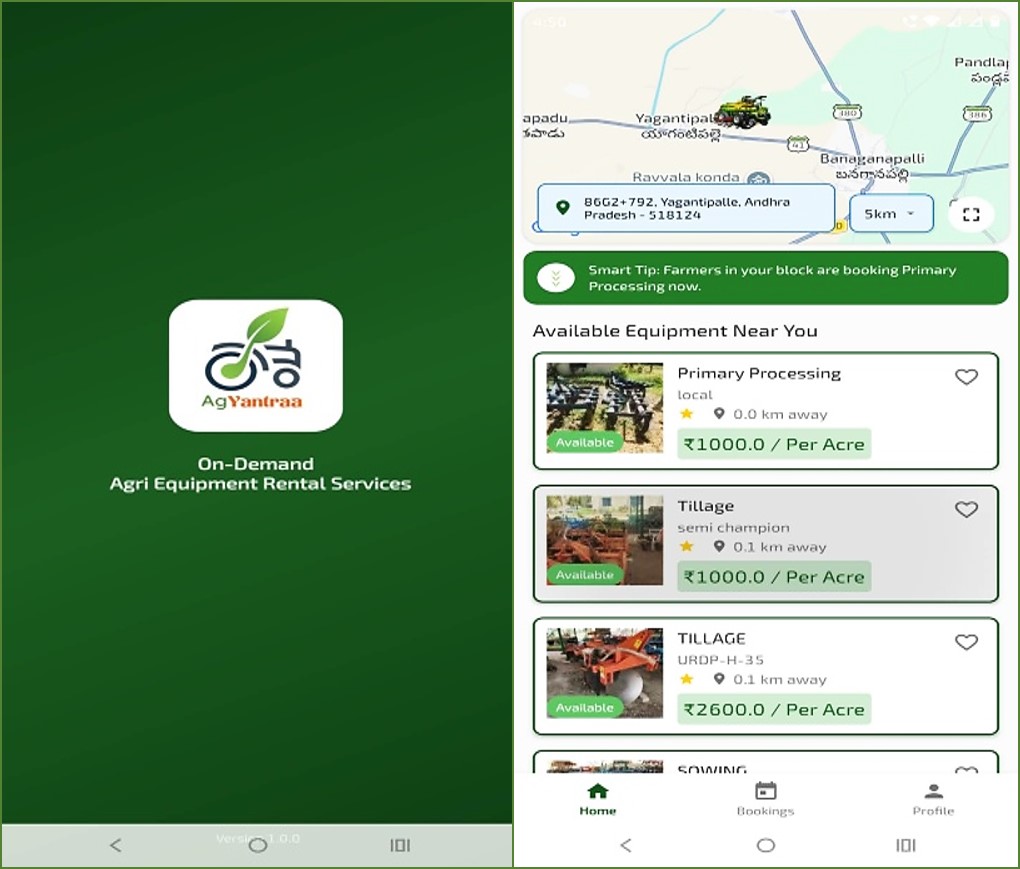
Farmers had to travel to CHC with a tractor to book and collect the implement. During peak seasons, long waiting lists often meant farmers returned without the machinery, causing lost time and transportation costs. To address this, KVK introduced a digital application, in collaboration with AgYantra, that lets farmers book implements and make payments from their doorstep. The application also provides real-time information on machinery availability and booking status, helping farmers avoid unnecessary travel and plan farm operations based on expected implement availability.
EVIDENCE OF CHANGE AND IMPACT
 The CHC currently serves nearly 3251 farmers across 35 villages within a 30 km radius of KVK. By providing farm implements at affordable daily hiring rates, it improved farmers’ access to machinery, particularly for small and marginal farmers who cannot purchase individual implements. The service enabled farmers to complete critical farm operations on time, particularly during narrow sowing windows, reducing dependence on private machinery operators and associated hiring costs.
A major economic benefit is the substantial reduction in machinery hiring costs, with charges 42-82% lower than those of private operators, depending on the implement. The highest savings (Fig. 1) were observed for 7-tyne and 5-tyne cultivators (82%), rotavator (79.2%), 2- and 3-MB ploughs (79%), and 9-tyne cultivator (74.8%). This significant reduction in machinery hiring costs improved affordability and enabled farmers to access mechanisation without investing in expensive implements.
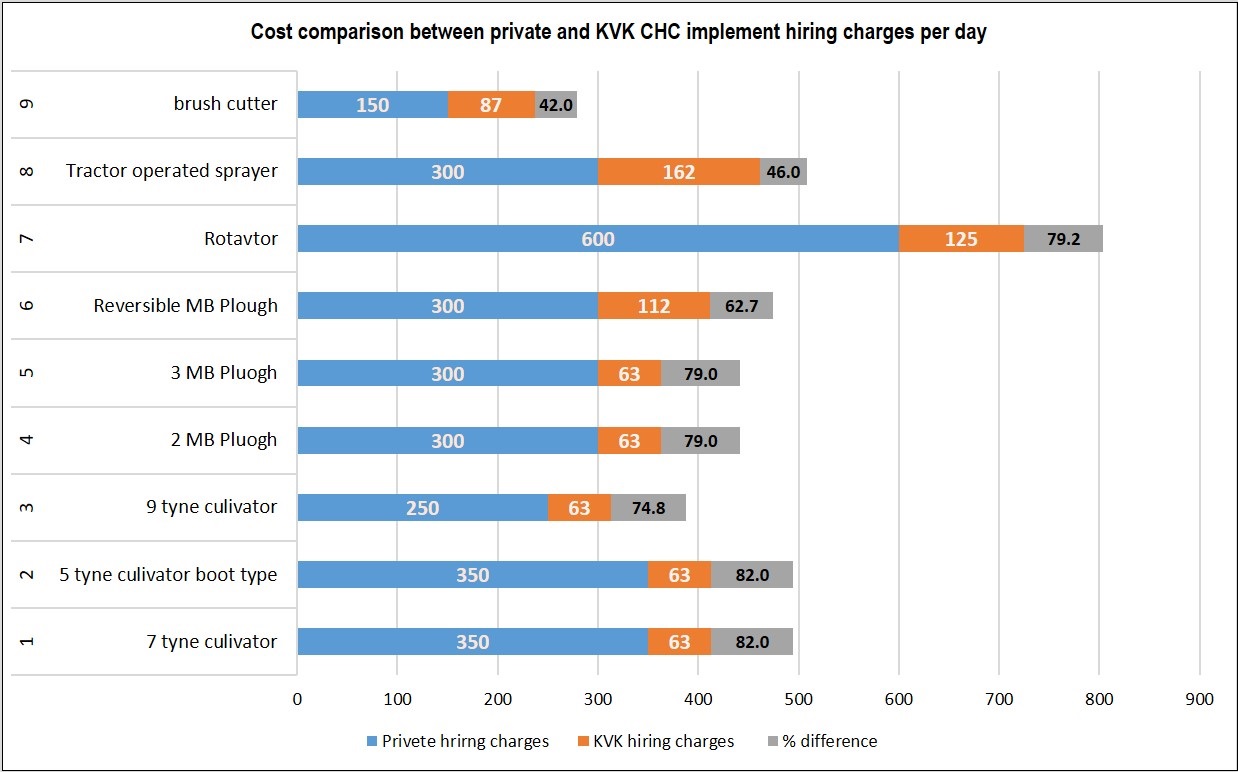 Fig-1 Cost comparison between private and KVK CHC implement hiring charges
Between 2021 and 2025, the CHC generated INR 20.25 lakh (Rs.20,25,345) through machinery hiring services, demonstrating sustained farmer demand and regular utilisation of the facility Fig-2. During the same period, approximately Rs. 11.30 lakh was spent on repair and maintenance. Thus, the revenue generated substantially supported the CHC’s recurring maintenance requirements and contributed to its operational sustainability.
The CHC introduced area-specific farm machinery to address local soil, crop and labour constraints. For primary tillage, power harrows were introduced for sticky soils, and nine-tine spring cultivators for stony soils. For sowing, BBF planters with 6- and 2-ridge configurations were demonstrated over 150 acres to facilitate raised-bed sowing; bund former-cum-planters (42–45 HP) were used over 100 acres for maize and sunflower under bund and paired-row planting systems. Manual seed push planters covered 150 acres, enabling a family member to sow about 3 acres/day in cotton, maize and redgram, reducing dependence on hired labour.
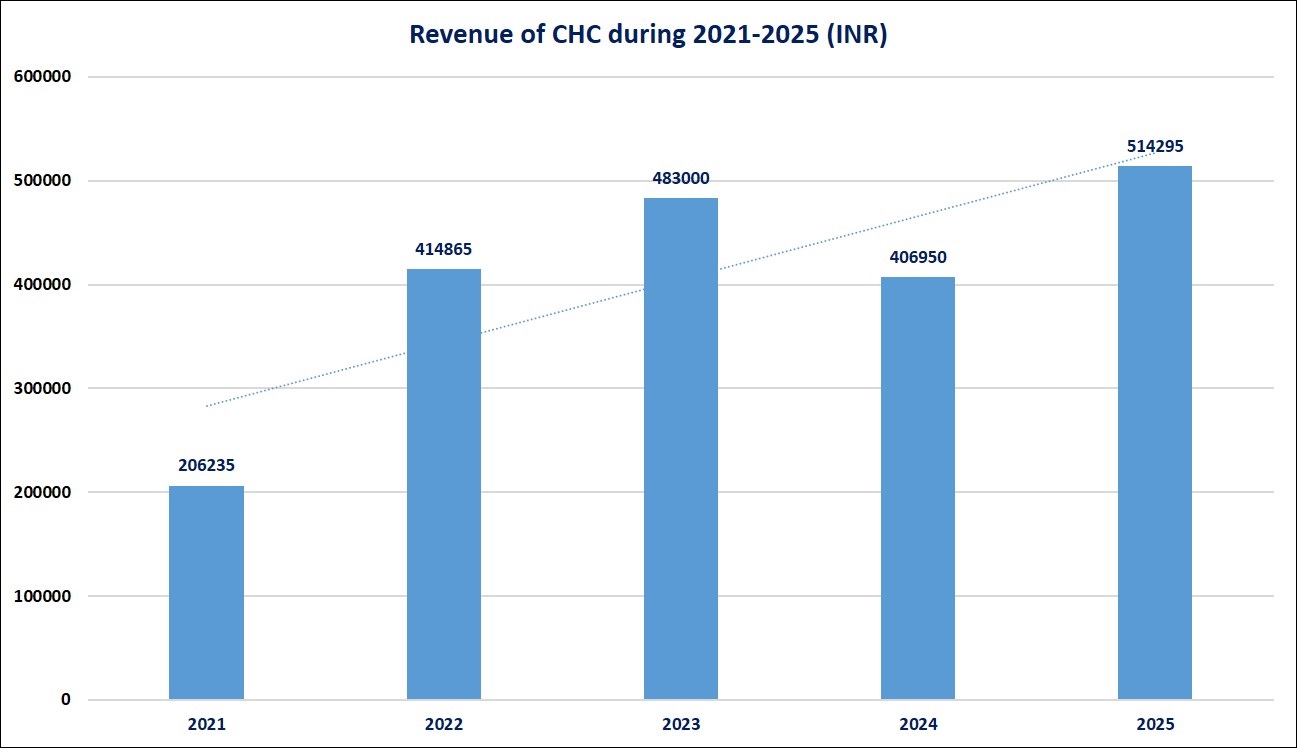 Fig-2 Revenue of CHC from 2021 to 2025
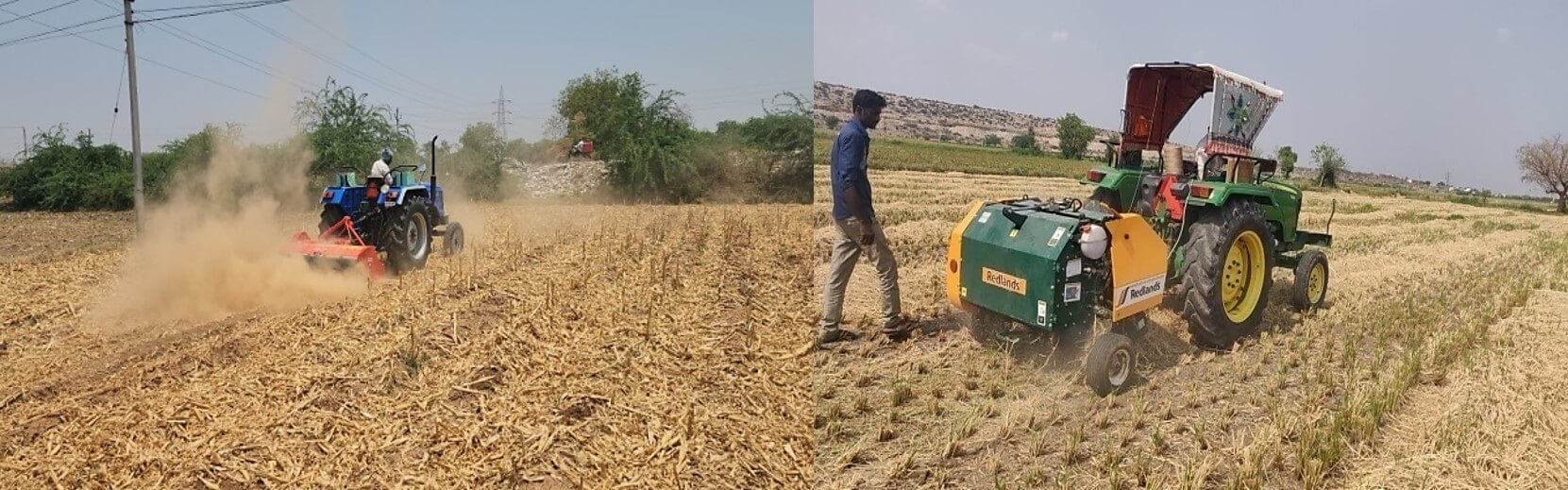
For inter-cultivation and field-boundary management, mini power weeders, brush cutters and chain weeders were introduced. For residue management, a hay straw baler (40–45 HP) covered over 1,000 acres of paddy stubble, rotary slashers covered 50 acres of paddy stubble, rotary mulchers covered 120 acres across multiple crops, and a cotton shredder (50 HP) covered over 250 acres for shredding and incorporation of cotton and chilli residues. These need-based implements expanded access to specialised machinery and improved the timeliness, efficiency and cost-effectiveness of farm operations.
The initiative has created wider benefits beyond machinery access. Through KVK demonstrations and technical guidance, farmers gained confidence in using improved farm machinery. The availability of suitable implements for tillage, inter-cultivation, and residue management further encouraged the adoption of resource-conserving farming practices.
SUSTAINABILITY AND SCALING UP
The CHC model is financially sustainable through revenue generated from machinery hiring services. As discussed earlier, the CHC is currently operating without any additional support for machinery, demonstrating its capacity to support recurring operational requirements. The demand-driven addition and replacement of implements based on farmer needs further strengthens the facility’s financial and operational sustainability.
The KVK management is committed to sustain this institution through deployment of dedicated technical manpower, regular machinery inspection and maintenance, and continuous interaction with farmers. The digital CHC application further strengthens service delivery by enabling doorstep booking, online payment and real-time machinery availability tracking.
The CHC model is highly scalable to other KVKs and districts with diverse farming systems, where small and marginal farmers have limited access to farm machinery. The model also provides opportunities for rural youth, agri-entrepreneurs and start-ups to establish decentralized farm machinery hiring, repair and maintenance, and drone-based services.
LESSONS LEARNED
- Farmer demand should drive machinery selection: Regular consultations with farmers, CHC users and local stakeholders helped KVK to identify crop-wise mechanisation needs and prioritise high-demand implements.
- Technical handholding is essential: Machinery hiring alone was not sufficient. Demonstrations, implement selection guidance, trial runs, safety instructions and field-level support improved farmers’ confidence and appropriate use of machinery.
- Peak-season planning ensures timely access: Short sowing windows and concentrated demand for specific implements can create waiting lists. Seasonal demand assessment and adequate numbers of high-demand implements are essential for timely service delivery.
- Systematic inspection and maintenance improve sustainability: pre-and post-hiring inspection, farmer accountability and timely repair reduce equipment downtime and ensure implements remain ready for subsequent users.
- Competitive pricing creates scope for sustainable enterprises: Keeping hiring charges below prevailing private operator rates improves farmer affordability and machinery utilisation. A 25-35% lower pricing model, supported by efficient operations and maintenance.
- Service and maintenance support for new machinery: Introduction of new farm machinery requires reliable after-sales service, readily available spare parts and trained technicians. Limited local repair facilities can increase downtime and maintenance costs, highlighting the need for strong service support when introducing new machinery.
CONCLUSION
The Custom Hiring Centre (CHC) at KVK Yagantipalle has emerged as a farmer-centred and sustainable farm mechanisation model for small and marginal farmers in the diversified cropping systems of Banaganapalli division of Nandyal district. By providing timely access to suitable farm machinery at affordable hiring charges, the CHC has benefited 3,251 farmers across 35 villages, reducing machinery hiring costs by 42–82%. It generated INR 20.25 lakh in revenue during 2021-2025, establishing its viability as a farmer-centric mechanisation model.
The initiative reduced dependence on private machinery owners, facilitated timely farm operations, enabled farmers to access and adopt advanced and specialised farm machinery not readily available through local service providers, and promoted mechanisation and conservation agriculture practices. Overall, the CHC model demonstrates the potential of demand-driven, affordable and technology-enabled mechanisation services to benefit smallholders without individual machinery ownership.
Acknowledgements: The authors sincerely acknowledge the constant support and encouragement extended by Sri P. Balaji, Secretary, SHE and CS, Krishi Vigyan Kendra, Yagantipalle, and Dr Shaik N. Meera, Director, ICAR ATARI-Zone X, Hyderabad.
 Ravi Goud, SMS (Agril. Extension), KVK, Yagantipalle, He has eight years of extension experience across the State Dept. of Agriculture and ICAR system. His interests include qualitative research and impact assessment of agricultural technologies (eravigoud068@gmail.com)
 Sohail, Farm Manager, KVK, Yagantipalle, M. Tech farm machinery and power engineering, He has patent in manual push planter and seed metering plat for mustard (Design No. 490782-001), has five years of experience in CHC maintenance. (maniyarsohail007@gmail.com)
 Sudhakar, SMS (Agronomy), KVK, Yagantipalle, he has 20 years of experience in KVK system and climate resilient farm mechanization in the rainfed situations. (mallela1972@gmail.com)
Add Comment