

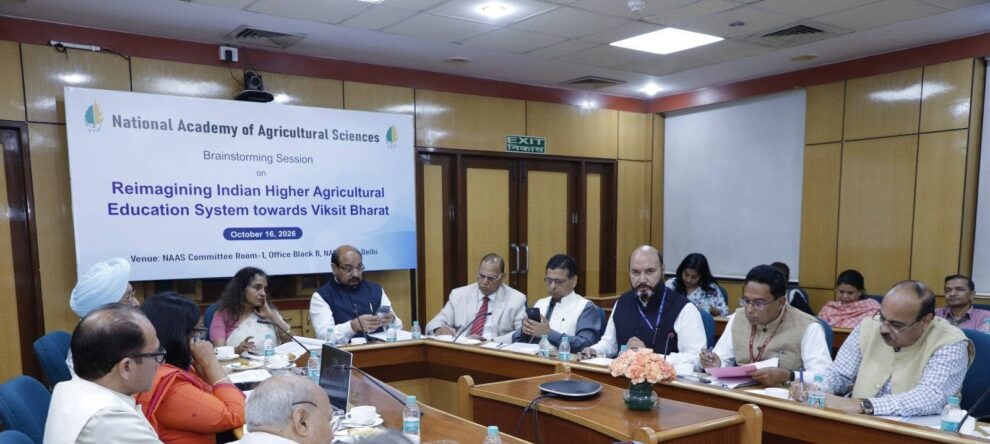
Mahesh Chander attended the Brainstorming Session on “Reimagining Indian Higher Agricultural Education System towards Viksit Bharat”, organised in Hybrid mode by the National Academy of Agricultural Sciences (NAAS), New Delhi, on 16 October 2026. He shares his experience here.
CONTEXT
India’s vision of Viksit Bharat@2047 envisages a developed nation characterised by economic prosperity, social progress, environmental sustainability and effective governance. Higher Education Institutions (HEIs) will be central to this transformation by creating knowledge, conducting research, fostering innovation, and promoting entrepreneurship. The National Education Policy (NEP) 2020 promotes multidisciplinary, research-driven education and targets a Gross Enrolment Ratio of 50% in higher education by 2035, emphasising the need to balance access, quality, relevance and inclusion. Agricultural education is pivotal to this vision, as agriculture encompasses nutrition, public health, climate resilience, natural resource management, markets and rural livelihoods.
Transforming India’s agri-food systems requires a skilled, multidisciplinary, future-ready workforce equipped with technical expertise, entrepreneurial capabilities, and problem-solving skills. This necessitates stronger integration of education, research, extension and policy.
Despite progress, higher agricultural education faces challenges in quality, accessibility, inclusiveness, industry relevance and graduate employability. Traditionally influenced by the US land-grant model, the system must evolve towards a “world-grant” perspective, integrating global knowledge with national priorities and local needs. Priorities include interdisciplinary and experiential learning, digital and vocational skills, entrepreneurship, faculty development, quality assurance and industry partnerships.
Against this backdrop, the brainstorming session brought together national and international experts to explore next-generation models for agricultural education. The deliberations sought to identify adaptable best practices, institutional innovations and actionable policy recommendations to enhance quality, relevance and inclusiveness, aligning agricultural higher education with the aspirations of Viksit Bharat@2047. The well-drafted CONCEPT NOTE as well as the TECHNICAL PROGRAMMEwas circulated in advance to streamline the discussions.
ABOUT THE BRAINSTORMING SESSION
Dr Anupama Singh, Joint Director (Education) and Dean, ICAR-IARI, and Dr K. M. Maredia, Professor and Director, World Agriculture Centre, Michigan State University, USA, convened the session, with Dr Anil Dahuja, IQAC Coordinator, ICAR-IARI, serving as Co-Convener. Dr M. L. Jat, President, NAAS, and Secretary, DARE, and Director General, ICAR, and Mrs Sripriya Ranganathan, Secretary (CPV & OIA), Ministry of External Affairs, Government of India, delivered the opening remarks as Chairperson and Co-Chairperson, respectively.
Dr Anupama Singh and Dr K. M. Maredia jointly presented the context, highlighting India’s demographic advantage and the expansion of higher agricultural education as opportunities to develop skilled human capital, strengthen innovation, and establish global knowledge leadership. They outlined key national initiatives, including National Education Policy (NEP) 2020, National Credit Framework (NCrF), National Skills Qualifications Framework (NSQF), Study Webs of Active-Learning for Young Aspiring Minds (SWAYAM), Scheme for Promotion of Academic and Research Collaboration (SPARC), Global Initiative of Academic Networks (GIAN) and National Apprenticeship Training Scheme (NATS), alongside ICAR’s regulatory and institutional frameworks. The National Agricultural Higher Education Project (NAHEP), implemented by ICAR with World Bank support in 2017, significantly strengthened digital infrastructure, faculty and student capacities, and international collaborations. Further directions are provided by ICAR’s NEP implementation roadmap and NAAS policy papers promoting multidisciplinary education, research-intensive institutions, academic flexibility and agripreneurship.
The fifth National Conference of Chief Secretaries (December 2025) reinforced the need for workforce-demand mapping, industry-aligned skilling, technology-driven agriculture and mission-oriented research. However, persistent gaps remain in vocational skills, experiential learning, industry engagement, interdisciplinary research, faculty development, and graduate employability. Limited mechanisms for technology commercialisation, internationalisation and workforce planning further constrain institutional potential. The presentation emphasised transitioning from the traditional land-grant model towards a globally connected, outcome-oriented “world-grant” approach to make higher agricultural education more responsive, innovative and globally competitive.
| India’s higher agricultural education system holds immense potential, but strengthening institutional capacity and implementation is essential to fully realise it. The Economic Survey 2025–26 underscores the importance of employment-focused skilling initiatives in bridging skill gaps and improving productivity. Only 4.9% of India’s population aged 15–29 years possesses a recognised vocational certificate. This significant skills gap highlights the need to integrate vocational training, experiential learning, and industry-relevant competencies into agricultural education to boost productivity, employability, and the availability of job-ready talent for emerging sectors. |
The Chairman and Co-Chairperson highlighted the immense potential of India’s Higher Agricultural Education (HAE) System in advancing Viksit Bharat@2047, emphasising the need to strengthen institutional capacity, implementation and alignment with emerging workforce demands. They underscored the importance of industry-relevant vocational skills, bridging the gap between research and commercialisation, promoting technology transfer, innovation and entrepreneurship, and strengthening interdisciplinary learning, international partnerships and academic mobility. Participants identified dynamic workforce assessment and skill-based curriculum reforms as essential priorities. Here arise the question, who will this?
The brainstorming session brought together national and international experts to deliberate on institutional transformation, curricular reform, quality assurance, global partnerships, innovative financing, research translation and education-to-employment linkages. Key recommendations included:
- integrating mainstream and vocational education,
- strengthening agriculture–industry collaboration,
- promoting international admission pathways,
- establishing agricultural education zones and
- developing multidisciplinary, research-intensive institutions.
The deliberations aimed to identify adaptable institutional models, foster sustainable global partnerships, strengthen institutional capacity and formulate actionable policy recommendations to transform HAEIs into inclusive, innovative and globally competitive institutions aligned with Viksit Bharat@2047.
NAHEP WAS GREAT, NOW WHAT NEXT?
Launched in 2017 with World Bank support, NAHEP was a transformative initiative that strengthened India’s National Agricultural Higher Education System through digital infrastructure, faculty and student capacity building, international collaborations, and improved educational outcomes, leading to enhanced institutional performance and increased student enrolment. However, the question now is: what next? The next phase must move beyond strengthening institutional capacity towards achieving global excellence, employability, innovation, and measurable societal impact.
Building on NAHEP’s achievements, ICAR and agricultural universities should implement NEP-2020 reforms, develop multidisciplinary, research-intensive institutions, promote flexible learning through the Academic Bank of Credits and multiple entry-exit pathways, and strengthen industry-academia partnerships. Agricultural education must be aligned with state, national, and global manpower demands, emerging industry clusters, and future skill requirements. Greater emphasis is needed on agripreneurship, technology-driven high-value agriculture, climate resilience, water and energy management, and national missions. Sustained investment, outcome-based accountability, and internationalisation will be essential to transform NAHEP’s foundation into a globally competitive, innovation-led agricultural education ecosystem.
The deliberations focused on transforming Higher Agricultural Education (HAE) from fragmented institutional approaches into an integrated, globally connected, outcome-oriented ecosystem. Key priorities included:
- experiential learning,
- curriculum alignment with national frameworks,
- global and national accreditation,
- internationalisation,
- human capital development,
- cross-sectoral capacity building,
- sustainable financing, and
- the evolution of agricultural universities from the traditional land-grant model to a broader world-grant perspective.
The policy also emphasised attracting and nurturing rural youth, transforming farmers into professional farm managers, strengthening research and innovation, improving education-to-employment linkages through active industry participation, and critically examining institutional rankings, relevance, and global competitiveness. These reforms aim to develop skilled, entrepreneurial and globally competitive graduates while enhancing institutional quality, research impact and responsiveness to national priorities.
The policy options envisaged an implementable framework that:
- integrates vocational education and skill development with mainstream agricultural education;
- a single-window database for agriculture–industry linkages;
- customised admission pathways for international students; and
- Skill India International Centres to develop globally competitive human capital.
Other proposals included integrated agricultural education zones that bring together industry, research institutions, technology and innovation parks, and foreign agricultural universities, along with a roadmap to establish world-class Multidisciplinary Education and Research Universities (MERUs) in agriculture and allied sectors. The group also considered a robust framework for strengthening institutional innovation and aligning university performance with national priorities as essential.
The BSS stressed for further efforts on:
- identifying adaptable best practices and innovative educational models;
- fostering enduring global networks for knowledge exchange and capacity building;
- establishing sustainable international partnerships; and
- charting a pathway to transform Higher Agricultural Education Institutions into globally recognised, high-performing, world-class universities aligned with Viksit Bharat@2047.
CLOSING REMARKS
The panellists raised several critical questions regarding the relevance, practical orientation and outcomes of higher agricultural education. Key concerns included the proportion of agricultural graduates who establish agri-clinics or pursue agricultural practice, and whether they have the competencies needed to sustain such ventures. They emphasised moving alumni networks beyond social interactions towards technological advancement, knowledge sharing, mentorship and resource mobilisation. The need to bridge the gap between theoretical learning and practical application through structured academic–industry internships and active engagement of Professors of Practice was also highlighted.
In his concluding remarks, the Chairman urged introspection on India’s global standing in agricultural education, the system’s ability to fulfil student aspirations, and its capacity to produce a globally competitive workforce. He underscored the importance of strengthening student–teacher relationships, mentoring, and promoting student exchange programmes within India and internationally to encourage cross-cultural learning and academic enrichment.
The Chairman further proposed preparing a comprehensive policy paper by December 2026, incorporating key issues, insights, and recommendations from the Brainstorming Session, to guide the future transformation of higher agricultural education in India.
MY OBSERVATIONS
Before this Brainstorming Session, several initiatives were suggested to improve agricultural education in India, including those documented in NAAS Policy Paper No. 99, New Agricultural Education Policy for Reshaping India. These documents offer several valuable recommendations for strengthening and reshaping agricultural education in the country. In this context, it would be worthwhile to reflect on the progress made in translating these recommendations into action. It would also be useful to review the outcomes of earlier workshops, brainstorming sessions, and deliberations, and to understand how they have contributed to policy and institutional changes.
I hope that the deliberations during this session will build upon these earlier efforts and help identify practical ways to move forward. A follow-up mechanism and periodic review of the recommendations could help ensure continuity and facilitate implementation.
It is hoped that the discussions and ideas emerging from this session will contribute to meaningful, tangible, and sustained improvements in the agricultural education scenario in India.
 Dr Mahesh Chander is a Fellow, National Academy of Agricultural Sciences (NAAS) – India. He served as an ICAR-ARS scientist for over 35 years and recently retired as Principal Scientist (Agricultural Extension) from the ICAR-Indian Veterinary Research Institute (ICAR-IVRI), Izatnagar, Uttar Pradesh, India. He served as Head of the Division of Extension Education at ICAR-IVRI for nearly 17 years and as In-charge Joint Director (Extension Education) at the Institute for over six years. He can be contacted at drmahesh.chander@gmail.com.
Add Comment