
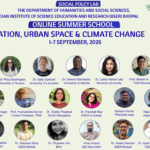
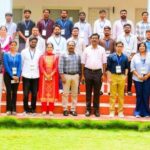
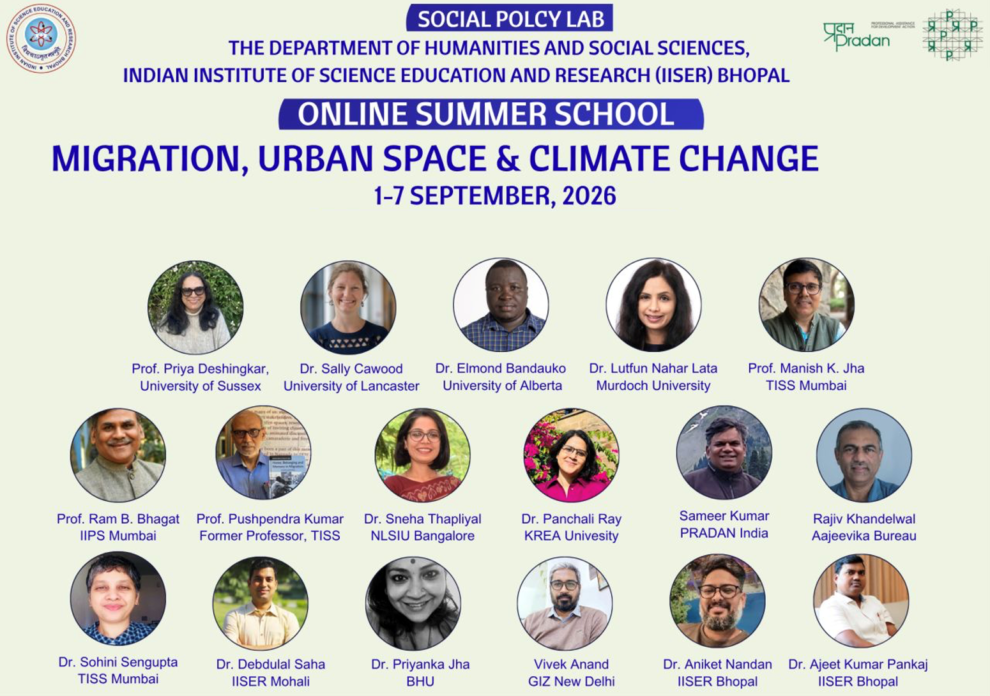
In this meeting note, Joe Shiney reflects on her participation in an online summer school organised by Social Policy Lab, IISER Bhopal.
CONTEXT
The Online Summer School on “Migration, Urban Space, and Climate Change”, organised by the Social Policy Lab, IISER Bhopal, from 1–7 September 2026, brought together researchers and practitioners working on migration, climate change, livelihoods, labour, gender and rural resilience. The programme explored migration beyond physical movement, highlighting how social, economic, environmental and spatial conditions shape mobility and immobility.
RETHINKING MIGRATION: BEYOND MOVEMENT FROM ONE PLACE TO ANOTHER
A major learning from the inaugural lecture by Dr. Arjan De Haan was the need to move beyond viewing migration simply as geographical movement. The question, “Who among us is not a migrant?” made me reflect on how different forms of mobility can have very different meanings. A person relocating by choice, a seasonal worker moving for livelihood and a farmer displaced by climate-related events may all be described as migrants, but their choices, constraints and vulnerabilities differ. Climate change should not be treated as a single or direct cause of migration; it interacts with livelihoods, inequality, land, caste, gender, opportunities and aspirations. This led to a more meaningful question: rather than asking only “Does climate change cause migration?”, how does climate change interact with existing vulnerabilities and livelihood conditions to shape people’s ability and need to move or remain in place?
The session by Dr. Sally Cawood on sanitation labour further showed how caste and coloniality shape occupational mobility. Historical inequalities may restrict choices, while younger generations may seek to move beyond inherited occupations. Migration therefore reflects both people’s choices and aspirations and the social and economic constraints they face.
MIGRATION IS ALSO A RELATIONSHIP BETWEEN PEOPLE AND PLACE
One of the most thought-provoking discussions came from Dr. R. B. Bhagat, who encouraged us to move beyond the commonly asked question, “Why do people migrate?”, and also ask, “Where do people migrate?” This shift placed place at the centre of understanding migration. Migration can therefore be viewed as a relationship between people and place; people change places, but places also change people.
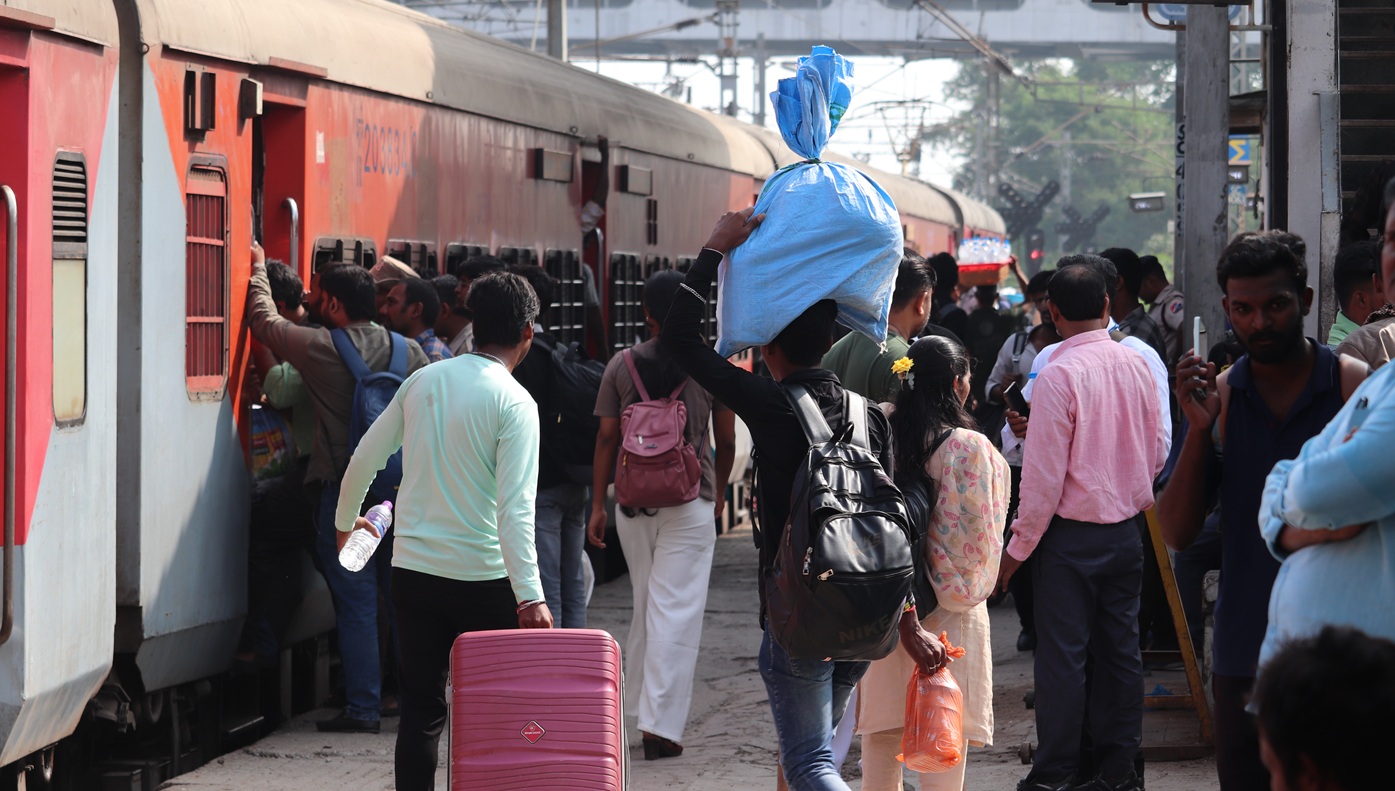
His distinction between space and place was particularly interesting. While space can be understood as relatively unbounded, place acquires meaning through people’s presence and relationships. The idea that “space with people is place” helped me think of migration as a process of making place out of space. The discussion also made me reconsider what home means. For seasonal and temporary migrants, home may not necessarily be a single fixed location. It can be experienced across multiple places and can change with circumstances. Similarly, migration is a form of mobility, but not all mobility constitutes migration. Seasonal migration, temporary labour migration, and displacement represent different forms of movement, each with different circumstances and consequences.
MIGRATION DOES NOT END AT THE DESTINATION
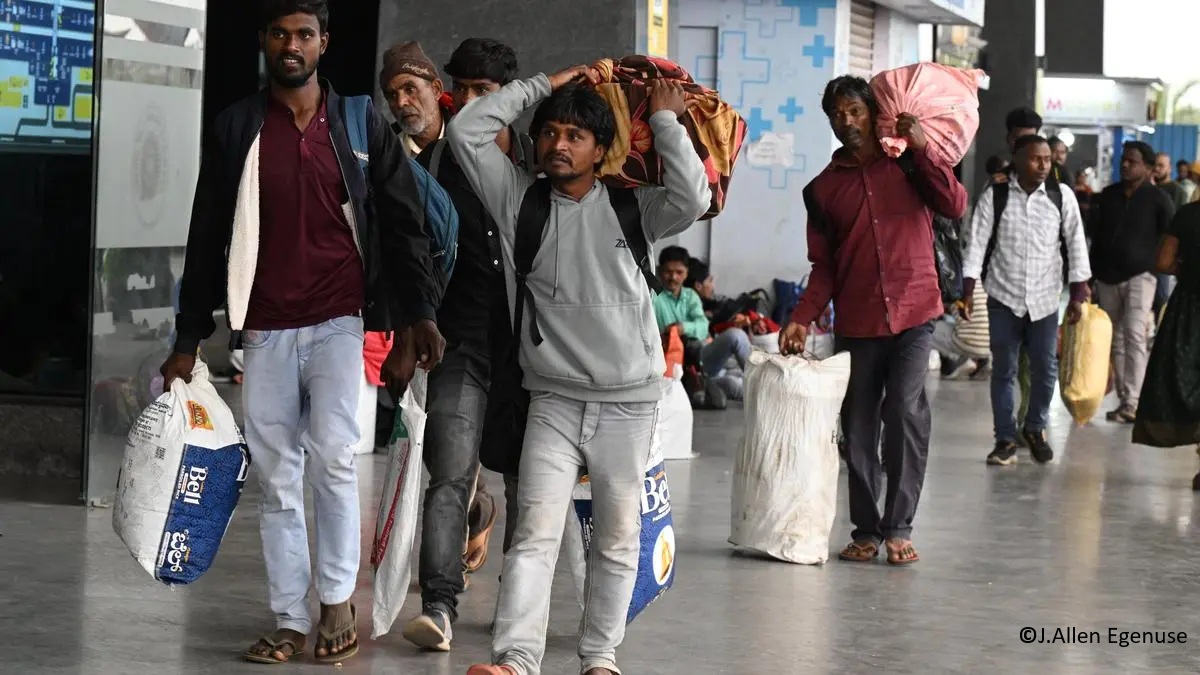
The sessions by Mr. Rajiv Khandelwal and Dr. Lutfun Nahar Lata on informal work and climate mobilities highlighted that migration does not necessarily end vulnerability after reaching a destination. Migrants may gain livelihood opportunities while continuing to face insecure work, unsafe conditions and limited access to housing and essential services. The discussions showed that rural–urban mobility involves multiple livelihood strategies and that cities can be spaces of both opportunity and exclusion, shaped by class, gender and migration status. This reinforced the importance of studying migration in both the place of origin and the place of destination.
UNDERSTANDING URBAN CLIMATE VULNERABILITY THROUGH A MIXED-METHOD APPROACH
Dr. Sneha Thapliyal’s discussion on urban heat was particularly useful for its mixed-method approach. The study combined GIS-based spatial analysis, household surveys, Q-methodology and policy analysis. GIS helped identify spatial patterns of heat exposure; household surveys captured experiences and responses; Q-methodology compared stakeholder perspectives; and policy analysis examined the gap between recommended adaptation measures and people’s actual opportunities to implement them. The key methodological learning was that complex climate problems cannot always be understood through a single method. Integrating spatial, household, stakeholder and policy-level evidence can provide a more comprehensive understanding of vulnerability and adaptation.
MARGINALISED GROUPS ARE NOT ONLY SUBJECTS OF CONTROL
The on-session “Subaltern Surveillance” offered a different way of looking at urban informality. Drawing on street traders in Harare, Dr. Elmond Bandauko questioned the conventional understanding of surveillance as something exercised only by the state. He introduced the idea of “flipping the surveillance gaze”, showing how marginalised groups observe and respond to those who monitor them.
Street traders developed knowledge of when and where municipal enforcement was likely to occur and used communication networks, collective vigilance and strategic relationships to negotiate contested urban spaces. These practices demonstrate that marginalised groups are not merely passive recipients of urban policies; they can also become observers, negotiators and active participants in shaping their everyday experiences of the city.
This concept offers an interesting lens for understanding informal and seasonal migrant populations in other urban contexts, including India. At the same time, the session appropriately cautioned against romanticising everyday resistance, since such strategies may provide temporary advantages without changing the structural conditions that create vulnerability.
DROUGHT, MOBILITY AND THE VULNERABILITY OF THOSE WHO CANNOT MOVE
Dr. Sohini Sengupta highlighted drought as a slow-onset disaster affecting agriculture, food and water security. The discussion showed that climate–mobility relationships are shaped not only by environmental conditions but also by livelihoods, geography, social and economic conditions, and access to resources and social protection.
An interesting discussion on place and distance, illustrated through the migration of monarch butterflies, encouraged attention to where migrants come from, where they go and how far they travel. More importantly, the session highlighted that not everyone affected by drought can migrate. Vulnerable households may remain in place because they lack the resources required to move. This led to an important reflection: immobility itself can be a form of vulnerability. The discussion on predictive and speculative knowledge also raised an important question: whose knowledge and voices are recognised when understanding drought and migration?
MIGRATION, GIG WORK AND NEW FORMS OF PRECARITY
The sessions on gig work connected migration with India’s changing labour economy. Dr. Debdulal Saha and Prof. Manish K. Jha highlighted how platform-based work creates opportunities but may also reproduce informality through long hours, low wages, insecurity, health risks and limited social protection.
Dr. Panchali Ray’s discussion on migration from the chars of the Ganga–Padma River further cautioned against explaining migration mainly through climate change. It highlighted the role of rural precarity, dispossession, labour relations, gender norms and women’s unpaid reproductive labour. Dr. Priyanka Jha’s session further showed how gender influences evacuation, care responsibilities, livelihood disruption, access to resources and recovery. Migration therefore does not automatically mean movement from vulnerability to safety.
FROM DISTRESS MIGRATION TO RURAL RESILIENCE
The session by Mr. Vivek Anand and Mr. Sameer Kumar highlighted how rural resilience, livelihood diversification and local opportunities can provide alternatives to distress-driven migration. The Enhancing Rural Resilience through Appropriate Development Actions (ERADA) project demonstrated how public works, climate-resilient natural resource management, GIS-based planning, IVRS advisories, living-income benchmarking, and enterprise development can strengthen rural livelihoods. The key takeaway was that stronger local livelihood opportunities can give households more choice about whether to stay or migrate.
THEORY MATTERS IN UNDERSTANDING MIGRATION
In the final session, Dr. Ajeeth Kumar Parkaj introduced Push–Pull Theory, Neoclassical Theory, New Economics of Migration, Segmented Labour Market Theory, Social Capital Theory, Cumulative Causation Theory and Transnational Theory. Push–Pull Theory explains how origin and destination factors influence migration, while other theories highlight households, social networks, labour markets, and structural conditions. This reinforced that theory shapes research questions, methods and interpretation.
KEY TAKEAWAYS
- Migration is a relationship between people, places, livelihoods and social structures, not simply physical movement.
- Asking “Where do people migrate?” is as important as asking why they migrate.
- Climate change interacts with livelihoods, inequality, caste, gender, geography and access to resources rather than operating in isolation.
- Some people migrate by choice or livelihood strategy, others face distress or displacement, while some vulnerable groups cannot move.
- Mixed-method and theoretically informed approaches can better connect household experiences with wider environmental, social and spatial processes.
IMPLICATIONS FOR AGRICULTURAL EXTENSION
The summer school highlighted connections between climate change, migration and rural livelihoods. Extension systems can move beyond technology transfer to support livelihoods, climate adaptation, information, skills, market linkages, and institutional coordination. Migration should not automatically be viewed as a failure of rural development; it may form part of livelihood strategies, while distress migration can indicate limited local opportunities.
Understanding who migrates, who remains, where migrants move and what vulnerabilities they encounter can help extension professionals design more responsive interventions. Strengthening local livelihood options, productive assets, and community institutions can also expand rural households’ choices. For researchers, the programme highlighted the value of integrating climate vulnerability, livelihoods, spatial context, migration, gender and inequality.
CONCLUSION
The summer school provided an interdisciplinary understanding of migration across rural and urban contexts. The most important reflection for me was that migration cannot be understood simply by asking why people move. We also need to ask where they move, what happens after they move, who can move, who cannot, and how places shape their experiences. The programme encouraged a shift from viewing migration as a problem or crisis to understanding the choices, aspirations, vulnerabilities, and structural constraints that shape mobility and immobility.
ACKNOWLEDGEMENT
I would like to express my sincere gratitude to the Vellore Institute of Technology (VIT), Vellore, for the opportunity and support to participate in the Online Summer School on “Migration, Urban Space, and Climate Change.” I am especially grateful to my research guide, Dr. Mohanraj K, for his guidance and encouragement.
I also extend my sincere thanks to Dr. Ajeeth Kumar Parkaj and Dr. Aniket Nandan, Social Policy Lab, Department of Humanities and Social Sciences, IISER Bhopal, for organising and facilitating the summer school. I am grateful to all the resource persons and speakers who shared their knowledge, research experiences and perspectives throughout the programme.
 Joe Shiney, M.A., is a PhD Scholar in Agricultural Extension Education at Vellore Institute of Technology (VIT). She holds a Master’s degree in Agricultural Extension Education and has professional experience with the M. S. Swaminathan Research Foundation (MSSRF), Ernakulam, Kerala. She is passionate about participatory learning, climate-resilient agriculture, climate-induced migration, gender-responsive extension, and inclusive, sustainable agricultural advisory systems. She can be reached at: joeshiney3@gmail.com
Add Comment