
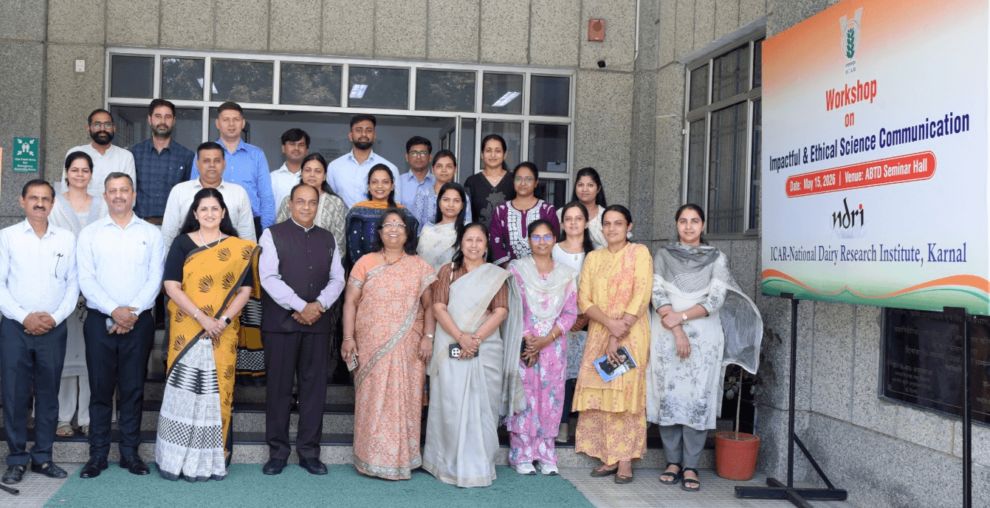
In this meeting note, Maina Kumari and Elizabeth Thomas reflect on their participation in the workshop jointly organised by ICAR-NDRI, Karnal and ICAR-DKMA, New Delhi.
CONTEXT
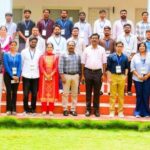
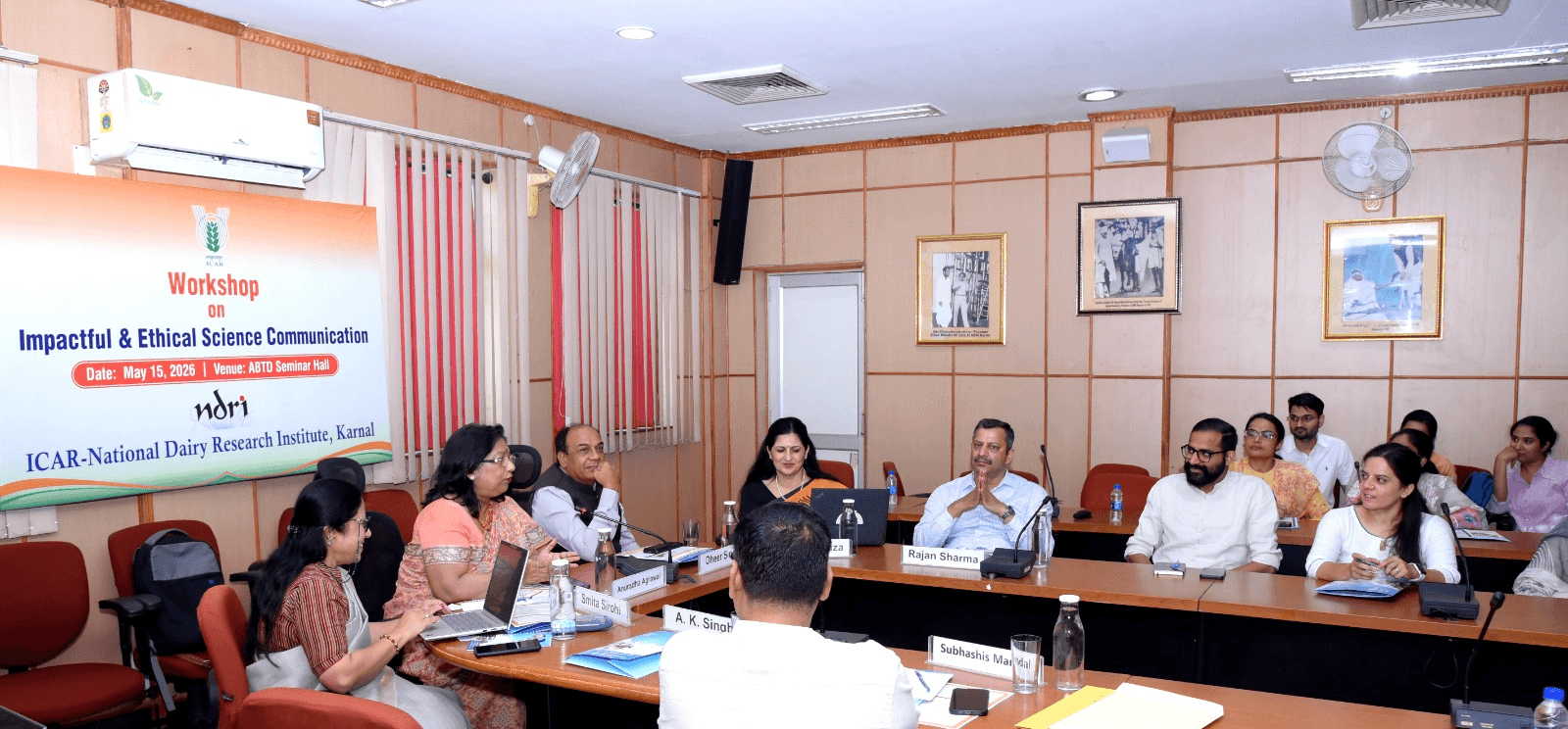
ICAR-National Dairy Research Institute (NDRI), Karnal, and ICAR-Directorate of Knowledge Management in Agriculture (DKMA), New Delhi, jointly organised a one-day workshop on May 15, 2026, titled “Impactful and Ethical Science Communication”, to promote excellence in academia. The workshop began with opening remarks by Dr Dheer Singh, Director of ICAR-NDRI, followed by sessions from eminent speakers Dr Smita Sirohi of ICAR-National Institute of Agricultural Economics and Policy Research, and Ms Sonal Dsouza from Alliance of Bioversity International and CIAT and Dr Anuradha Agarwal from DKMA. Dr Dheer Singh emphasised the growing importance of clear and responsible science communication in the digital age. He highlighted the need for researchers to develop strong communication skills to present complex scientific concepts in an engaging and accessible way for the public.
KEY CONVERSATIONS AT THE WORKSHOP
The workshop primarily targeted the institute’s young faculty members and focused on enhancing their research communication and publication skills. Key sessions covered Mastering Research Presentations, Ethics in Research Writing, The Art of Purposeful Pitching, Behind the Pages: A Publisher’s Perspective on Agricultural Journals, and How to Amplify Your Research Through Social Media.
Mastering the Research Presentation: Ms Sonal Dsouza highlighted key aspects researchers should keep in mind when drafting and presenting their research effectively.
- Always begin your presentation with a powerful hook to capture the audience’s attention and spark their interest from the very start. It can be a problem, a data point, a question, a story, or a myth-buster.
- The scientific presentations should begin with a research question, then describe the methodology or approach used, and conclude with key insights and their significance.
- Presentations should be designed like storytelling, with a clear narrative arc comprising the challenge, response, and result.
- Using real-world examples, analogies, emotions, and relevant data.
- Presentation content and writing style should be tailored according to the target audience, with practical communication approaches for farmers, impact-focused messaging for policymakers, and cost- and innovation-oriented perspectives for funding agencies.
- Using “one key idea per slide,” minimal text, highlighting keywords, incorporating relevant visuals, maintaining uniform fonts and applying simple colour schemes increases the presentability.
Ethical Research Writing: The Foundation of Credible Science: Dr Smita Sirohi highlighted unethical practices in research and scientific writing.
- Authorship order should reflect genuine intellectual contribution and should never be influenced by hierarchy, pressure, or personal favour.
- Practices such as buying and selling authorships are not ethical and should be avoided.
- “You write my name; I will write your name” practices in scientific research are unethical.
- AI use in manuscript writing should be declared. Which AI is used and for what purpose it is used, and it should be declared that “After using this tool/service, the author(s) reviewed and edited the content as needed.
- Use hedging to present research findings cautiously and objectively.
- Acknowledgements should be made to the people, centres, or bodies that have collaborated or supported the work in any form, including funding support.
- Contributors who did not meet any one of the criteria for authorship, such as (1) substantial contribution to the conception and design, (2) the acquisition of data, (3) statistical analysis of data, and (4) interpretation of the results or drafting or critically revising the manuscript, should not be listed as authors, but they should be acknowledged.
- Publishing a greater number of papers from a single research by slicing the data (Salami slicing) should be avoided.
Mastering the art of purposeful pitching: Ms Sonal Dsouza’s session provided valuable insights into structuring and delivering an effective pitch.
- A strong pitch should begin with a compelling hook and follow a storytelling approach.
- An effective pitch should create impact, focus on one key idea, and clearly communicate the core message.
- It should demonstrate real-world outcomes to make the idea more practical and convincing.
- The pitch must be tailored to suit the target audience.
- Confidence and impactful communication during delivery play a key role in making the pitch successful.
- Relevance of the idea is essential for making the pitch meaningful and effective.
Behind the pages: A publisher’s view of an agriculture journal: Dr Anuradha Agarwal encouraged us to step beyond the writer’s perspective and explore the world of publishing through a publisher’s lens.
- Publishing a research article is not only about strong research findings, but also about effective writing skills and clear presentation.
- Selecting the right journal using journal finder tools improves publication success.
- Researchers should carefully choose genuine subscription or free journals to avoid predatory publishing traps.
- Researchers can improve the global visibility of their work by carefully framing titles, abstracts, and keywords using SEO strategies.
- Collaboration among researchers enhances research visibility, impact, and academic reach.
- Novelty, quality communication, and reader relevance significantly improve the chances of manuscript acceptance.
- Responding professionally and constructively to reviewers’ comments helps strengthen scientific communication and improve the overall research ecosystem.
From Research to Recognition-The power of social media: Ms Sonal Dsouza highlighted the importance of using social media strategically to enhance the visibility, accessibility, and outreach of scientific research.
- Every researcher should use social media to increase the global visibility of their work.
- Complex research findings should be presented in a simple and easy-to-understand form.
- Use LinkedIn for professional visibility, academic networking, and institutional updates.
- Use X (formerly Twitter) for research sharing, policy engagement, academic discussions, and global scientific conversations.
- Use Facebook to reach farmers, students, extension workers, and the general public.
- Maintain consistency in posting, use relevant hashtags, tag collaborators, respond to comments, and engage in discussions.
- Avoid using too much technical jargon in posts.
- Use short captions and add alt text to improve accessibility.
REFLECTION AND CONCLUSION
The workshop was a highly enriching and transformative experience that significantly enhanced my understanding of ethical research communication, scientific writing, presentation skills, and professional outreach. It served as an eye-opener by highlighting how ethical considerations in research and communication can sometimes be compromised, both intentionally and unintentionally. Through interactive sessions, practical activities, and expert guidance, the workshop provided valuable knowledge and practical strategies applicable to academic and professional life. The sessions not only improved my technical understanding of scientific communication but also broadened it.
I felt that several challenges could potentially undermine ethical communication within research organisations, such as:
- Pressure to publish and meet Career Advancement Scheme (CAS) requirements may compromise research integrity.
- Hierarchical influence within organisations can discourage ethical decision-making and transparency.
- Peer pressure and competition may lead to unethical research and publication practices.
- Lack of awareness and proper training on research ethics can result in unintentional misconduct.
- Predatory journals and publication pressure create challenges in maintaining ethical publication standards.
To overcome these challenges, such training programmes should be organised for individuals at all hierarchical levels and incorporated into foundation training programmes.
Acknowledgement
The participants sincerely acknowledge Dr Dheer Singh, Director, ICAR-NDRI, Karnal, for his patronage. The participants also express sincere gratitude to the Course Director, Dr Anuradha Agrawal, ICAR-DKMA, New Delhi, and the Course Coordinator, Dr Subhasis Mandal, Head, DESM ICAR-NDRI, Karnal.
 Dr Maina Kumari, Scientist, Dairy Extension Division, ICAR-NDRI, Karnal, she can be contacted at mainadhaka1591@gmail.com
 Dr Elizabeth Thomas, Scientist, Dairy Technology, ICAR-NDRI, Karnal, she can be contacted at elizabethblesson1109@gmail.com
Add Comment