



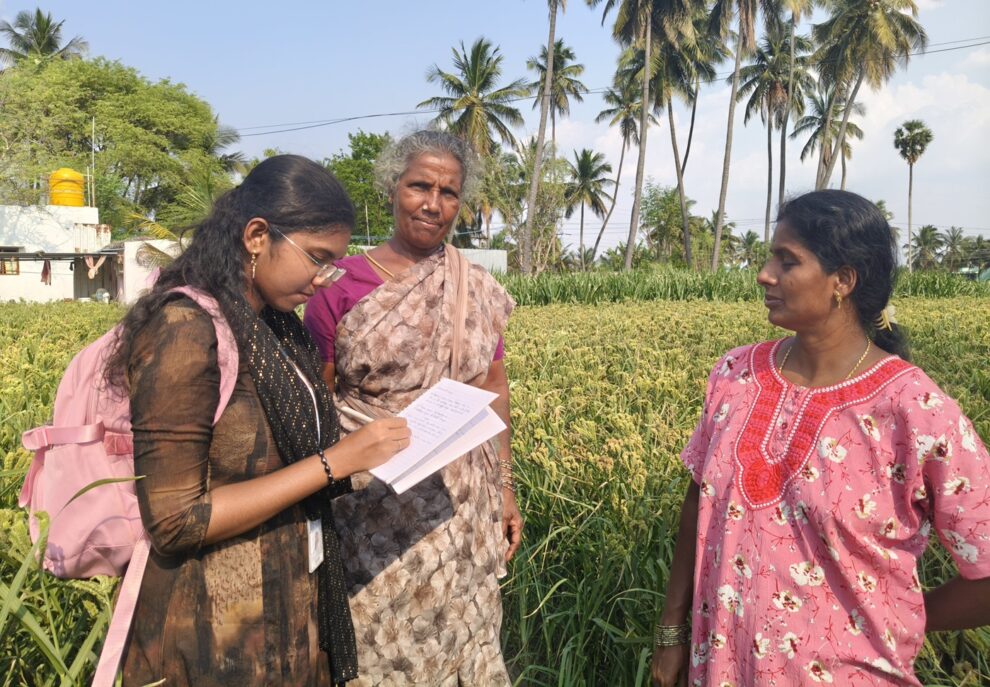
In this blog, Juno Ashok reflects on her experiences and learnings from fieldwork, highlighting the importance of being empathetic towards respondents and approaching data collection as an opportunity to learn—rather than simply as a means of gathering the data needed for a study.
CONTEXT
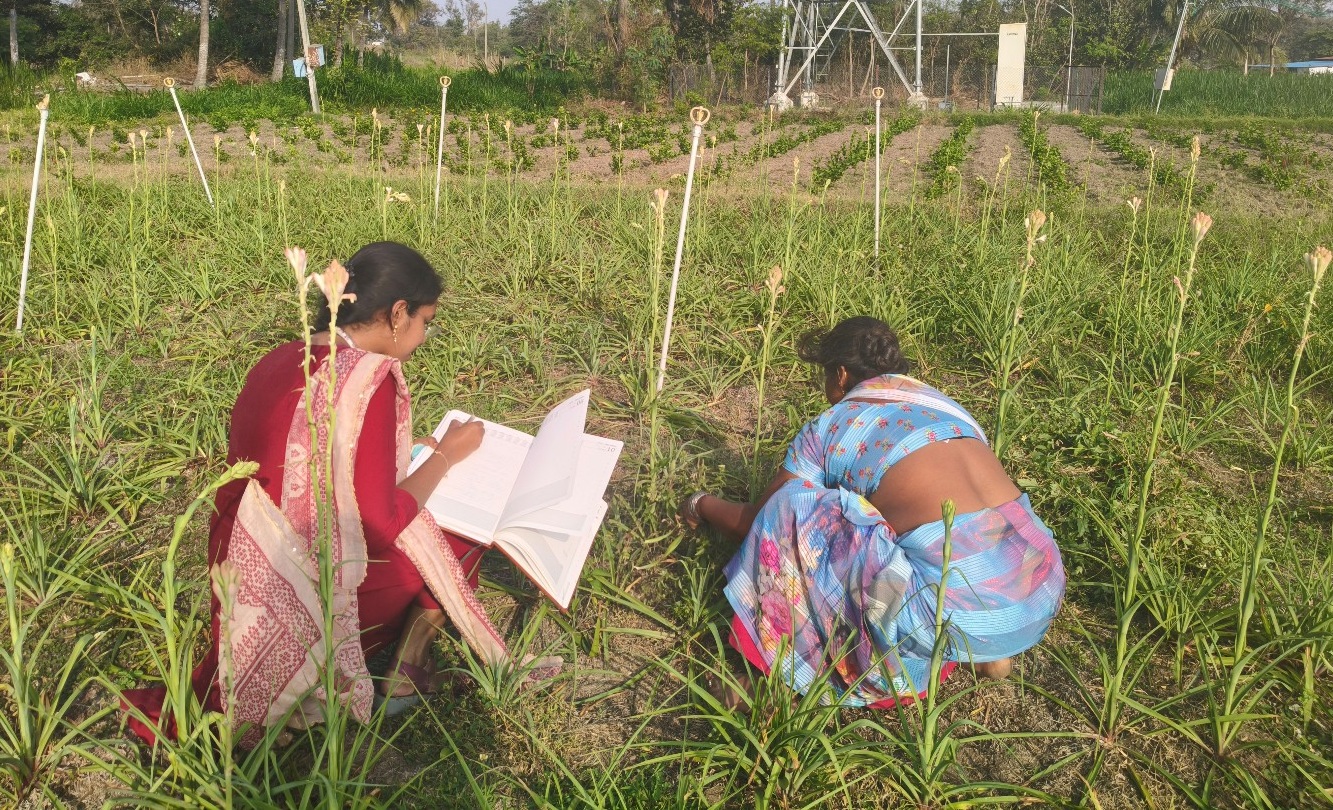
The farmer looked at me for a few seconds before answering my question. Then he smiled and asked, “Will this survey help us get any subsidy?” Around him, a few other farmers paused their work and waited for my response. At that moment, I realised that while I had come looking for data, the farmers were trying to understand something entirely different—the purpose behind my visit. What appeared straightforward in research methodology textbooks became far more complex in practice. Farmers rarely viewed surveys as academic exercises. Conversations extended beyond questionnaires, responses were influenced by people around them, and numbers often carried stories that could never fit into a spreadsheet. Gradually, I began to question a basic assumption underlying most field research: Are we really collecting data, or are we co-creating it through our interactions with respondents?
The more I reflected on these experiences, the clearer it became that field data are not produced by the questionnaire alone. They emerge through an interaction between the researcher, the respondent, the questions being asked, and the social context in which the conversation takes place. What a farmer chooses to share, how a question is understood, and even the meaning attached to a response can be shaped by trust, expectations, relationships, and the presence of others. In this sense, data collection is not always a one-way process of extracting information; it can become a process of co-creating meaning between the researcher and the farming community?
THE CHALLENGE
Varying Expectations of Respondents
One of the first realities I encountered was that every farmer interpreted a survey differently. Many farmers associated surveys with government programmes, subsidies, training programmes, or development initiatives. Their questions were often less about the survey and more about what might come after it. Would their concerns reach policymakers? Could this survey bring any support to their village? Would this study help them access a scheme?
Initially, I wondered whether these questions indicated that the purpose of the study had not been communicated clearly enough. However, I gradually realized that even when the purpose and nature of the interview were explained, farmers interpreted the interaction through the lens of their previous experiences with government departments, extension agencies, researchers, and development programmes. Their questions therefore reflected more than a need for clarification; they revealed the expectations and concerns they brought into the interview. Farmers were not merely respondents waiting to answer questions; they were individuals trying to understand the purpose behind yet another visit from an outsider. Building trust therefore became just as important as explaining the study and administering the questionnaire.
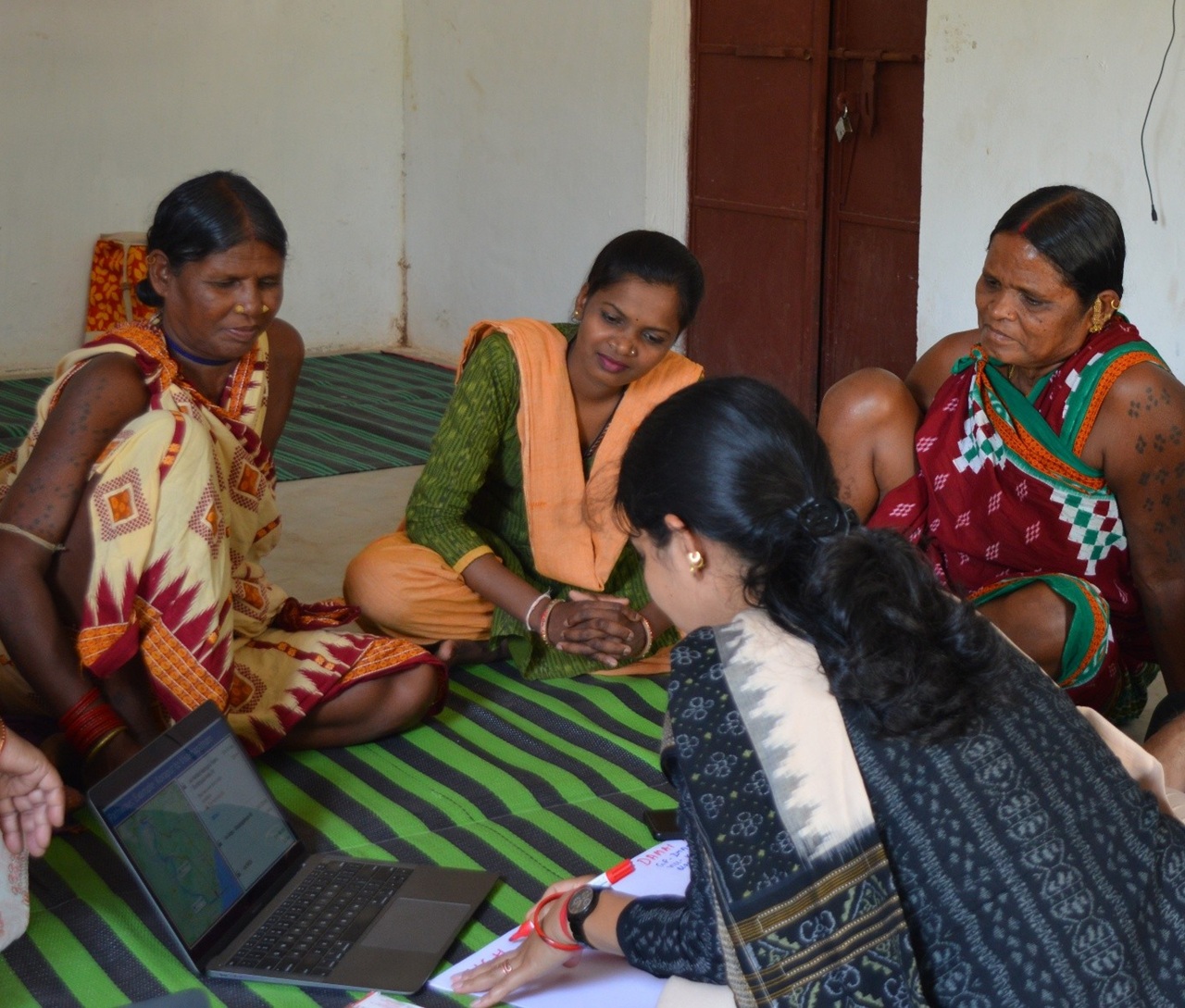
As interviews progressed, another interesting reality emerged. Research designs often assume that respondents provide independent opinions. Rural life rarely works that way. A farmer interviewed alone could provide very different responses from the same farmer interviewed in the presence of neighbours or family members. What began as an individual interview would sometimes transform into a group discussion, with neighbouring farmers offering their own interpretations and experiences.
Women respondents offered another important insight. In many households, agricultural decisions are discussed collectively, and responses often reflected household perspectives rather than individual opinions. This reminded me that farming decisions are rarely made in isolation; they are shaped by relationships, responsibilities, and shared experiences.
Researchers Love Numbers. Farmers Live Experiences
Perhaps the greatest challenge, however, was not social—it was numerical.
Questionnaires ask for exact figures on yield, income, expenditure, labour costs, and returns. Yet many farmers do not maintain detailed records. They remember the season, the rainfall pattern, the market price fluctuations, and whether the harvest was better or worse than the previous year. Asking for precise numbers often required them to reconstruct entire seasons from memory.
Income-related questions were particularly sensitive. Some farmers were cautious while discussing their earnings, partly because they feared that disclosing higher incomes might affect their eligibility for existing schemes and benefits. Others simply provided approximate figures because exact records were unavailable. This was not dishonesty. It was a reflection of how rural livelihoods operate. The neat precision that appears in research reports often originates from realities that are far more fluid and complex.
Identifying the Right Respondents
Another lesson came from identifying respondents. Researchers often depend on local extension personnel, village leaders, or progressive farmers to establish contact. Their support is invaluable and often makes fieldwork possible. However, I gradually realized that the most visible farmers are not always the only farmers whose experiences matter. Farmers who are active in village meetings, associated with farmer groups, or already known to extension personnel may be easier to identify and approach, while women, smallholders, tenant farmers, older farmers, or those less connected to local institutions may remain less visible. This can shape not only who participates in a study but also which experiences become represented in the resulting dataset. Some voices are easier to reach than others. This reminded me that representativeness is not only a statistical concern but also a social one. The process through which respondents are identified is itself part of field methodology and deserves careful attention.
DEMYSTIFYING ACADEMIC TERMS
One of the most surprising lessons came from discussions around climate-smart agriculture. When asked whether they were aware of climate-smart agriculture, many farmers responded negatively. Yet as the conversation continued, they described practices such as crop diversification, moisture conservation, drought-tolerant varieties, organic nutrient management, and adjustments in sowing dates based on weather conditions.
At first glance, this seemed contradictory. In reality, it revealed a gap between the language of researchers and the language of farmers. Farmers often practice more than they can name. They may not be familiar with academic terminology, but they possess a deep understanding of practical solutions developed through years of experience and adaptation. This realization reminded me that extension is not merely about introducing new concepts; it is also about recognizing and building upon existing knowledge.
The experience also highlighted the importance of communication. Some questionnaires are filled with concepts that make perfect sense in research proposals but sound unfamiliar in villages. A good interviewer is therefore not someone who reads questions exactly as written. A good interviewer is someone who can translate academic language into meaningful conversations. Often, a simple example from everyday farming life generated more useful responses than a technically perfect question.
UNINTENTIONAL LEARNINGS
Yet the most memorable moments from fieldwork were not recorded in the questionnaire at all.
Many interviews took unexpected turns. A question about crop production would lead to a discussion about labour shortages. A question about farm income would become a conversation about educational expenses, health concerns, debt, or migration. Farmers frequently spoke about market uncertainties, erratic weather, rising cultivation costs, and the challenges of sustaining agriculture as a livelihood.
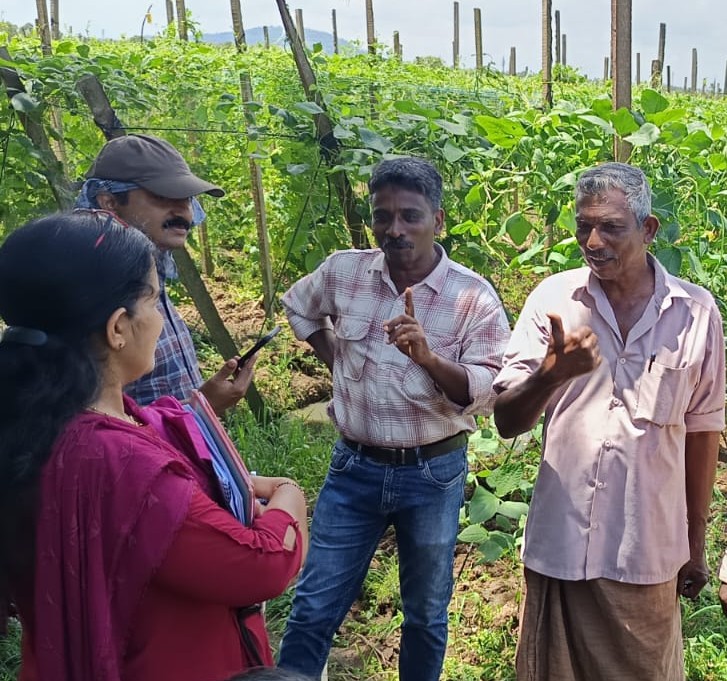 In one instance, a question about farm income led to a long conversation that had little to do with income itself. The farmer spoke about rising cultivation costs, uncertainty about rainfall, difficulties in finding labour, and concerns about whether the next generation would remain in agriculture. The questionnaire remained open on my lap while the conversation moved far beyond its pages. That interaction reminded me that farmers often carry concerns that cannot be captured through predefined response categories.
Initially, I worried that these conversations were taking time away from the survey. Over time, I realized they were often the most important part of the interaction.
Ironically, some of the most valuable insights emerged after the questionnaire had ended. The stories farmers shared often explained survey findings better than the numbers themselves. A low adoption rate could be linked to labour shortages. Income variability could be traced to market fluctuations. Decisions that appeared irrational in datasets suddenly became understandable when viewed through the lens of everyday realities.
IMPORTANCE OF EMPATHY
While researchers visit villages seeking data, farmers often see these interactions as rare opportunities to be heard.
Many farmers simply wanted someone to listen. They spoke about years of uncertainty, frustrations with agriculture, and concerns about the future. In those moments, the role of the researcher extended beyond collecting information. Empathy became as important as methodology. Listening respectfully was not merely a courtesy; it was an essential part of understanding the realities behind the data.
END NOTE
In the field, every number has a story behind it. These experiences taught me three lessons.
First, trust-building is as important as questionnaire design.
Second, communication matters more than terminology.
Third, some of the most valuable insights emerge when researchers pause their questioning and simply listen.
 These lessons also point towards the value of mixed-methods research designs in agricultural extension. Quantitative approaches are essential for identifying patterns, measuring adoption, comparing groups, and generating evidence at scale. However, numbers alone may not explain why farmers make particular decisions, how they interpret new technologies, or what social and livelihood realities shape their choices.
Qualitative conversations can provide the context needed to interpret these patterns and reveal perspectives that predefined response categories may overlook. Rather than treating qualitative insights as supplementary to quantitative data, agricultural extension research can benefit from integrating both approaches from the outset. After all, people do not live in datasets; datasets emerge from people’s lives.

Juno A M is currently pursuing M.Sc. in Agricultural Extension Education at Tamil Nadu Agricultural University, Coimbatore and is an AESA Volunteer. She can be reached at amjuno2001@gmail.com.


Add Comment