



For those who have worked closely with coconut farmers and the extension community, this year’s World Coconut Day theme, “Coconuts in Times of Uncertainty: Securing Food, Energy, and Livelihoods,” resonates deeply. In this blog, M. K. Rajesh, S. Jayasekhar and K. P. Chandran bring this theme to life, highlighting the everyday realities and challenges faced by coconut-growing communities.
CONTEXT
Let us be honest about where the sector stands. Multiple, overlapping crises grip the coconut economy. Climate change is no longer a distant threat. It is a lived experience for farmers across the coconut belt. Rising temperatures, erratic rainfall, and pest outbreaks such as whitefly infestations have devastated plantations. They have altered the coconut landscape in several heartlands. Farmers report steep yield declines. Many ageing palms are turning unproductive well before the end of their natural lifespan.
Globally, the picture is equally challenging. The threat of El Niño-linked dry spells looms over Southeast Asian production. This leads to reduced rainfall, heat stress, and delayed flowering, all of which directly affect yields and copra quality. Ageing plantations, stagnant field productivity, and a widening gap between production and demand define the current state of the global coconut sector. Conflicts near major shipping and energy routes are also pushing up freight and input costs, adding further strain to an already stretched sector.
Yet amid this uncertainty, real opportunity remains. Global demand for coconut-based products is surging. This includes virgin coconut oil, coconut milk, activated carbon, and cosmetics. India’s coconut product exports rose by 62 per cent in 2025 to 2026, climbing to ₹7,038.35 crore from ₹4,349.03 crore the previous year. This growth was driven largely by value-added products reaching markets well beyond the traditional Middle East corridor, into the US, Europe, and Australia. The challenge, therefore, is not finding a market. It is producing enough, sustainably, and ensuring that farmers actually benefit from this growing demand.
RESPONDING TO THE CHALLENGE
Over the past decade, a wide range of interventions have been rolled out across the coconut sector. It is important to acknowledge these efforts before discussing what needs to change.
Promoting Improved Varieties and High-Density Planting
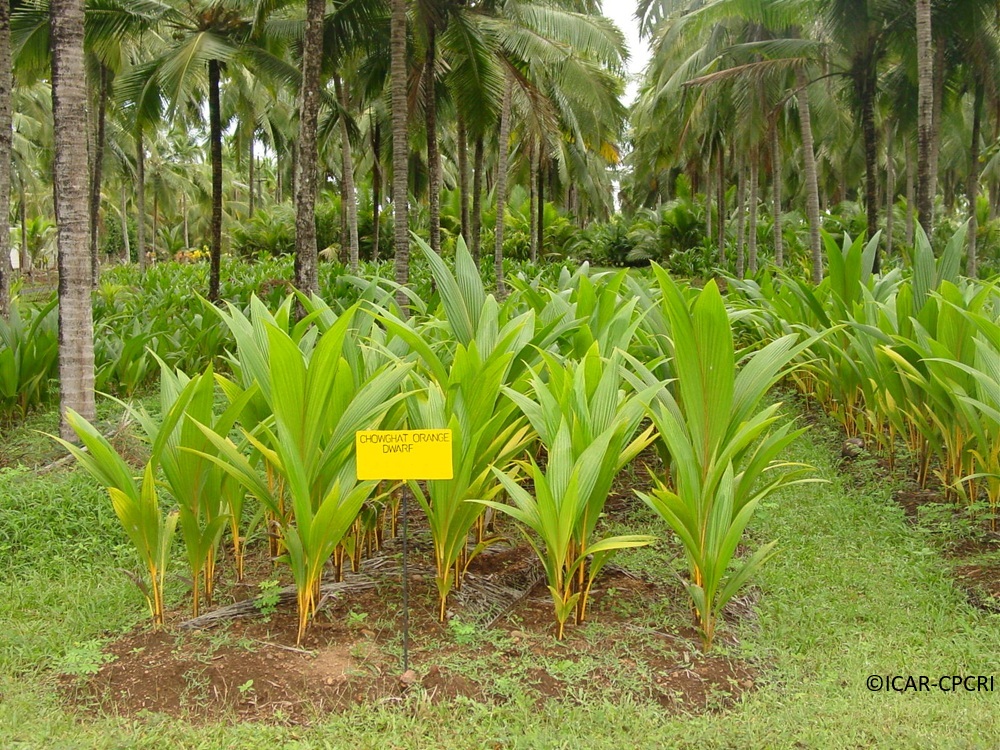
In India, the ICAR-Central Plantation Crops Research Institute (CPCRI) and the State Agricultural Universities have together released close to thirty improved coconut varieties, both tall and dwarf, suited to different climate zones. They have also released around 20 Dwarf by Tall hybrids that bear earlier and yield more than traditional tall varieties. Depending on the hybrid and management conditions, these can yield between 100 and over 160 nuts per palm per year. This is well above the yield of unimproved tall cultivars. The state Departments of Agriculture and Horticulture and the Krishi Vigyan Kendras (KVKs) have been actively promoting these varieties on the ground.
Organising Farmers through FPOs and FPCs
The Coconut Development Board (CDB) and the National Bank for Agriculture and Rural Development (NABARD) have made significant efforts to organise coconut farmers into Farmer Producer Organisations (FPOs) and Farmer Producer Companies (FPCs). The idea is to enable small and marginal farmers, who dominate the sector, to pool their produce, access better markets, and negotiate better prices. Several coconut FPOs have shown genuine promise. A few have even won national recognition for their performance.
Strengthening Value Addition and Processing
Training programmes on value addition are being conducted regularly by both research and extension agencies involved in the coconut sector. These cover everything from virgin coconut oil production to coconut chips and neera. The newly announced Coconut Promotion Scheme under the Union Budget 2026-27 aims to raise productivity, replace ageing and non-productive palms, and strengthen processing capacity. It forms part of a broader ₹350 crore allocation for high-value crops, which also covers cashew and cocoa. Implementation details, including the scheme’s coconut-specific outlay, are still being worked out. This is itself a reminder that intent on paper must be matched by pace on the ground.
Digital and Innovative Extension
Cyber extension activities are bringing information closer to farmers. These include mobile applications such as Krishi Sparsham, developed by the ICAR-KVK Pathanamthitta in Kerala, that can diagnose pests, diseases, and nutrient deficiencies. In Lakshadweep, the KVK, in collaboration with the Department of Agriculture, introduced the barn owl as a biological control method to combat rodent damage, which accounts for 40-50% yield loss in the islands. Rodents account for an estimated 40 to 50 per cent of yield loss on the islands. The initiative also runs skill development programmes that have created rural employment.
These are commendable efforts. But have they succeeded as much as hoped?
THE HARD TRUTH: WHAT HAS NOT WORKED, AND WHY
The Adoption Gap
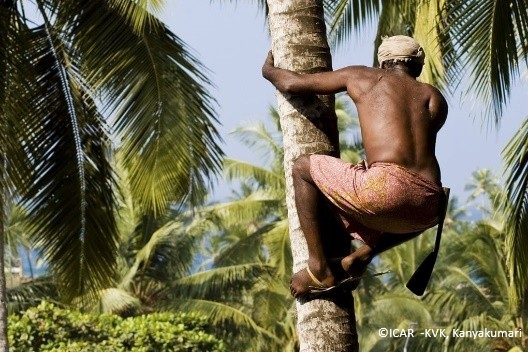
Despite the release of improved varieties and high-density planting recommendations, adoption among small and marginal farmers remains low. Why? Because farmers need access to quality planting material at affordable prices, credit to make the transition, and assurance that the market will reward their investment. Most of these enabling factors are often not available. Moreover, extension agencies often focus only on providing information on crop management; while necessary, this alone is not enough to promote adoption.
FPOs: From Promotion to Performance
The push for FPOs has been vigorous, but the outcomes have been mixed. Diagnostic studies of coconut FPOs have revealed significant challenges. These include poor coordination among stakeholders, hasty promotion without adequate capacity building, and insufficient attention to business viability. Many FPCs struggle with inadequate funding, limited technology support, and a shortage of managerial expertise. Farmers cite a lack of awareness of the benefits and capital requirements, as well as uneven distribution of gains, as reasons for staying out. Without market linkages, processing infrastructure, and professional management, FPOs risk remaining hollow structures on paper.
Value Addition: Bridging the Gap between Training and Reality
Countless training programmes on value addition have been conducted. But how many farmers have actually moved from selling raw nuts to producing value-added products? The constraints are well documented. They include limited access to training, lack of equipment, high costs of processing machinery, inadequate market infrastructure, and poor access to credit. A farmer who learns to make virgin coconut oil in a two-day training, but cannot afford an expeller or find a reliable buyer for the oil, has not really been empowered.
The Coordination Deficit
Perhaps the most persistent challenge is the lack of coordination among the many agencies working in this sector. These include research institutes, the Coconut Development Board, State Agriculture Departments, KVKs, the Agricultural Technology Management Agency (ATMA), and NABARD. Each tends to operate with its own priorities, timelines, and reporting lines.
WHAT SHOULD EXTENSION DO DIFFERENTLY?
As we celebrate World Coconut Day 2026, the extension community should make a fundamental shift in how coconut development is approached.
Move from Technology Transfer to Ecosystem Building
The traditional extension model assumes that if a good technology is developed and farmers are told about it, adoption will follow. It does not always work that way. What is needed is an entire ecosystem around each technology. This means ensuring availability of quality planting material, facilitating access to credit, creating market linkages, and providing support after farmers adopt a new technology. The Coconut Promotion Scheme’s holistic intent is a step in the right direction, but implementation must match that intent.
Make FPOs Work, Not Just Exist
FPO performance needs to be measured, not assumed. This means investing in professional management, providing hand-holding support for at least 3 to 5 years, and ensuring that FPOs have access to working capital, processing infrastructure, and market intelligence. The success stories show what is possible when these elements come together. The task now is to learn from them and scale what works.
Take Value Addition to the Village Level
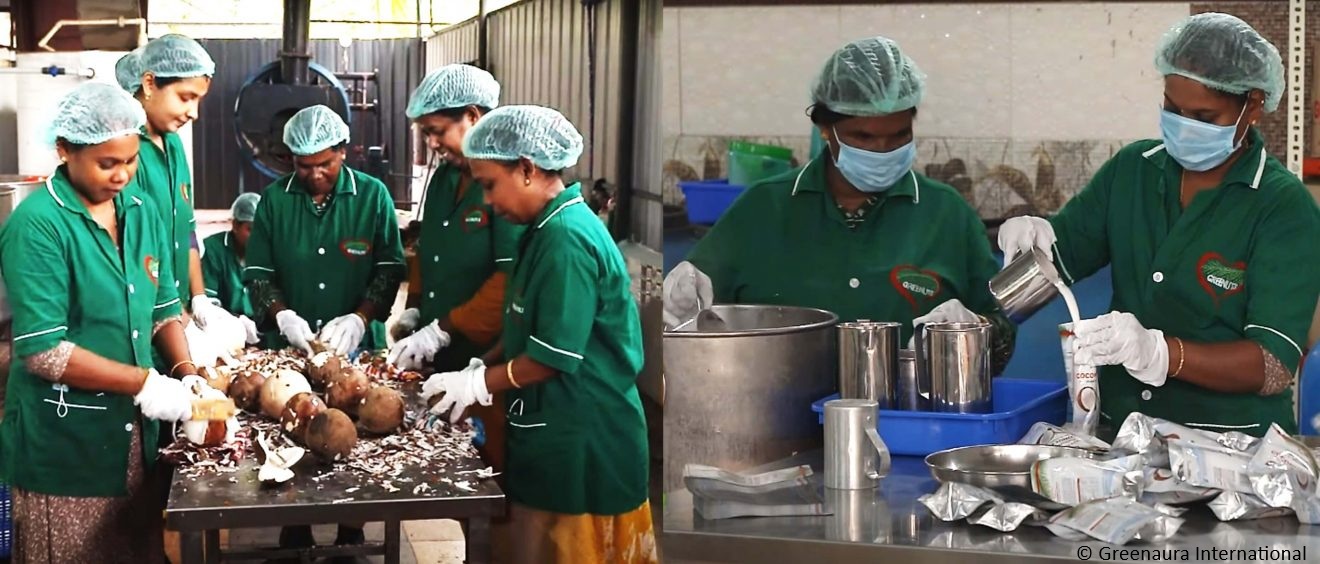
Instead of expecting farmers to become entrepreneurs overnight, a graded approach is needed. Start with simple, low-cost value-addition, such as improved copra drying with solar dryers or tender coconut water bottling at the village level. Then move progressively to more sophisticated processing as skills and infrastructure develop. The focus should be on reducing post-harvest losses and capturing more value at the farm gate.
Embrace Climate Smart Extension
Climate change is not a future scenario. It is the present reality. Extension must build climate risk management into every piece of advice given. This means promoting drought-tolerant varieties, climate-
resilient cropping systems, soil health management, and weather-based advisories. It also means helping farmers diversify through intercropping, integrated farming systems, and alternative livelihood options to build resilience to climate shocks.
Use Digital Technology Strategically
Cyber extension and mobile apps are a good start, but the sector needs to go further. Real-time market price information, weather forecasts, and pest and disease alerts must reach farmers when they need them most. Hello Naariyal is a good initiative, but a call centre cannot replace the trust and contextual advice that a local extension worker provides. Digital tools should support human extension, not replace it.
Coordinate
This is perhaps the most important; the sector cannot afford to keep working in silos. All stakeholders must come together under a unified framework. A district-level coconut development plan, owned and implemented jointly by all stakeholders, with clear roles and accountability, is long overdue.
CONCLUSION: EXTENSION AS AN ECOSYSTEM ENABLER, NOT MERELY AN INFORMATION PROVIDER
This World Coconut Day, as the coconut palm’s remarkable potential to secure food, energy, and livelihoods is celebrated, it is worth committing to doing extension differently. The uncertainties, whether climate, market, or geopolitical, are not going away. But neither is the coconut palm. It has sustained communities for centuries, and it will continue to do so if the extension community rises to the occasion.
The shift required is clear. It means moving from being information providers to being ecosystem enablers. It means moving from counting outputs to measuring outcomes. It means working together rather than competing. Above all, extension must listen to farmers, not as passive recipients of technical wisdom, but as partners in building a resilient coconut future.
The 2026 theme sets the challenge: “Coconuts in Times of Uncertainty: Securing Food, Energy, and Livelihoods.” Extension systems must rise to match it, so that when the next generation looks back at this moment, they see not just uncertainty, but the determination of an extension community that refused to give up on the coconut palm, or on the farmers who depend on it.
 Dr. M. K. Rajesh, Principal Scientist and Head at ICAR-CPCRI Vittal, has 27 years of research in coconut genomics, including genome assembly and transcriptomics. His contributions include developing molecular markers, improving tissue culture protocols, and releasing five coconut varieties. He can be reached at: rajesh.mk@icar.org.in
 Dr. Jayasekhar Somasekharan, an agricultural economist and Principal Scientist at ICAR–CPCRI, Kasaragod, holds a PhD in Economics from Jawaharlal Nehru University, specializing in international trade. With over 20 years of experience in plantation-crop economics, policy analysis, and commodity value chains, he also served as an ITEC Expert in Tonga, helping develop a strategy to revitalise the coconut sector and earning a Certificate of Merit from the Government of Tonga. He can be reached at: jayasekhar.s@icar.org.in
 Dr Chandran K. P. is a Principal Scientist in Agricultural Statistics at ICAR-CPCRI, Kasaragod. He specialises in statistical and computational methods for plantation crop research, focusing on advanced approaches to address complex challenges and support evidence-based decision-making. He can be reached at: chandran.kp@icar.org.in
Very insightful blog. And really connected to the ground reality faced by coconut farmers. And the real challenges faced by them.
Timely and important perspective on reimagining agricultural extension. The shift from technology transfer to ecosystem building is exactly what is needed to make extension more relevant to today’s farmers. Rightly emphasised, resilient coconut farming will require more than technologies—it will require strong farmer institutions, effective advisory systems, market linkages, value addition and sustained support.
A valuable contribution to the conversation on reimagining agricultural extension system for uncertain times. Congratulations to the authors & AESA.
I read the blog written by three eminent coconut scientists—outside the ‘extension frame,’ of course—and am happy to note that the need for reimagining extension is well articulated by them. It’s a welcome step. Dr. Rajesh (Biotechnologist), Dr, Jayasekhar (Agricultural Economist) and Dr. Chandran (Ag. Statistician) have penned this nice blog for extension professionals to consider and act upon.
I feel Behavioural Economics can improve extension services for coconut development by shifting the focus from technical inputs to optimizing how farmers make the right decisions. I would like Dr. Jayasekhar to respond.
Since coconut is a perennial crop with long gestation periods, technology adoption by farmers is likely to be affected by cognitive biases and risk aversion and even social norms.
I suggest two behavioural solutions for the coconut farmers. as examples
1. For coconut promotion, commitment devices and framed incentives could be a solution. The supply of HYV coconut seedlings can be combined with immediate short term compensation, such as supplying intercropping seed kits tooffset the temporary income gap.
2. In the case of value addition, extension messages must frame value addition through the lens of preventing loss rather than gaining profit. Also, modern digital tools such as Bharat Vistaar AI tools can be used for delivering micro tangible, just in time nudges for young coconut farmers”