
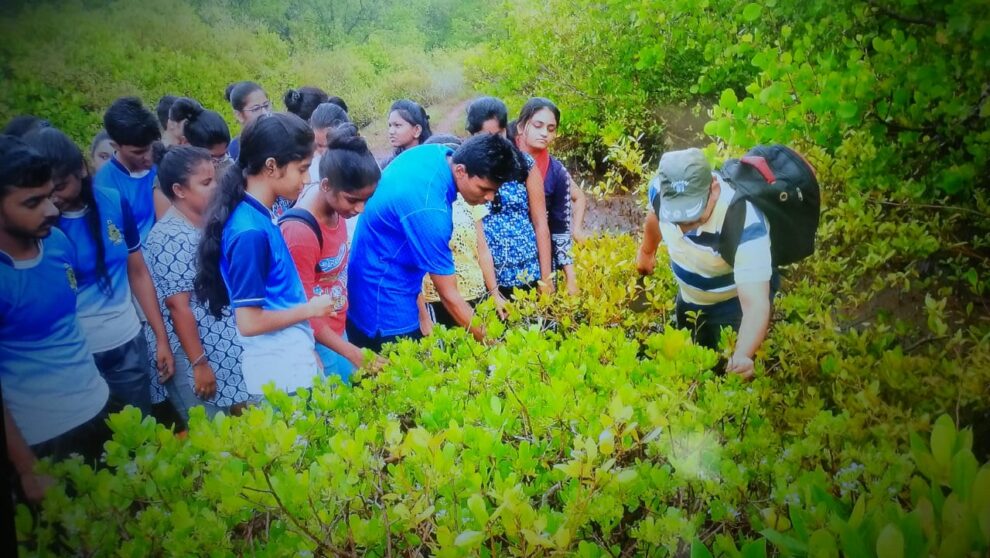
Every year, 26th July is celebrated as the International Day for the Conservation of the Mangrove Ecosystem. In this good practice note, Akshata Thavai, Shivaji Argade and Vadra Jagdev discuss how the community eco-tourism initiative of Swamini Women Self Group in Sindhudurg is combining mangrove conservation and livelihood generation.
CONTEXT
Mangroves are highly productive coastal ecosystems that protect shorelines from erosion, sequester carbon, support biodiversity conservation, and provide livelihood support for millions of coastal communities. Conserving these ecosystems requires active community participation and sustainable livelihood opportunities that empower local communities to protect and sustainably manage mangrove ecosystems. Recognising their ecological and socio-economic importance, the International Day for the Conservation of Mangrove Ecosystems is observed every year on 26 July to promote the conservation and sustainable management of mangrove ecosystems. The date commemorates the sacrifice of Hayhow Daniel Nanoto, a young environmental activist from Guinea who lost his life in 1998 while campaigning for mangrove conservation. Since its inception in 2015, the observance has encouraged governments, organisations, and communities worldwide to strengthen efforts towards the conservation, restoration, and sustainable management of mangrove ecosystems.
MANGROVE CONSERVATION IN MAHARASHTRA
Maharashtra, a coastal state on the western part of India, has a coastline of approximately 878 km and possesses the second-largest mangrove cover in the country after West Bengal. These mangrove systems function as integrated ecological networks that sustain marine food chains, buffer coastal hazards, and strengthen the socio-economic significance of local communities.
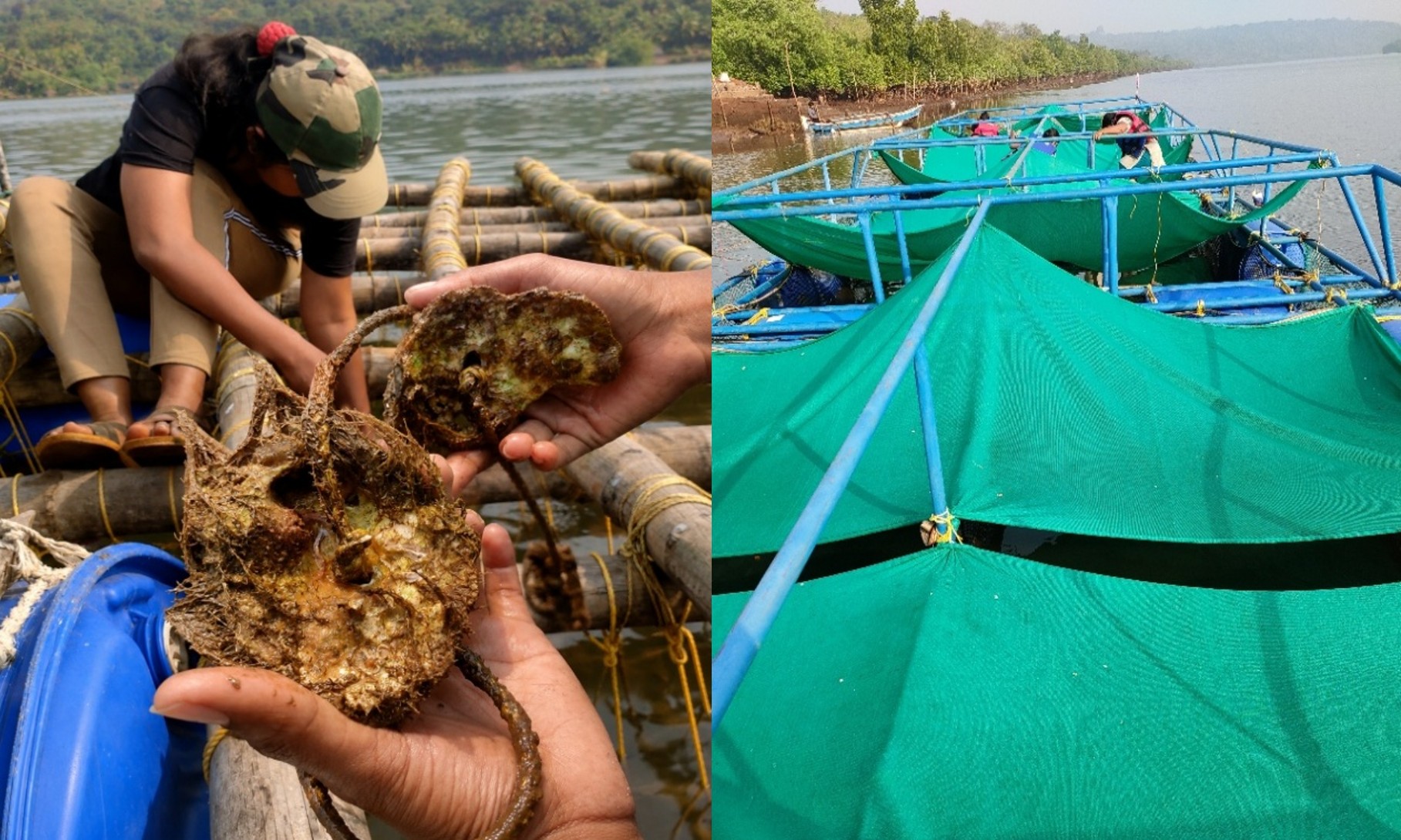
However, they continue to face increasing pressures from urbanisation, coastal development, pollution, and other anthropogenic activities. To address these challenges, the Government of Maharashtra established the Mangrove Cell in 2012 under the Department of Forests. The Mangrove Cell supports the implementation of various livelihood activities under the ‘Mangrove Conservation and Livelihood Generation Scheme ‘. The scheme is implemented by the Mangrove Foundation, India through village-level Mangrove Co-Management Committees (MCMCs) and provides financial assistance for sustainable livelihood activities. It offers a 90% subsidy for group-based initiatives and a 75% subsidy for eligible individual landowners with more than one acre of private mangroves. Initially implemented for the period 2017–2025, the scheme has been extended until 2030 and currently covers 177 villages across the coastal districts of Palghar, Thane, Raigad, Ratnagiri, and Sindhudurg. These activities have played a pivotal role in conserving mangrove ecosystems while promoting sustainable livelihood opportunities through community-based initiatives such as oyster and mussel farming, sea bass and pearl spot fish cage culture, mud crab farming, ornamental fish rearing, and mangrove ecotourism.
Mangrove Eco-Tourism in Maharashtra
Mangrove ecotourism is a form of nature-based tourism that promotes environmental conservation while benefiting local communities. In Maharashtra, the Mangrove Cell has developed a community-led ecotourism initiative that encourages responsible tourism in mangrove ecosystems. The programme is being implemented across all coastal districts, where local communities are running ecotourism and other mangrove-based enterprises. Besides generating income, the initiative enhances public awareness of mangrove ecosystems and strengthens community stewardship of coastal resources. Swamini Women Self Help Group is one of the very successful SHGs that have ventured into Mangrove Eco-tourism in Ratnagiri District in Maharashtra. The good practices adopted by this SHG that contributed to their success are discussed below.
GOOD PRACTICES
Introduction of Mangrove Eco-Tourism
Shweta Hule, a fisherwoman and currently the President of the Swamini Women’s Self-Help Group (SHG), lives near Mandavi Creek in Vengurla city of Sindhudurg district. In 2015, she came up with the idea of developing mangrove ecotourism in Mandavi Creek (which has very high biodiversity, see Box 1) as an alternative livelihood opportunity for local fisher women.
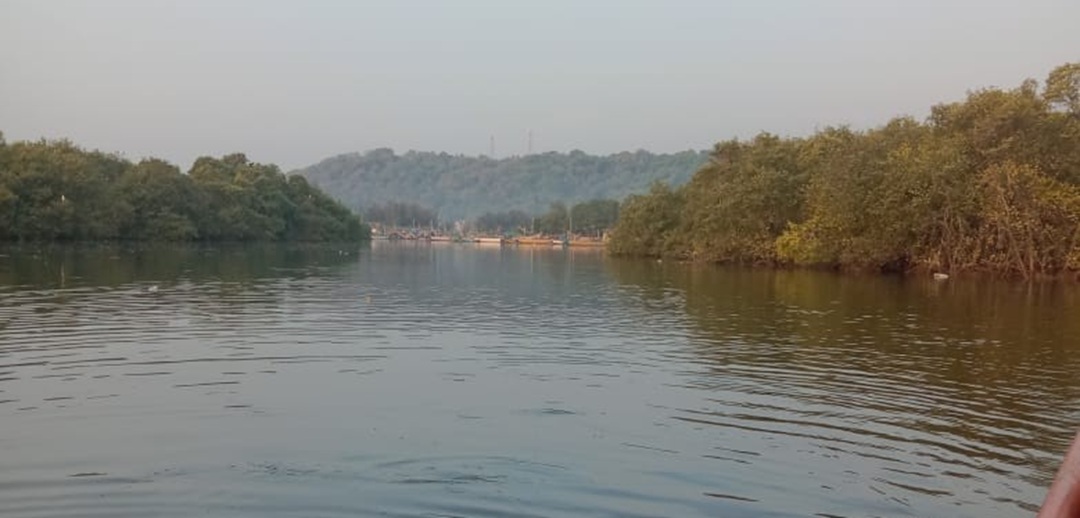
In 2016, the members of the Swamini Women’s Self-Help Group received training from the United Nations Development Programme (UNDP) in collaboration with the Mangrove Cell, Maharashtra. The training focused on mangrove interpretation, biodiversity identification, hospitality management, and communication skills, enabling the women to conduct guided mangrove safaris and educate visitors about the ecological importance of mangrove ecosystems.
Mangrove Safari
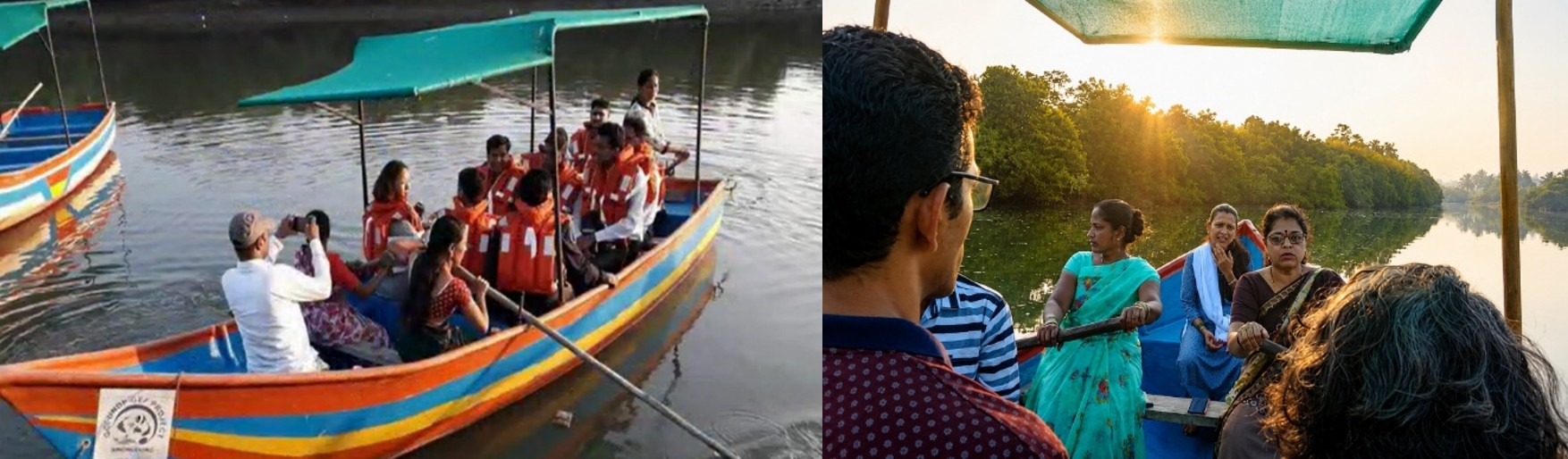
During the Makar Sankranti Patang Mahotsav in 2017, Swamini Women’s SHG officially launched its mangrove safari initiative at Mandavi Creek. To introduce the newly launched mangrove safari initiative and encourage public participation, the SHG offered complimentary mangrove rides to around 500 visitors, ferrying them from Mandavi Jetty to Navabag Jetty. The women learnt how to operate manually rowed boats, ensuring that the safaris remained environmentally friendly by avoiding noise and water pollution associated with motorboats. Despite initial challenges such as strong water currents and winds, the women successfully managed the boat operations. Today, four women row the boats while one serves as a nature guide, interpreting the mangrove ecosystem, birdlife, and aquatic biodiversity for visitors.
Each one-hour safari accommodates up to 12 visitors. The safari fee has increased from ₹70 per person in 2017 to ₹350 in 2026, reflecting the initiative’s growing popularity and sustainability. The safari operates daily from 10:00 a.m. to 6:00 p.m., with November to May being the ideal season for visitors.
|
Box 1: Mangrove Biodiversity in Mandovi Creek |
Food Court
To diversify their income beyond mangrove ecotourism, the Swamini Women’s Self-Help Group established a food court in 2019. The food court was introduced to cater to visitors participating in the mangrove safari while creating an additional livelihood opportunity for the SHG members.
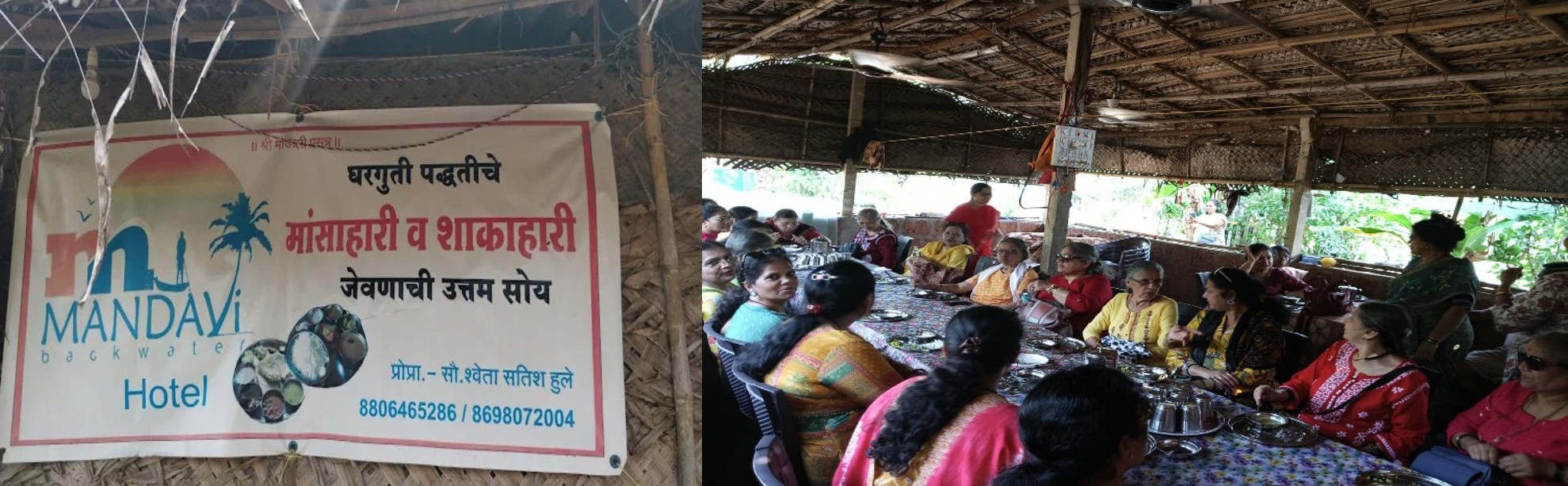
The food court serves freshly prepared traditional Maharashtrian and Konkani cuisine using locally available ingredients. Breakfast options include Poha (flattened rice), Shira (semolina pudding), Ghavane (traditional Konkan rice pancakes), and Amboli (soft fermented rice and pulse pancakes). Lunch is served as authentic Konkani plates, with vegetarian, chicken, and fish options that showcase the region’s culinary heritage. By offering local cuisine alongside the mangrove safari, the SHG has enhanced the overall visitor experience while generating an additional source of income for its members.
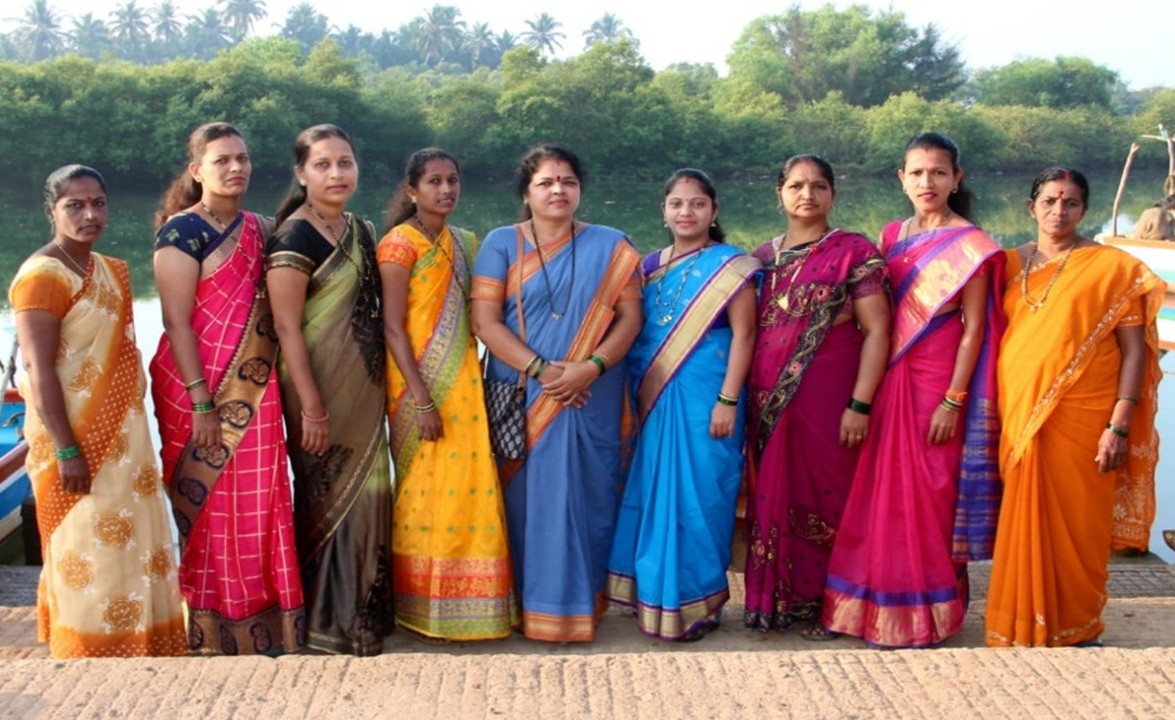
Awareness programmes to promote environmental stewardship
Beyond managing mangrove ecotourism, the Swamini Women’s Self-Help Group actively engages in environmental conservation and awareness initiatives. The members regularly participate in mangrove plantation drives organised in and around Mandavi Creek, contributing to the restoration and protection of the coastal ecosystem.
The SHG also conducts awareness programmes for school students, local communities, and visitors to highlight the ecological importance of mangroves. Through guided nature walks and interactive sessions, they educate participants about the role of mangroves in conserving biodiversity, protecting coastlines from erosion, supporting fisheries, and enhancing resilience to climate change. These initiatives have strengthened environmental awareness among visitors while fostering a sense of responsibility towards mangrove conservation.
Looking ahead, the group plans to establish a mangrove nursery near Mandavi Jetty to raise and supply mangrove seedlings for plantation programmes. This initiative is expected to support long-term restoration efforts, increase community participation in conservation, and further strengthen the link between sustainable livelihoods and ecosystem protection.
Monthly creek clean-up
Demonstrating their strong commitment to environmental conservation, the members of the Swamini Women’s Self-Help Group organise a monthly creek clean-up on the first day of every month at Mandavi Creek. During these clean-up drives, the women remove plastic waste and other debris from the creek and its surrounding areas, helping to maintain the ecological health and aesthetic appeal of the mangrove ecosystem.
The SHG also encourages visitors and the local community to avoid single-use plastics and dispose of waste responsibly. As part of their commitment to sustainable ecotourism, the mangrove safaris are conducted using manually rowed boats instead of diesel-powered motorboats. This practice reduces noise and water pollution, minimises disturbance to birds and other aquatic fauna, and helps preserve the fragile mangrove ecosystem. Through these conservation initiatives, the SHG has demonstrated that livelihood generation and environmental stewardship can go hand in hand.
OUTCOMES
Through mangrove safari and the food court, the Swamini SHG could raise its income steadily over the years, except during the COVID-19 pandemic, and the details are presented in Table 1.
Table 1. Annual income generated by Swamini SHG from mangrove ecotourism (2017–2026)
| Season | Income (₹) |
| Nov 2017 – May 2018 | 1,00,000 |
| Nov 2018 – May 2019 | 2,35,000 |
| Nov 2019 – Mar 2020 | –* |
| Nov 2020 – May 2021 | 1,40,000* |
| Nov 2021 – May 2022 | 1,30,000 |
| Nov 2022 – May 2023 | 3,60,000 |
| Nov 2023 – May 2024 | 4,80,000 |
| Nov 2024 – May 2025 | 5,21,000 |
| Nov 2025 – May 2026 | 5,20,000 |
*Operations were suspended in March 2020 following the nationwide COVID-19 lockdown. Tourist arrivals remained low during the 2020–21 season because of travel restrictions and public health measures, resulting in reduced income.
SCALING UP AND REPLICATION
The innovative model of mangrove tourism developed by the SHG has also gained recognition at the state, national, and international levels, demonstrating its potential as a replicable approach for integrating women’s empowerment, community-based ecotourism, and mangrove conservation in other coastal regions.
The success of the Swamini Women’s SHG has inspired the replication of community-based mangrove ecotourism initiatives in other coastal villages of Sindhudurg district. Drawing on the experience and guidance of Swamini SHG, Om Sai Bachat Gat at Nivati and Jalkannya Bachat Gat at Devgad have adopted similar ecotourism models to generate sustainable livelihood opportunities while promoting mangrove conservation.
CHALLENGES
During the initial stages, the SHG members had very limited experience in ecotourism, visitor management, and biodiversity interpretation. This gap was addressed through extensive training and continuous capacity building. Learning to operate manually rowed boats in the mangrove creek was physically demanding, particularly under strong tidal currents, changing water levels, and high winds. The enterprise is also highly seasonal, with visitor numbers concentrated between November and May, resulting in fluctuations in income. The COVID-19 pandemic further disrupted operations, forcing the temporary closure of the ecotourism activities and significantly reducing tourist arrivals and earnings. As the initiative continues to grow, other challenges have emerged, including maintaining tourism infrastructure, ensuring visitor safety, and balancing increasing tourist activities with the conservation of the fragile mangrove ecosystem. These are being addressed through sustained community commitment and institutional support.
LESSONS LEARNT
Mangroves protect shorelines, support fisheries and biodiversity, mitigate climate change through carbon sequestration, and sustain the livelihoods of millions of coastal communities. However, their long-term conservation depends not only on policy interventions but also on meaningful participation of local communities. The success of the Swamini Women’s SHG demonstrates that conservation and livelihood generation can go hand in hand when local communities are placed at the centre of resource management. What began as a small initiative with a vision of a few determined women has evolved into a model of community-led mangrove conservation, sustainable tourism, women’s empowerment, and rural entrepreneurship.
CONCLUSIONS
The Swamini Women’s SHG has not only demonstrated a successful model of ecotourism in mangroves but has also encouraged other women’s groups to adopt similar ecotourism projects. In terms of conservation, these women become community champions for protecting the mangroves, which are now a source of income for them, and this also contributes to increasing the tourism value of mangrove ecosystems.
Replicating such community-based eco-tourism models across suitable coastal regions can strengthen conservation efforts, create sustainable livelihoods, and ensure that future generations continue to benefit from the invaluable ecological services provided by mangrove ecosystems.
 Ms. Akshata Thavai is a Ph.D. Research Scholar at ICAR-Central Institute of Fisheries Education, Mumbai (India) working on fisheries cooperatives, and fishers’ livelihoods. Her current research examines the impact of urbanisation on fishers’ livelihoods in the Mumbai Metropolitan Region. She can be reached at akshata.fexpb301@cife.edu.in
 Dr. Shivaji D. Argade is a Senior Scientist at ICAR-Central Institute of Fisheries Education, Mumbai (India) with over 12 years of experience in teaching, research and extension in fisheries and aquaculture. His expertise includes gender in fisheries, impact studies, governance & ease-0f-doing business in fisheries cooperatives. He can be reached at shivaji@cife.edu.in
 Mr. Vadra Jagdev is a Masters Research Scholar at ICAR-Central Institute of Fisheries Education, Mumbai (India) currently working on fisheries cooperatives. He can be reached at vadra.fexmb405@cife.edu.in
Very interesting reading of this Women Power to sustain MANGROVE ecology of Marathi coastline.
The narrative became exciting with imaginative ecotourism undertsken by this powerful SWAMINI SELFHELP GROUP.
An example for agrobiodiversity enlargement through self-sustaining coastal women initiative that deserve regular financial support of National Biodiversity Authoriy & National Awards and glorification through school curriculum.
Best wishes for best national attention.
Hope these good practices inspire people around other Mangroves or they share their own good practices. Good practices happening anywhere need documentation and sharing for wider impact. Congratulations to the authors and AESA for this well written Good Practices Note. Looking forward to more!
Thank you Sir for the encouraging words and appreciation. Indeed, documenting and sharing good practices from different mangrove landscapes can help inspire wider adoption, learning, and replication. We hope this initiative encourages more practitioners and communities to share their experiences and innovations for greater collective impact.